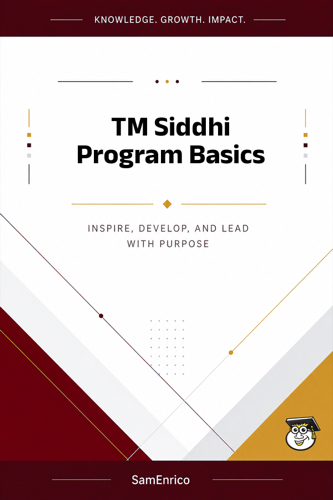
TM Siddhi Program Basics eBook
Introduces advanced techniques briefly.
Introduces advanced techniques briefly.
Formats
Free sample
Chapter 1: The Silent Reservoir--–- Imagine for a moment that everything you have ever been taught about success is wrong. Not partially wrong, not in need of minor adjustment, but fundamentally, structurally, and dangerously backward. From the moment you entered kindergarten, you received a clear and consistent message: hard work leads to results. Effort equals reward. Struggle is the price of achievement.
The person who tries the hardest, stays the latest, and pushes through the most resistance will ultimately prevail. This is the gospel of modern civilization, preached in schools, corporations, sports arenas, and even families. And on the surface, it seems undeniable. After all, does anything valuable come without effort? Does any great accomplishment emerge from laziness?The answer, as you are about to discover, is far more subtle and far more revolutionary than a simple yes or no.
Effort does produce results. Hard work does move the needle. But here is the question that almost no one dares to ask: at what cost, and from what source?Every human action originates from a specific level of consciousness. Think of consciousness as a spectrum, like the colors of light moving from infrared to ultraviolet. At the surface level—the level of everyday waking awareness—the mind is active, noisy, fragmented, and perpetually stressed.
Thoughts bounce around like pinballs, triggered by memories, anxieties, desires, and external distractions. From this surface level, most human beings live their entire lives. They plan, they worry, they strategize, they react. And then they wonder why their best efforts so often fall short, why success feels hollow when it comes, and why sustainable happiness remains stubbornly out of reach.The premise of this book, and the foundation of everything you will learn in the chapters ahead, is breathtaking in its simplicity: the source of your action determines the quality of your results. Action born from surface-level, stressed thinking produces outcomes that are partial, unstable, and ultimately unsatisfying.
Action born from the deepest level of consciousness—what the ancient Vedic tradition calls Pure Consciousness—produces outcomes that are effortless, precise, and naturally fulfilling.This chapter introduces you to that deepest level. It is not a theory, not a belief system, and not a philosophy to be debated. It is a direct, verifiable, physiological state of restful alertness that has been studied by hundreds of scientists, documented in thousands of research papers, and experienced by millions of people across every culture, religion, and walk of life. The name for this state is Transcendental Consciousness, and understanding its nature is the first and most essential step on the path to the TM-Sidhi program.The Mechanics of the Mind's Natural Tendency To understand Transcendental Consciousness, you must first understand something surprising about your own mind: it is naturally wired to seek greater happiness, and it knows exactly how to find it without any effort on your part.Consider the experience of falling asleep. You do not try to fall asleep.
You do not concentrate on falling asleep. In fact, the moment you try to fall asleep, you remain awake. Sleep happens when you allow the mind to settle naturally, when you stop interfering with a process that your body already knows how to perform. The same principle applies to the experience of deeper states of consciousness, though with one critical difference: unlike sleep, which involves a loss of awareness, Transcendental Consciousness involves a state of alertness without an object of attention.Here is the mechanism. The human mind has a natural tendency to move toward a state of greater satisfaction, greater peace, and greater coherence.
This is not a spiritual claim; it is an observable fact of neurophysiology. When you place a thought in the mind, the mind examines that thought, experiences it, and then, if the thought does not provide complete fulfillment, the mind spontaneously moves to a more satisfying thought. This process continues, thought after thought, each one slightly more refined, slightly quieter, slightly closer to the source of thought itself.You have experienced this countless times without recognizing it. Think of the moment just before you fall asleep, when random images and fragments of thoughts drift through your awareness. Or think of the feeling of driving on a familiar road, when the mind settles into a quiet, alert, almost effortless state.
Or think of the experience of listening to beautiful music, when the internal dialogue fades away and you are simply present, aware, but not thinking about anything in particular.The Transcendental Meditation technique, which serves as the foundation for everything in this book, uses this natural tendency in a systematic, reliable way. By allowing the mind to settle effortlessly—not by concentrating, not by controlling, not by forcing—the meditator experiences increasingly refined levels of thought until the mind arrives at its least excited state. That state is Pure Consciousness. It is the silent, unbounded reservoir from which all thoughts emerge, like waves rising from the surface of a vast ocean.Defining the True Self Here is where the journey becomes truly transformative. Most people, when asked to define themselves, will point to their thoughts, their emotions, their memories, their roles, or their bodies.
"I am a parent." "I am a lawyer." "I am anxious." "I am successful." "I am a failure." All of these identifications share a common feature: they refer to something that changes. Thoughts come and go. Emotions rise and fall. Roles change. Bodies age.
If your sense of self is tied to changing phenomena, then your sense of self is inherently unstable. You will spend your entire life trying to prop up an identity that is, by its very nature, temporary.The Vedic tradition, and the modern science of consciousness that has emerged from it, offers a radically different definition of the Self. The true Self is not the thinking, active, changing mind. The true Self is the silent, unbounded, unchanging reservoir of creativity, intelligence, and bliss that lies at the base of the mind. It is the awareness that remains when all thoughts have settled.
It is the witness that observes thoughts without being disturbed by them. It is the canvas upon which the paintings of daily experience appear and disappear.This distinction is not merely philosophical. It is physiological, practical, and immediately verifiable. When you learn the Transcendental Meditation technique, you begin to have direct experiences of this silent Self. At first, these experiences may be brief, perhaps only a few seconds at a time.
But with regular practice, the experience stabilizes. You begin to recognize that beneath the noise of everyday thinking, there is a silent, peaceful, alert presence that has always been there, waiting to be noticed.The implications of this recognition are staggering. If your true Self is silent and unbounded, then your potential is also silent and unbounded. Creativity does not have to be forced; it can emerge effortlessly from the silence. Intelligence does not have to be acquired; it can be accessed from the depth.
Happiness does not have to be pursued; it can be recognized as your own essential nature.The Fourth State of Consciousness Modern neuroscience has identified three distinct states of consciousness: waking, dreaming, and deep sleep. Each has its own characteristic…
This is the end of the free sample. Get the eBook to keep going. Buy now
About this book
Details
- Author
- Traylor Johnathon
- Publisher
- SamEnrico
- Language
- English
- Genre
- Non-Fiction, Self-Help, Advanced
- Released
- 2026-06-08
- Pages (approx.)
- 154
- Available as
- eBook, Audiobook

Read better in the ZLOADR app
Your eBooks on your phone or tablet. Sign in with your SamEnrico account and start reading.
More by Traylor Johnathon
 Hal Sutton Challenger MemoirTraylor Johnathon$11.99
 Mayor of the Tech HubTraylor Johnathon$11.99
 Remote Feedback FrameworkTraylor Johnathon$11.99
 Small Talk for ReunionsTraylor Johnathon$11.99
 Crowns & Consequences: The Royal Scandals That Shook the 21st CenturyTraylor Johnathon$11.99
 The Bone Hunters of the Dordogne: Uncovering Europe's First AncestorsTraylor Johnathon$11.99
 Takt Time Scheduling GuideTraylor Johnathon$12.99
 Kuda Bank YC Application TipsTraylor Johnathon$12.99
 Spacecraft Telemetry AnalysisTraylor Johnathon$11.99
 Understanding Cleft Palate Colobomata Radial Synostosis DeafnessTraylor Johnathon$17.99
 How to Become a Chain-testing-machine OperatorTraylor Johnathon$11.99