
Non-FictionSelf-HelpShift Work Wellness
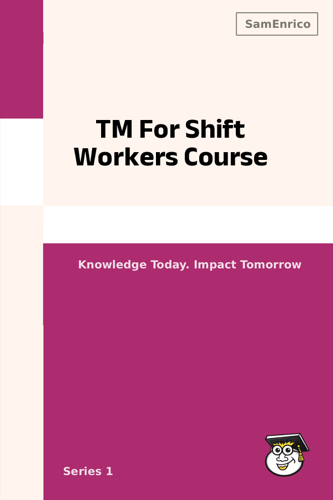
TM For Shift Workers Course eBook
Adapts TM practice for non-traditional schedules i
by Mckeown Illa
Adapts TM practice for non-traditional schedules including night shifts.
Formats
Free sample
Chapter 1: The Graveyard Tax--–- The alarm reads 6:00 PM, not 6:00 AM. You are pouring coffee into a thermos while the rest of your neighborhood is sitting down for dinner. Your partner kisses you goodbye with a look that says both "I love you" and "I miss you already." Your children are doing homework at the kitchen table, and you will not see them again until tomorrow afternoon, when they are at school. You are heading into work while the world winds down. If this describes your life, you have just picked up the only book ever written specifically for you.The Invisible Burden No One Talks About Every book about meditation, sleep, health, or productivity assumes a 9-to-5 world.
The authors write about "morning routines" that begin at 6:00 AM. They discuss "evening wind-downs" that start at 9:00 PM. They offer advice about "getting enough sleep" as if the sun sets and rises according to human convenience rather than astrophysics. These books are not wrong. They are simply not written for you.You work while others sleep.
You sleep while others work. Your "Monday" might be Wednesday. Your "weekend" might be Tuesday and Thursday. You have learned to smile when a well-meaning friend says, "Just go to bed earlier," as if you have not already tried every possible combination of blackout curtains, melatonin, white noise machines, and prayer. You have learned to nod politely when someone suggests you "just switch to days," as if that decision belongs to you rather than your employer, your seniority, your bills, and the brutal math of the 24-hour economy.Here is the truth that no one tells you: you are not bad at self-care.
You are not lazy. You are not weak-willed. You are attempting to live a human life under conditions that the human body was never designed to endure, and you are doing so without a single manual written for your reality.This book is that manual.Why "Twice a Day" Fails on the Graveyard Shift If you have already learned Transcendental Meditation, you were likely told to meditate for twenty minutes twice a day: once in the morning after waking and once in the evening before dinner. This instruction is ancient, proven, and completely logical for anyone who lives on a solar schedule. For you, it is actively counterproductive.Let me explain what happens when you follow this instruction literally as a night shift worker.You finish your shift at 7:00 AM.
You drive home through morning traffic, exhausted but wired. According to the traditional rule, this is your "morning," so you sit to meditate. You close your eyes. You begin to use your mantra. And then something strange happens: you fall deeply, profoundly, almost uncontrollably asleep.
Not the gentle drift of transcendence. Actual sleep. You wake up twenty minutes later disoriented, groggy, and no more rested than before. You have just experienced what we call the Literal Trap.The Literal Trap occurs because you meditated at your biological midnight, not your social morning. Your body's circadian clock—the ancient, hardwired timer that governs your temperature, hormones, and alertness—does not care what the clock on the wall says.
It cares about light, darkness, and the rhythm you have trained into it over millions of years of evolution. When you meditate at 7:00 AM after a night shift, your core body temperature is at its lowest point of the day. Your cortisol should be rising to wake you up, but instead it is flatlined from the stress of working through the night. Your brain is screaming for sleep, not transcendence.The traditional instruction fails because it confuses social time with biological time. And this confusion is not a small problem.
It is the entire problem.Biological Time Versus Social Time: The Core Distinction To understand why your schedule requires a completely different approach to meditation, you must first understand the difference between tiredness and fatigue. These two words are not synonyms, and confusing them has ruined more shift workers' health than any other single misunderstanding.Tiredness is a signal. It is your body saying, "I have been awake for an appropriate number of hours, and I am ready to sleep." Tiredness feels pleasant in a certain way—the way a bed feels good at the end of a long day. Tiredness resolves with sleep. One good night of rest, and you are fine.Fatigue is not a signal.
Fatigue is a symptom. It is your body saying, "My stress response system has been activated for too long, and I am breaking down." Fatigue feels unpleasant—the way your bones ache when you have the flu, the way your brain feels stuffed with cotton, the way your emotions become brittle and explosive over nothing. Fatigue does not resolve with sleep alone. You can sleep twelve hours and wake up exhausted because sleep addresses tiredness, but it does not address the underlying stress that caused the fatigue.Here is what the research from Super Mind and other major TM studies has shown: shift workers do not suffer primarily from tiredness. They suffer from fatigue.
Your problem is not that you need more sleep, although you do need more sleep. Your problem is that your stress response system—the hypothalamic-pituitary-adrenal axis, or HPA axis for short—has been forced to operate outside its designed parameters for months or years. Your body is producing cortisol at the wrong times, in the wrong amounts, and for too long. You are not sleeping poorly because you are bad at sleeping. You are sleeping poorly because your body no longer knows when to sleep, when to wake, or how to transition between the two.This is not a moral failing.
It is a physiological consequence of working against your own biology. And it requires a physiological solution, not more willpower.The Post-Sleep Reset Anchor The solution begins with a single, simple shift in how you think about your meditation schedule. You must stop anchoring your practice to the clock on the wall and start anchoring it to your sleep.Throughout this book, we will use two terms that replace "morning meditation" and "evening meditation." These terms work for every shift type, every rotation, and every possible schedule variation.Meditation 1 is called the Post-Waking meditation. You practice it within thirty minutes of waking up from your main sleep block. It does not matter whether that waking happens at 6:00 AM, 2:00 PM, or 9:00 PM.
The moment your eyes open after your longest period of sleep, you are in the Post-Waking window. This meditation sets your stress hormones for the coming wake period. It calms the startle reflex that shift workers develop as a survival mechanism. It tells your nervous system, "You are awake now, but you do not need to be on high alert."Meditation 2 is called the Pre-Sleep meditation. You practice it within one to two hours before your main sleep block begins.
Again, the clock does not matter. What matters is the relationship to your sleep. This meditation acts as a bridge from the high-alert state required for work to the low-alert state required for rest. It lowers cortisol while maintaining wakefulness, allowing you to fall asleep faster and stay asleep longer. Unlike…
This is the end of the free sample. Get the eBook to keep going. Buy now
About this book
Details
- Author
- Mckeown Illa
- Publisher
- SamEnrico
- Language
- English
- Genre
- Non-Fiction, Self-Help, Shift Work Wellness
- Released
- 2026-06-09
- Pages (approx.)
- 132
- Available as
- eBook, Audiobook

Read better in the ZLOADR app
Your eBooks on your phone or tablet. Sign in with your SamEnrico account and start reading.
More by Mckeown Illa
 EQ for Entrepreneurs GuideMckeown Illa$11.99
 Payday Loan Trap DoorMckeown Illa$11.99
 The Joy of EnoughMckeown Illa$11.99
 Self Esteem for Partners With Different LibidoMckeown Illa$11.99
 The Olmec Voyagers: Navigators of the Ancient AmericasMckeown Illa$11.99
 Account CoordinatorMckeown Illa$11.99
 Depreciation Formula GuideMckeown Illa$12.99
 Qualcomm SWOT GuideMckeown Illa$12.99
 Understanding MyelofibrosisMckeown Illa$17.99
 How to Become a Spotter IiMckeown Illa$11.99
You may also like
 Hong Kong Handover 1997Dunn Johnnie$11.99
 Zumba For Postnatal Recovery CourseNeal Christian$11.99
 Zumba for BeginnersLadner Nikia$11.99
 YouTube Comment Mining GuideHumes Pandora$12.99
 Worry Box MeditationCarlin Rudy$11.99
 Workplace Stress MeditationNguyen Lynn$11.99
 Workplace Stress and Sleep RepairHawley Ivory$11.99
 Workplace Perfectionism CureDelaney Jeffry$11.99
 Workplace Injustice Anger GuideWallen Isabelle$11.99
 Work Addiction and Burnout LinkGreenwood Ester$11.99
 Women in Yoga and WellnessBeattie Galina$11.99
 Women in Stand Up ComedyChun Evangeline$11.99