
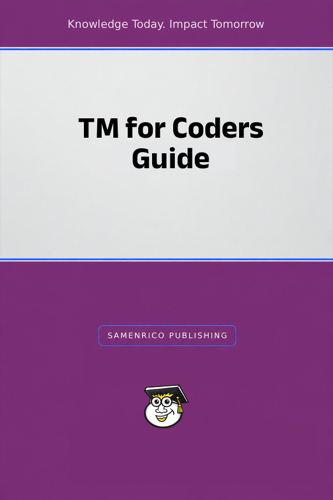
TM for Coders Guide eBook
Enhances problem-solving and reduces burnout.
Enhances problem-solving and reduces burnout.
Formats
Free sample
Chapter 1: The Fragile Machine--–- The email arrived at 2:47 AM on a Tuesday. Sarah, a senior backend engineer at a fast-growing fintech startup, had been debugging a race condition for eleven hours. Her Slack was a graveyard of unanswered pings. Her Jira dashboard showed seventeen overdue tickets. Her Apple Watch, which she’d bought to track her workouts, now tracked something else entirely: a resting heart rate of 98 beats per minute, up from 62 just six months earlier.
She had stopped exercising. She had stopped cooking. She had stopped calling her mother back. The race condition was eventually fixed by a junior developer the next morning in twenty minutes. Sarah submitted her resignation two weeks later, citing “personal reasons.” The real reason was simpler and more terrifying: her mind had stopped working the way it used to, and she no longer recognized herself.This is not an isolated story.
It is not a cautionary tale about a single burned-out engineer who couldn’t handle the pressure. According to a 2022 survey by Haystack Analytics, 83% of software developers report experiencing burnout symptoms, but only 12% seek help because they have been conditioned to see burnout as a weakness rather than a medical signal. The industry worships the “10x developer”—the mythical coder who produces ten times the output of an average peer—while systematically ignoring the physiological reality of the human brain that powers the code. The 10x developer is not a sustainable human being. The 10x developer is a burnout vector disguised as a career aspiration.This book will teach you a different way.
Not a productivity hack. Not a time management system. Not another to-do list app or Pomodoro timer or cold plunge protocol. This book will teach you how to reboot your nervous system using a specific, scientifically validated technique called Transcendental Meditation (TM), adapted for the unique cognitive demands of software development. By the time you finish this chapter, you will understand why your brain is not broken—it is merely overloaded.
And you will begin to see that the path back to clarity, creativity, and curiosity about code is not through working harder, but through a very specific form of deep rest that most developers have never been taught.The 10x Myth and Its Body Count Let us be precise about what we mean when we say “burnout.” The World Health Organization formally classified burnout as an occupational phenomenon in 2019, defining it by three dimensions: feelings of energy depletion or exhaustion, increased mental distance from one’s job (cynicism, negativism), and reduced professional efficacy. For software developers, these dimensions have specific, recognizable flavors.Energy depletion in coding manifests not as mere tiredness but as a specific cognitive phenomenon: the inability to hold a stack trace in working memory. A healthy developer can track three to four levels of function calls simultaneously. A burned-out developer loses this ability, reading the same error message fifteen times without comprehension. This is not a skill deficit.
It is a physiological marker of prefrontal cortex downregulation caused by chronic stress.Increased mental distance appears as what developers call “legacy code rage”—the visceral disgust at looking at code you wrote six months ago, or worse, code someone else wrote. The burned-out developer does not see a solvable problem; they see evidence of incompetence (their own or others’) and feel a wave of dread before typing a single character. Reduced professional efficacy shows up as the dreaded “impostor syndrome” taken to pathological extremes: the belief that any task longer than fifteen minutes is probably beyond your ability, and everyone is about to find out.The 10x myth accelerates this process. The myth says that great developers write code effortlessly, ship features instantly, and debug with superhuman pattern recognition. The reality, as documented by research psychologist Anders Ericsson (whose work on deliberate practice was popularized by Malcolm Gladwell), is that expertise requires thousands of hours of focused, often uncomfortable effort.
The 10x developer, if they exist at all, is not a person who works ten times harder but a person whose nervous system is regulated enough to enter deep flow states consistently. The myth has been weaponized by management to extract unsustainable output. And your body has been keeping score.The Biology You Cannot Think Your Way Out Of Here is the central fact that most stress-management books get wrong, and that analytically-minded developers find most difficult to accept: chronic stress is not a thought problem. It is a body problem.Your nervous system has two main branches. The sympathetic nervous system (SNS) is your accelerator.
It activates fight-or-flight responses, raises heart rate, increases cortisol production, and narrows attention to threat detection. The parasympathetic nervous system (PNS) is your brake. It activates rest-and-digest responses, lowers heart rate, reduces cortisol, and broadens attention to allow for creative problem-solving.In a healthy human, these systems oscillate naturally. You encounter a stressor (a production outage, a tight deadline), the SNS activates, you solve the problem, and the PNS brings you back to baseline. In a burned-out developer, this oscillation breaks.
The SNS remains partially activated all the time. Your baseline cortisol creeps upward. Your heart rate variability—a key metric of nervous system flexibility—collapses. You become what neuroscientists call “sympathetically dominant.”This is not a metaphor. This is measurable physiology.
A 2017 study published in the Journal of Occupational Health Psychology measured cortisol levels in software developers across two-week sprints. The researchers found that cortisol levels did not return to baseline after sprint completion; they accumulated across sprints, rising by an average of 15% per sprint cycle. By the fourth sprint, developers were operating with baseline cortisol levels equivalent to someone being chased by a predator—while sitting at a desk, writing React components.The amygdala, a small almond-shaped structure deep in your brain, is the primary threat-detection circuit. When your SNS is chronically activated, the amygdala becomes sensitized. It detects threats where none exist.
A code review comment that says “consider edge cases” is processed with the same neural intensity as a physical attack. A Slack notification triggers the same cortisol spike as a sudden loud noise. This is why burned-out developers describe feeling “on edge” all the time, even when nothing is wrong.And here is the cruelest part: you cannot think your way out of this. The prefrontal cortex—the seat of logic, reasoning, and willpower—has limited influence over the amygdala. You cannot reason with a threat-detection circuit that evolved to save you from predators.
Trying to “just relax” or “think positive thoughts” is like trying to debug a hardware failure with software patches. The tools are mismatched to the problem. You need a hardware reset.The Burnout Symptom Checklist for Coders Before we go further, take a moment to assess where you are. The following checklist is not a clinical diagnosis, but it is a validated set of markers drawn from occupational health research. For each item, ask yourself: “Has this been true for me, at least several times per week, for the past month?”Cognitive Symptoms:You read error messages or documentation multiple times without comprehension.You lose your place in a function you wrote yourself an hour ago.You fixate on one possible cause of a bug and…
This is the end of the free sample. Get the eBook to keep going. Buy now
About this book
Details
- Author
- Venegas Norah
- Publisher
- SamEnrico
- Language
- English
- Genre
- Non-Fiction, Self-Help
- Released
- 2026-06-07
- Pages (approx.)
- 124
- Available as
- eBook, Audiobook

Read better in the ZLOADR app
Your eBooks on your phone or tablet. Sign in with your SamEnrico account and start reading.
More by Venegas Norah
 Values And Mission Alignment Merger Integration GuideVenegas Norah$11.99
 The Yet Mindset HandbookVenegas Norah$11.99
 The Dawn Simulator SAD GuideVenegas Norah$11.99
 Meeting Fatigue Recovery GuideVenegas Norah$11.99
 The Boto’s Lament: Amazonian Shape-Shifters and the Moonlit WatersVenegas Norah$11.99
 Armored Car Courier (Unarmed)Venegas Norah$11.99
 Understanding Tricho Odonto Onychodysplasia Syndactyly Dominant TypeVenegas Norah$17.99
 KPI Dashboard Business PlanVenegas Norah$12.99
 Value Proposition Wi Fi GuideVenegas Norah$12.99
 How to Start a Drag Hounds Business (Beginners Guide)Venegas Norah$11.99
You may also like
 Hong Kong Handover 1997Dunn Johnnie$11.99
 Zumba For Postnatal Recovery CourseNeal Christian$11.99
 Zumba for BeginnersLadner Nikia$11.99
 YouTube Comment Mining GuideHumes Pandora$12.99
 Worry Box MeditationCarlin Rudy$11.99
 Workplace Stress MeditationNguyen Lynn$11.99
 Workplace Stress and Sleep RepairHawley Ivory$11.99
 Workplace Perfectionism CureDelaney Jeffry$11.99
 Workplace Injustice Anger GuideWallen Isabelle$11.99
 Work Addiction and Burnout LinkGreenwood Ester$11.99
 Women in Yoga and WellnessBeattie Galina$11.99
 Women in Stand Up ComedyChun Evangeline$11.99