
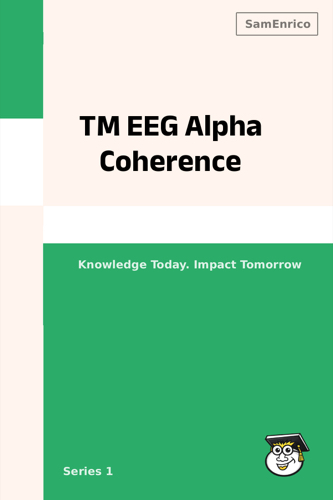
Non-FictionSelf-HelpBrain Waves
TM EEG Alpha Coherence eBook
Understand how TM produces unique brain wave patte
Understand how TM produces unique brain wave patterns of restful alertness.
Formats
Free sample
Chapter 1: The Silent Epidemic--–- You are probably reading this book because something feels wrong. Not catastrophically wrong—you haven't lost your job, your relationships are intact, and you managed to get out of bed this morning. But there is a low-grade hum of unease that follows you like a shadow. Your mind races when you try to sleep. Your attention fragments the moment you sit down to work.
You have tried meditation apps, breathing exercises, and cutting back on caffeine. Nothing sticks. You have begun to suspect that this is simply what adult life feels like: a perpetual state of mild overwhelm, punctuated by exhaustion.What if the problem is not your discipline, your schedule, or your stress levels? What if the problem is that your brain has lost the ability to synchronize itself?This chapter introduces the central argument of this book: the epidemic of modern life is not anxiety or depression alone—it is neural fragmentation. Your brain's regions have stopped talking to each other efficiently.
The result is a mind that feels noisy, delayed, and disconnected from the present moment. But there is a specific, measurable solution: a brain wave pattern called alpha coherence, produced reliably by a simple mental technique known as Transcendental Meditation (TM). By the end of this chapter, you will understand why the standard solutions have failed you, what "restful alertness" actually means, and how a fourth state of consciousness—distinct from waking, dreaming, and sleep—offers a way out.The Two Poles of Modern Existence Imagine a spectrum. At one end is the stressed-out waking state. Your eyes are open, but your brain is running too hot.
The EEG (electroencephalogram) of this state is dominated by high-frequency beta waves, often in the range of 20 to 30 Hz. Beta is not bad—you need it to solve problems, drive a car, and hold a conversation. But chronic beta is a disaster. It feels like a motor running inside your skull that never turns off. You check your phone at 11 PM.
You rehearse arguments with people who aren't there. Your mind jumps from unpaid bills to a vaguely critical comment your boss made three months ago. This is the hyperarousal trap.At the other end of the spectrum is the checked-out sleep state. Here, the brain produces low-frequency delta and theta waves, typically 1 to 7 Hz. This is essential for physical restoration, memory consolidation, and immune function.
But you cannot live here. When you try to "relax" by watching television, scrolling social media, or drinking wine, you are not achieving restful sleep. You are achieving a kind of waking stupor—low arousal without the benefits of deep rest. Your brain slows down, but your body remains tense. The result is the exhaustion trap.Between these two poles lies a vast wasteland where most people spend their waking hours.
Not fully alert. Not fully rested. Just... surviving.The Nobel Prize-winning neuroscientist Sir John Eccles once described the brain as "a machine that a ghost can operate." But what happens when the machine is mis-calibrated? What happens when the ghost—your conscious self—wants to focus, but the machine keeps stuttering?
The answer is the silent epidemic of our time: neural fragmentation.What Is Neural Fragmentation?Neural fragmentation is not a clinical diagnosis. It is a descriptive term for a measurable phenomenon: the loss of phase synchrony between distant brain regions. To understand this, you need a basic map of the brain.Your brain is not a single organ. It is a collection of specialized regions that must communicate constantly. The frontal lobes (behind your forehead) handle executive functions: planning, decision-making, impulse control, and what psychologists call the "central executive." When your frontal lobes are working well, you can delay gratification, regulate your emotions, and think before you speak.
The occipital and parietal lobes (at the back and top of your brain) handle sensory processing: vision, spatial awareness, touch, and the integration of body position. These regions tell you where your hand is in space, whether you are standing upright, and how fast a car is approaching.When these regions are well-connected, information travels between them with minimal delay. You react quickly. You feel present. Your decisions feel effortless because the relevant data arrives on time.When these regions are poorly connected—fragmented—information is delayed by milliseconds.
Milliseconds do not sound like much. But in the brain, a millisecond is an eternity. A 50-millisecond delay between your occipital lobe (seeing the coffee cup) and your frontal lobe (deciding to reach for it) means you knock the cup over. A 30-millisecond delay between your parietal lobe (sensing your body position) and your frontal lobe (regulating your emotional response) means you snap at your partner for no reason and do not understand why.You have experienced this. Everyone has.
The question is: what causes chronic fragmentation, and can it be reversed?The Hidden Cost of Modern Life The usual suspect is stress. But stress is a vague term. Let us be precise. Chronic stress—whether from work deadlines, financial pressure, relationship conflict, or trauma—does something specific to the brain. It causes the thalamus (a small structure deep in the center of the brain) to become hyperactive.
The thalamus acts as a relay station, gating sensory information before it reaches the cortex. Under chronic stress, the thalamus gates too aggressively. It filters out information that might be relevant. It delays information that should arrive quickly. The result is a brain that is simultaneously over-aroused (because the thalamus is working overtime) and under-connected (because the cortex is not receiving clean, timely signals).This is not a moral failing.
It is a physiological loop. The more fragmented your brain becomes, the more stressed you feel. The more stressed you feel, the more fragmented your brain becomes. Breaking this loop requires more than willpower. It requires a specific intervention that targets the underlying mechanism.Here is what does not work for most people: trying harder.
The "just focus" advice assumes that your frontal lobes are intact and simply need a motivational kick. But if your frontal lobes are poorly connected to your sensory regions, trying harder only increases beta activity—making the fragmentation worse. This is why so many people fail at meditation apps. They sit down, close their eyes, and try to concentrate. Their brains respond by generating more high-frequency noise.
They feel frustrated, conclude that meditation is not for them, and return to the stressed-out/exhausted cycle.There is another way.The Fourth State of Consciousness Most people are aware of three major states of consciousness: waking, dreaming, and deep sleep. But there is a fourth state, recognized in the Vedic tradition of India for thousands of years and validated by EEG research over the past five decades. This state is called Transcendental Consciousness. Its practical description is restful alertness: the body experiencing profound physiological rest while the mind remains fully awake and alert.Restful alertness is not the same as waking (where the body is active and the mind is often distracted). It is not the same as dreaming (where the body is paralyzed but the mind is chaotic).
It is not the same as deep sleep (where the body is restored but the mind is unconscious). It is…
This is the end of the free sample. Get the eBook to keep going. Buy now
About this book
Details
- Author
- Trejo Alethea
- Publisher
- SamEnrico
- Language
- English
- Genre
- Non-Fiction, Self-Help, Brain Waves
- Released
- 2026-06-11
- Pages (approx.)
- 155
- Available as
- eBook, Audiobook

Read better in the ZLOADR app
Your eBooks on your phone or tablet. Sign in with your SamEnrico account and start reading.
More by Trejo Alethea
 Delegation for TranslatorsTrejo Alethea$11.99
 Men's Congenital Heart Adult GuideTrejo Alethea$11.99
 Innocence Project Missouri CasesTrejo Alethea$11.99
 The Pink Panther Heist: A Jewelry Caper That Shocked the WorldTrejo Alethea$11.99
 The First Mind Mappers: Decoding the Prehistoric Brain in the Atlantic DepthsTrejo Alethea$11.99
 Understanding Chromosome 15q, TrisomyTrejo Alethea$17.99
 Venusian Atmospheric Energy HarvesterTrejo Alethea$11.99
 Learning Style Assessment GuideTrejo Alethea$12.99
 Canadian Degree Express EntryTrejo Alethea$12.99
 How to Become a Transmission-and-protection EngineerTrejo Alethea$11.99
You may also like
 Hong Kong Handover 1997Dunn Johnnie$11.99
 Zumba For Postnatal Recovery CourseNeal Christian$11.99
 Zumba for BeginnersLadner Nikia$11.99
 YouTube Comment Mining GuideHumes Pandora$12.99
 Worry Box MeditationCarlin Rudy$11.99
 Workplace Stress MeditationNguyen Lynn$11.99
 Workplace Stress and Sleep RepairHawley Ivory$11.99
 Workplace Perfectionism CureDelaney Jeffry$11.99
 Workplace Injustice Anger GuideWallen Isabelle$11.99
 Work Addiction and Burnout LinkGreenwood Ester$11.99
 Women in Yoga and WellnessBeattie Galina$11.99
 Women in Stand Up ComedyChun Evangeline$11.99