
Non-FictionSelf-HelpTimeoutCooling
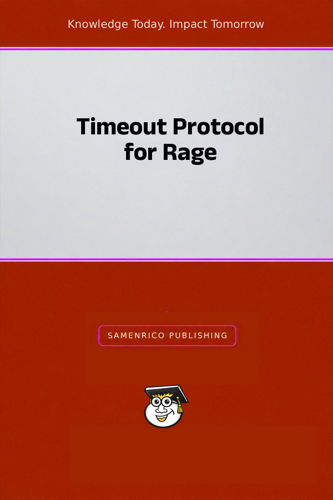
Timeout Protocol for Rage eBook
Implement structured breaks when anger rises to pr
Implement structured breaks when anger rises to prevent explosive outbursts.
Formats
Free sample
Chapter 1: The Seven-Second Gap--–- The explosion always comes with a sound. Sometimes it is a door slamming. Sometimes it is a word you cannot take back. Sometimes it is a silence so heavy that everyone in the room knows something has broken. But before the sound, before the word, before the silence, there is a gap.
You have never been taught to see it. You have been taught to see the trigger—the insult, the spilled drink, the critical remark—and then the explosion. But between these two events, there is a space. It lasts approximately seven seconds. In that space, your body makes a decision.
Not your mind. Your body. And that decision determines whether you become someone who manages rage or someone who is destroyed by it.This chapter is about those seven seconds. It is about why counting to ten fails, why your body betrays you before your mind can save you, and how learning to see the gap is the single most important skill you will ever develop. By the end of this chapter, you will understand the physiology of rage in a way that no anger management class has ever taught you.
More importantly, you will have your first real tool for cutting the fuse before the dynamite goes off.The Myth of Counting to Ten You have heard it a thousand times. When you feel angry, just count to ten. Take a deep breath. Walk away. This advice is everywhere—from self-help books to well-meaning friends to corporate wellness seminars.
It is also, for the purpose of rage, dangerously wrong.Counting to ten assumes that you have ten seconds of rational control. It assumes that your prefrontal cortex—the logical, decision-making part of your brain—remains online during those ten seconds. It assumes that you can choose to count, choose to breathe, choose to calm down. But here is the truth that no one tells you: rage does not ask for permission. Rage is not a feeling you have.
Rage is a feeling that has you.When a true rage trigger occurs, your brain does not wait for you to count. It bypasses your conscious mind entirely and activates a survival circuit that is millions of years old. In the first second after a trigger, your amygdala—two small almond-shaped clusters deep in your brain—has already scanned the environment, labeled the threat, and initiated a cascade of stress hormones. By the time you think to count to one, your body is already preparing for war.This is not a failure of willpower. This is biology.
And you cannot willpower your way out of biology any more than you can willpower your way out of a broken leg.The research is clear. Psychophysiological studies measuring heart rate, skin conductance, and cortisol levels show that the window between a trigger and the physiological onset of rage is approximately seven seconds. That is the entire fuse. Seven seconds from "that thing just happened" to "my body is already in fight mode." Counting to ten might work for mild irritation. For rage, the fuse burns faster than you can count.So why does the advice persist?
Because most people have never experienced true rage. They have experienced annoyance, frustration, and irritability. They have mistaken these low-grade emotions for the real thing. True rage is different. True rage is a hijack.
And you cannot count your way out of a hijack.The Anatomy of an Explosion To understand the seven-second gap, you must first understand what happens inside your body during those seconds. This is not abstract neuroscience. This is the mechanics of your own destruction or salvation.Imagine you are driving home from work. Traffic is heavy. You are already tired.
Your partner calls to say they will be late again, and you feel the first flicker of irritation. Then, a driver cuts you off without signaling. You swerve. Your heart jumps. And then—something in you flips.In that moment, here is what is happening inside your body:Second 1: Your eyes send a signal to your thalamus, the brain's relay station.
The thalamus does not analyze. It simply passes the information along two pathways simultaneously: a low road and a high road. The low road is fast but crude. The high road is slow but accurate. For rage, the low road wins.Second 2: The low road reaches your amygdala.
This is the faster pathway, designed for survival. Your amygdala does not ask, "Is this really a threat?" It asks only, "Could this be a threat?" And because the cost of missing a real threat is death, the amygdala errs on the side of danger. It sounds the alarm before any conscious evaluation has occurred.Second 3: Your amygdala activates your hypothalamus, which is the command center for your stress response. Your hypothalamus sends a signal to your adrenal glands, located on top of your kidneys. This signal travels through your spinal cord.
It is instantaneous. There is no committee meeting. There is no vote. There is only action.Second 4: Your adrenal glands release epinephrine (adrenaline) into your bloodstream. Your heart rate spikes from a resting rate of 60-80 beats per minute to 120, 150, even 180 beats per minute.
Your blood pressure rises. Blood is diverted away from your digestive system and toward your large muscles. Your pupils dilate. Your hearing sharpens. Your peripheral vision narrows into tunnel vision, focusing only on the threat.
You are now physically prepared for fight or flight.Second 5: Your amygdala also activates your HPA axis—the hypothalamic-pituitary-adrenal axis. This is a slower but more sustained response. Your hypothalamus releases CRH (corticotropin-releasing hormone), which signals your pituitary gland to release ACTH (adrenocorticotropic hormone), which finally signals your adrenal cortex to release cortisol. This cascade takes a few seconds longer than the adrenaline response, which is why you feel the "heat" of anger building after the initial jolt.Second 6: Cortisol begins to flood your system. Unlike adrenaline, which peaks and fades quickly, cortisol is designed for endurance.
It keeps your body in a state of high alert for minutes or even hours. It suppresses non-essential functions like digestion, immune response, and—critically—higher-order thinking. Your prefrontal cortex, the part of your brain that would normally say, "Let's think about this rationally," is now being chemically starved of glucose and oxygen. Blood flow to your PFC decreases by up to 50 percent.Second 7: Your prefrontal cortex goes offline. This is called cortical inhibition.
Your ability to reason, to consider consequences, to see another person's perspective, to delay gratification, to choose a different response—all of it vanishes. You are now running on pure survival instinct. Your brain has decided that you are in a life-or-death situation, even if you are just arguing about dishes or traffic. The ancient parts of your brain do not know the difference between a lion and a rude email.And then, if you have no intervention, the explosion comes. Your body has been primed for action.
The cortisol is demanding release. The adrenaline is demanding movement. And so you yell. You slam. You throw.
You shut down. You do something that you will regret within seconds.But here is the crucial detail that most people…
This is the end of the free sample. Get the eBook to keep going. Buy now
About this book
Details
- Author
- Richmond Sherita
- Publisher
- SamEnrico
- Language
- English
- Genre
- Non-Fiction, Self-Help, Timeout, Cooling
- Released
- 2026-06-10
- Pages (approx.)
- 158
- Available as
- eBook, Audiobook

Read better in the ZLOADR app
Your eBooks on your phone or tablet. Sign in with your SamEnrico account and start reading.
More by Richmond Sherita
 Social Confidence for TeensRichmond Sherita$11.99
 Teen Self Esteem and DanceRichmond Sherita$11.99
 Ayurvedic Pharmacology GuideRichmond Sherita$11.99
 Spanish Digital Nomad Visa ImpactRichmond Sherita$11.99
 The Minstrel and the Monk: How a Wandering Troubadour and a Benedictine Scholar Reinvented Sacred MusicRichmond Sherita$11.99
 Warehouse Parts PickerRichmond Sherita$11.99
 Understanding Microcephaly Cervical Spine Fusion AnomaliesRichmond Sherita$17.99
 How to Start a Private Consultants Clinics Business (Beginners Guide)Richmond Sherita$11.99
 Ghana Dropshipping Pricing StrategyRichmond Sherita$12.99
 Exception Handling AI GuideRichmond Sherita$12.99
You may also like
 Hong Kong Handover 1997Dunn Johnnie$11.99
 Zumba For Postnatal Recovery CourseNeal Christian$11.99
 Zumba for BeginnersLadner Nikia$11.99
 YouTube Comment Mining GuideHumes Pandora$12.99
 Worry Box MeditationCarlin Rudy$11.99
 Workplace Stress MeditationNguyen Lynn$11.99
 Workplace Stress and Sleep RepairHawley Ivory$11.99
 Workplace Perfectionism CureDelaney Jeffry$11.99
 Workplace Injustice Anger GuideWallen Isabelle$11.99
 Work Addiction and Burnout LinkGreenwood Ester$11.99
 Women in Yoga and WellnessBeattie Galina$11.99
 Women in Stand Up ComedyChun Evangeline$11.99