
Non-FictionSelf-HelpConflict Resolution
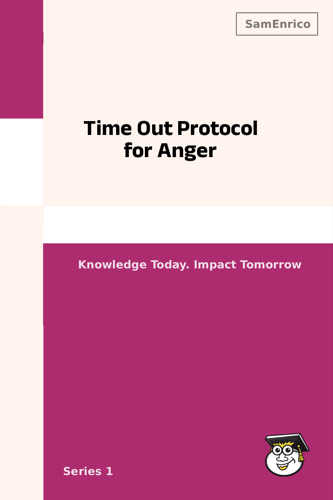
Time Out Protocol for Anger eBook
Take structured breaks before saying something you
by Sims Ted
Take structured breaks before saying something you'll regret during heated moments.
Formats
Free sample
Chapter 1: The 7-Second Trap--You are about to learn a number that will change every argument you have for the rest of your life.That number is seven.From the moment you perceive an insult, a disrespect, or a threat—real or imagined—you have approximately seven seconds before your body’s emergency response system hijacks your rational brain. In those seven seconds, a cascade of neurochemicals floods your system. Cortisol spikes. Adrenaline surges. Your heart rate accelerates from a resting 70 beats per minute to over 100, sometimes 120 or more.
Your blood vessels constrict to send oxygen to your large muscle groups—preparing you to fight. Your pupils dilate. Your hearing sharpens. And your prefrontal cortex, the part of your brain responsible for impulse control, long-term thinking, and rational decision-making, begins to go offline.This is the arousal cascade. It is ancient, automatic, and extraordinarily powerful.
It kept your ancestors alive when they faced saber-toothed tigers. It is utterly useless—and often destructive—when you are trying to have a difficult conversation with your partner, your child, your boss, or your coworker.Here is the cruel irony: The same physiological response that protects your body destroys your relationships.The goal of this book is not to eliminate your anger. Anger is a normal, useful emotion. It signals that a boundary has been crossed, that something you value is under threat, that you need to pay attention. The goal is to catch your anger within those seven seconds—before the arousal cascade completes its takeover—so that you can choose a response instead of being ruled by a reaction.This chapter will teach you how to recognize the first whisper of anger, how to distinguish between useful and destructive anger, and how to deploy the 4 Immediate Moves that will buy you the time you need to execute the full Time Out Protocol in the chapters ahead.The 7-Second Window: What Science Tells Us Let us go deeper into the biology, because understanding what happens inside your body is the first step toward controlling it.The amygdala is a small, almond-shaped cluster of nuclei located deep within your brain’s temporal lobe.
Its job is threat detection. It scans your environment constantly, asking one question: Is this dangerous? The amygdala does not think. It does not reason. It does not consider context, history, or long-term consequences.
It reacts.When your amygdala perceives a threat—including a verbal insult, a dismissive gesture, or even a tone of voice it has learned to associate with past danger—it sends an emergency signal to your hypothalamus. That signal triggers the sympathetic nervous system. Within seconds, your adrenal glands release epinephrine (adrenaline) and norepinephrine. Your body is now in fight-or-flight mode.Here is what happens in those seven seconds:Second 1–2: You notice something. A tone of voice.
A phrase. A look. Your amygdala flags it as a potential threat. You may not even be consciously aware of the trigger yet.Second 3–4: Your heart rate begins to climb. Your breathing becomes shallower and faster.
Your muscles tense, particularly in your jaw, shoulders, and hands. You may feel a flush of heat in your face or chest.Second 5–6: Your prefrontal cortex—the rational, thinking part of your brain—begins to lose access to working memory. You literally cannot think as clearly as you could thirty seconds ago. Your peripheral vision narrows (tunnel vision). Time may feel like it is slowing down.Second 7: You are now in a state of physiological arousal that makes reasoned conversation nearly impossible.
If you speak now, you will likely say something you regret.This is the 7-Second Window. It is your only opportunity to intervene before the arousal cascade completes. After seven seconds, you are no longer choosing your words. Your amygdala is choosing them for you.The good news is that seven seconds is enough time to act. Not to solve the problem, not to have the conversation, not to reach a resolution—but to stop the explosion before it starts.The 4 Immediate Moves: Your Emergency Brake When you feel the first signs of the arousal cascade—clenched fists, flushing skin, rapid heartbeat, tunnel vision, tense jaw—you have four moves to make.
These are not the full Time Out Protocol. They are split-second interventions designed to do one thing: buy you time.Move One: Recognize The single most important skill in anger management is not breathing, not walking away, not reframing your thoughts. It is recognition. You cannot interrupt what you do not notice.Recognition means developing what psychologists call interoceptive awareness—the ability to detect your own internal physiological state. Most people do not notice they are getting angry until they are already at Level 7 or 8 on a 10-point scale.
By then, the arousal cascade has completed. The window has closed.Your job is to catch anger at Level 3 or 4.What does Level 3 anger feel like? A slight increase in heart rate. A subtle tension in your jaw. Your breathing becoming just a little shallower.
A feeling of irritation, not yet rage. A voice in your head saying, “I don’t like this.”At Level 3, you still have full access to your prefrontal cortex. You can still think, reason, and choose. At Level 7, you cannot. The goal is to recognize anger at Level 3 so you can act before it becomes Level 7.Physiological Stop Signs Memorize this list.
These are your body’s early warning signals:Clenched or tingling hands Flushing or warmth in the face, neck, or chest Rapid or pounding heartbeat (check your pulse at your wrist or neck)Shallow, fast breathing (place one hand on your chest, one on your stomach)Tunnel vision or difficulty focusing your eyes Tense jaw, clenched teeth, or grinding Shoulders rising toward your ears A feeling of heat or pressure in your head Your voice becoming louder or higher-pitched A sudden urge to interrupt, correct, or defend You do not need all of these. You need one or two that reliably appear when your anger begins to rise. For some people, it is the clenched jaw. For others, it is the racing heart. For many, it is the sudden awareness that they have stopped breathing deeply.Your exercise this week: Set a random alarm on your phone five times per day.
When the alarm goes off, pause for ten seconds and ask: “What is my body feeling right now?” Do not judge it. Do not try to change it. Just notice. Over time, you will become exquisitely sensitive to the earliest whispers of anger.Move Two: Retreat (Micro)Once you recognize the signs, your second move is to retreat—but not necessarily from the room or the house. That is a macro-exit, which we will cover in Chapter 5.
For now, you need a micro-retreat: a small, almost invisible physical change that interrupts the anger loop without escalating the situation.A micro-retreat is:Taking one physical step back (three feet or more) from the other person Turning your body slightly to the side (never turning your back completely, which can be interpreted as rejection)Dropping your hands to your sides or placing them on a surface Uncrossing your arms (crossed arms increase physiological arousal)Sitting down if you were standing…
This is the end of the free sample. Get the eBook to keep going. Buy now
About this book
Details
- Author
- Sims Ted
- Publisher
- SamEnrico
- Language
- English
- Genre
- Non-Fiction, Self-Help, Conflict Resolution
- Released
- 2026-06-10
- Pages (approx.)
- 140
- Available as
- eBook, Audiobook

Read better in the ZLOADR app
Your eBooks on your phone or tablet. Sign in with your SamEnrico account and start reading.
More by Sims Ted
 The Social Battery WorkbookSims Ted$11.99
 CrossFit Box Management GuideSims Ted$11.99
 Beginner Fitness for DepressionSims Ted$11.99
 Antwerp Diamond Heist Kingpin BiographySims Ted$11.99
 The First Tides: Prehistoric Mariners of the Indian OceanSims Ted$11.99
 From Ashes to Icons: The Unlikely Rise of the Phoenix SunsSims Ted$11.99
 CTA Privacy Concerns GuideSims Ted$12.99
 CTA Reporting Service GuideSims Ted$12.99
 Advanced Service TechnicianSims Ted$11.99
 Ultimate Handbook Guide to Riyadh : (Saudi Arabia) Travel GuideSims Ted$11.99
You may also like
 Hong Kong Handover 1997Dunn Johnnie$11.99
 Zumba For Postnatal Recovery CourseNeal Christian$11.99
 Zumba for BeginnersLadner Nikia$11.99
 YouTube Comment Mining GuideHumes Pandora$12.99
 Worry Box MeditationCarlin Rudy$11.99
 Workplace Stress MeditationNguyen Lynn$11.99
 Workplace Stress and Sleep RepairHawley Ivory$11.99
 Workplace Perfectionism CureDelaney Jeffry$11.99
 Workplace Injustice Anger GuideWallen Isabelle$11.99
 Work Addiction and Burnout LinkGreenwood Ester$11.99
 Women in Yoga and WellnessBeattie Galina$11.99
 Women in Stand Up ComedyChun Evangeline$11.99