
Non-FictionSelf-HelpTime Management
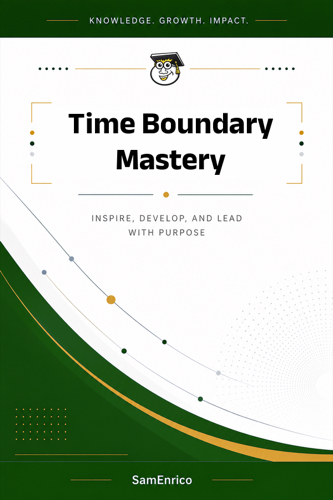
Time Boundary Mastery eBook
Stop overcommitting and protect your schedule from
by Vinson Iesha
Stop overcommitting and protect your schedule from others' urgent demands.
Formats
Free sample
Chapter 1: The Addiction of Agreeable--–- The first time I realized I had a problem, I was standing in a grocery store aisle at 11:47 PM, buying birthday candles for a party that had already started without me.My daughter had turned six that day. I had promised her pancakes for breakfast, a lunchtime visit to her classroom, and dinner with candles and singing. I delivered none of it. Not because I forgot. Because I said yes to other people first.At 8:00 AM, a colleague messaged about a "quick emergency" with a client presentation.
At 10:30 AM, my boss asked if I could "jump on a call" to help a struggling team member. At 1:00 PM, a different department head requested a "five-minute chat" about a project I was not even on. At 3:00 PM, someone from another team asked me to "review something quickly."Every request was small. Every request was reasonable. Every request came from someone I liked and wanted to help.
And every request was a lie—not intentionally, but structurally. The "quick emergency" took two hours. The "jump on a call" turned into a forty-five-minute firefighting session. The "five-minute chat" ran to thirty minutes. The "quick review" required an hour of deep concentration.By 5:00 PM, I had not written a single word of my own work.
By 7:00 PM, I had missed dinner. By 11:47 PM, I was buying candles alone in an empty grocery store, rehearsing excuses for why I had failed my family for a stack of favors that no one would remember next week.I was not a bad person. I was not lazy. I was not disorganized. I was addicted to saying yes.The Hangover You Did Not Know You Had There is a name for what I felt that night in the grocery store.
I call it the Yes Hangover.A Yes Hangover is the specific cocktail of dread, exhaustion, resentment, and self-disgust that arrives the morning after you overcommit. You wake up and realize you promised fourteen hours of work in a ten-hour day. You scan your calendar and see back-to-back meetings you did not want to attend, favors you did not want to grant, and obligations you did not want to accept—all of which you agreed to voluntarily. The resentment is the worst part. You are not angry at the people who asked.
You are angry at yourself for saying yes when every instinct knew you should have said no.The Yes Hangover is not a time management problem. You cannot schedule your way out of it. You cannot app, system, or color-code your way out of it. The Yes Hangover is an identity problem. It is a boundary problem.
It is a problem with who you believe yourself to be and what you believe you owe the world.And it is far more common than anyone admits.The Biology of Yes: Why Your Brain Betrays You To understand why we overcommit, we have to start not with calendars or productivity systems, but with the three pounds of electrochemical tissue between your ears. Your brain is not neutral about saying yes. It actively rewards you for it.When someone asks for your help and you agree, your brain releases a small amount of dopamine—the same neurotransmitter involved in pleasure, reward, and addiction. Social acceptance triggers the same neural reward pathways as food, money, and certain drugs. From a neurological perspective, saying yes feels good.
Saying no feels bad.This is not a metaphor. Functional MRI studies show that social rejection activates the same brain regions as physical pain. When you say no to someone, especially someone you like or respect, your anterior cingulate cortex—the brain's error-detection and pain-processing center—lights up. Saying no literally hurts. Saying yes literally rewards you.This creates what I call the Dopamine Loop.
The loop has four stages:First, someone makes a request. Your brain briefly experiences the request as a potential threat—an unknown demand on your limited resources. This triggers a small spike of anxiety.Second, you say yes. Immediately, the anxiety dissipates. You feel relief.
Then comes the dopamine hit: social approval, gratitude, the warm feeling of being helpful and needed. Your brain learns that saying yes reduces anxiety and produces pleasure.Third, you perform the favor or complete the task. This may take minutes, hours, or days. During this time, the dopamine has faded. You are now in the cost phase of the loop—spending time and energy you did not budget.Fourth, the Yes Hangover arrives.
The person thanks you. You feel a brief residue of pride. But underneath, you feel the cost. You realize what you sacrificed. You promise yourself you will say no next time.
But when the next request comes, the loop resets. The immediate relief of saying yes always wins against the distant cost of the hangover.The Dopamine Loop explains four seemingly different behaviors that will appear throughout this book:One, the chronic yes-sayer who cannot decline any request, no matter how trivial. This person is neurologically hooked on the approval hit.Two, the instant responder who answers emails and messages within seconds. This person is chasing the dopamine of "task completion" and the relief of clearing the notification badge.Three, the guilt-ridden boundary-setter who says no successfully but then feels terrible for hours afterward. This person is experiencing the neurological pain of the anterior cingulate cortex—the brain treating a healthy boundary like an injury.Four, the procrastinator who avoids difficult work by doing small favors for others.
This person uses the dopamine from easy yeses to escape the anxiety of hard tasks.The Dopamine Loop is not a moral failure. It is your brain doing exactly what evolution designed it to do: seek social approval, avoid social pain, and prefer immediate rewards over delayed ones. The problem is not your brain. The problem is that modern work has weaponized this loop against you.Every notification, every message, every "quick question" is designed to trigger your dopamine system. The people who design Slack, email, and text messaging know exactly what they are doing.
They have built systems that exploit your brain's craving for closure and approval. You are not weak for being affected by them. You are human.But being human does not mean being helpless. Understanding the Dopamine Loop is the first step to breaking it. You cannot hack your biology.
But you can recognize when the loop is running and choose to interrupt it.The Two Identities That Battle for Your Calendar The Dopamine Loop explains why saying yes feels good in the moment. But it does not explain why some people overcommit more than others, or why the same person overcommits in some areas of life but not others. For that, we need to look at identity.I have found that most people operate from one of two implicit identities when it comes to time and productivity. I call them the Achievement Identity and the Essential Identity. These are not personality types.
They are frameworks—ways of organizing your relationship with work, requests, and worth.The Achievement Identity is the default setting for most high-performers. Under this identity, your self-worth is tied to how much…
This is the end of the free sample. Get the eBook to keep going. Buy now
About this book
Details
- Author
- Vinson Iesha
- Publisher
- SamEnrico
- Language
- English
- Genre
- Non-Fiction, Self-Help, Time Management
- Released
- 2026-06-11
- Pages (approx.)
- 138
- Available as
- eBook, Audiobook

Read better in the ZLOADR app
Your eBooks on your phone or tablet. Sign in with your SamEnrico account and start reading.
More by Vinson Iesha
 The Travel Nap StrategyVinson Iesha$11.99
 Parent Death Guilt ResolutionVinson Iesha$11.99
 Pain Meditation WorkbookVinson Iesha$11.99
 Hybrid Team ProductivityVinson Iesha$11.99
 Prescription Aid Strategy GuideVinson Iesha$11.99
 Peloton Leaderboard EnvyVinson Iesha$11.99
 Amazon A9 Algorithm GuideVinson Iesha$11.99
 Crisis Burnout PreventionVinson Iesha$11.99
 The Day the Internet Broke: The Great DNS Crash of 2016Vinson Iesha$11.99
 The Whispering Walls of the Overlook HotelVinson Iesha$11.99
 The Last Chain Breaker: The Untold Story of the Angola 3Vinson Iesha$11.99
 Growing GloriosaVinson Iesha$11.99
You may also like
 Hong Kong Handover 1997Dunn Johnnie$11.99
 Zumba For Postnatal Recovery CourseNeal Christian$11.99
 Zumba for BeginnersLadner Nikia$11.99
 YouTube Comment Mining GuideHumes Pandora$12.99
 Worry Box MeditationCarlin Rudy$11.99
 Workplace Stress MeditationNguyen Lynn$11.99
 Workplace Stress and Sleep RepairHawley Ivory$11.99
 Workplace Perfectionism CureDelaney Jeffry$11.99
 Workplace Injustice Anger GuideWallen Isabelle$11.99
 Work Addiction and Burnout LinkGreenwood Ester$11.99
 Women in Yoga and WellnessBeattie Galina$11.99
 Women in Stand Up ComedyChun Evangeline$11.99