
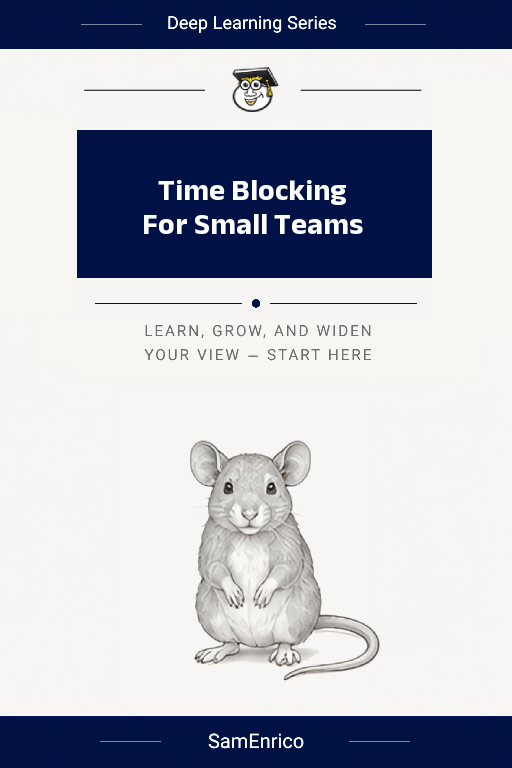
Non-FictionProfessional's Cheat Sheet
Time Blocking For Small Teams eBook
Align executive and direct report blocks for colla
Align executive and direct report blocks for collaborative deep work sessions.
Formats
Free sample
Chapter 1: The Alignment Lie--If you picked up this book, you have probably already tried time blocking. You have probably failed at it too—or watched your team fail. You carved out quiet hours for deep work. You color-coded your calendar. You said no to meetings.
And yet, nothing got faster. Approvals still took three days. Your best people still complained about interruptions. And you still ended your weeks wondering where all the time went.You are not alone. And you are not undisciplined.You are misaligned.This entire chapter exists to deliver one uncomfortable truth that most productivity books refuse to say out loud: Individual time blocking does not work for teams.
It cannot work. It was never designed to work. The very act of an executive blocking 9 AM to 11 AM for "strategy" while their designer blocks 9 AM to 11 AM for "creative work" and their engineer blocks 9 AM to 11 AM for "coding" is not productivity. It is three people working in parallel on three different planes that never intersect. They are busy together, alone.
And that is the Alignment Lie.The Alignment Lie is the seductive belief that if every person on your team manages their own time well, the team as a whole will perform well. It sounds reasonable. It feels fair. It is catastrophically wrong.What follows in this chapter is the dismantling of that lie. You will learn why individual productivity often creates team bottlenecks, what "ghosted approvals" are costing you, and the single most important distinction between being busy and being aligned.
By the end of this chapter, you will never look at a calendar the same way again.The Startup That Worked 60 Hours and Got Nothing Done Let me introduce you to Sarah. She is the chief technology officer of a twelve-person fintech startup. When I met her, she was six months behind on a product launch, her engineering team was averaging fifty-five hour weeks, and her best developer had just submitted a resignation letter citing "burnout and chaos."Sarah was not lazy. She was not stupid. She had read every productivity book on the shelf.
She had implemented "no-meeting Wednesdays." She had bought her team subscriptions to a popular time blocking app. She had even painted a "focus wall" in their open office where people could hang a red flag when they did not want to be interrupted.None of it worked.I asked Sarah to show me her calendar for the previous week. It was a masterpiece of individual time management. Monday: 9–10 AM strategy, 10–11 AM investor update, 11–12 PM product review, 12–1 PM lunch, 1–3 PM deep work on architecture, 3–4 PM emails, 4–5 PM one-on-ones. Every block was accounted for.
Every hour had a purpose. She was, by any individual metric, a model of productivity.Then I asked to see her lead engineer's calendar. It was also beautifully blocked. 9–11 AM coding on the payment integration. 11–12 PM standup.
12–1 PM lunch. 1–3 PM deep work on the API. 3–4 PM code review. 4–5 PM documentation.On paper, both calendars were perfect. In reality, they were a disaster.The problem revealed itself when I asked a simple question: "When do you two work together?"Sarah looked confused.
"We don't need to work together. He codes. I review. That's how it works."But that was exactly the problem. Sarah's calendar said she would review the payment integration at 3 PM on Thursday.
The engineer's calendar said he would finish coding it at 11 AM on Thursday. There was no overlap. The engineer finished his work and waited. Sarah reviewed it three days later, but by then she had lost context. She asked for changes.
The engineer made them. She reviewed again two days after that. A task that should have taken four hours stretched across two weeks.I calculated what I now call the Alignment Ratio—a metric you will learn deeply in Chapter 3. For Sarah's team, the Alignment Ratio was 12 percent. Twelve percent of the deep work hours that Sarah blocked overlapped with the deep work hours her team blocked.
The other 88 percent was individual productivity that created no collective progress.Sarah's team was working fifty-five hour weeks but achieving perhaps twenty hours of aligned output. The rest was waste. Not laziness. Not poor effort. Structural misalignment.Six weeks after implementing the system this book will teach you, Sarah's team shipped their delayed feature in four days.
Their weekly hours dropped to forty. The developer who had resigned withdrew his letter. And Sarah's Alignment Ratio climbed to 78 percent.This book is what Sarah learned. But before we get to the solutions, we must fully understand the problem.The Difference Between Busy and Aligned Here is a question that will change how you lead: If your entire team worked alone in separate rooms for a week, communicating only by email, would your most important project move forward faster or slower?Most executives answer "slower," but they cannot explain why. The reason is that deep work on a team is not a collection of individual deep work sessions.
It is a network of dependencies. Your work creates my work. My work enables her work. Her work requires your approval. When those dependencies are not synchronized, time does not move linearly.
It stalls.Let me define two terms that will appear throughout this book.Busy means every calendar slot is filled. Busy is easy to measure and easy to fake. You can be busy for sixteen hours a day and produce nothing of value. Busy is the default state of most organizations because it requires no coordination. Everyone just does their own thing.Aligned means the right slots overlap with the right people.
Alignment is harder to measure and harder to fake. It requires coordination. It requires sacrifice. But it produces output that busy cannot touch.Consider two scenarios.Scenario A (Busy): Five people each block four hours of deep work daily. They work on different tasks at different times.
They finish their individual assignments but wait an average of two days for dependencies to be reviewed, approved, or integrated. Total aligned output: the slowest dependency chain determines the team's speed. This is called the bottleneck effect, and it is the silent killer of small teams.Scenario B (Aligned): Five people block the same three hours daily for synchronous deep work. They work silently in parallel on tasks that share dependencies. When an engineer finishes a function, the reviewer is already there, already in deep work mode, and can provide feedback within minutes, not days.
Total aligned output: the team moves at the speed of its fastest dependency chain.Scenario B does not require more hours. It does not require more effort. It requires only that calendars overlap where dependencies exist.This is the central insight of this book: Productivity is not a solo sport. The highest-leverage unit of productivity is not the individual. It is the dyad—the manager and direct report working together—and the small team.
When you optimize for individual productivity, you optimize for busy. When you optimize for aligned productivity, you optimize for outcomes.The Ghosted Approval: A $47,000 Problem Let me put a number on misalignment.I worked with a fifteen-person marketing agency where the creative director and the copy chief had a classic…
This is the end of the free sample. Get the eBook to keep going. Buy now
About this book
Details
- Author
- Hooks Vernita
- Publisher
- SamEnrico
- Language
- English
- Genre
- Non-Fiction, Professional's Cheat Sheet
- Released
- 2026-05-30
- Pages (approx.)
- 146
- Available as
- eBook, Audiobook

Read better in the ZLOADR app
Your eBooks on your phone or tablet. Sign in with your SamEnrico account and start reading.
More by Hooks Vernita
 Gut Health CookbookHooks Vernita$11.99
 Twelve Step Phone MeetingsHooks Vernita$11.99
 Scraping By in Coal CountryHooks Vernita$11.99
 Breakup Self Esteem RebuildingHooks Vernita$11.99
 The Floating Sensation TMHooks Vernita$11.99
 Breach Notification Legal Hold ScriptsHooks Vernita$11.99
 Squat Depth Optimization CourseHooks Vernita$11.99
 Alexander HaigHooks Vernita$11.99
 Ops Team FirefightingHooks Vernita$11.99
 Into the Heart of Darkness: The Pygmies, the Explorers, and the Secrets of the CongoHooks Vernita$11.99
 The Art of the Steal: How a Billion-Dollar Laundry Empire Fooled the WorldHooks Vernita$11.99
 The Vanishing of the Green ChildrenHooks Vernita$11.99
You may also like
 Hong Kong Handover 1997Dunn Johnnie$11.99
 Zumba For Postnatal Recovery CourseNeal Christian$11.99
 Zumba for BeginnersLadner Nikia$11.99
 YouTube Comment Mining GuideHumes Pandora$12.99
 Worry Box MeditationCarlin Rudy$11.99
 Workplace Stress MeditationNguyen Lynn$11.99
 Workplace Stress and Sleep RepairHawley Ivory$11.99
 Workplace Perfectionism CureDelaney Jeffry$11.99
 Workplace Injustice Anger GuideWallen Isabelle$11.99
 Work Addiction and Burnout LinkGreenwood Ester$11.99
 Women in Yoga and WellnessBeattie Galina$11.99
 Women in Stand Up ComedyChun Evangeline$11.99