
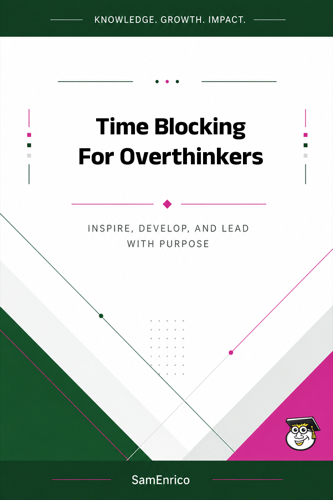
Non-FictionSelf-HelpOverthinking
Time Blocking For Overthinkers eBook
Schedule decision blocks to contain analysis paral
by Slone Joya
Schedule decision blocks to contain analysis paralysis.
Formats
Free sample
Chapter 1: The Grocery Store Trap--–- You have probably made thirty-seven decisions before finishing your first cup of coffee today. The alarm going off or hitting snooze—that was decision one. What temperature the shower should be—decision two. Whether to wash your hair or postpone it—three. What to wear—four through twelve depending on how many times you changed your mind.
What to eat for breakfast—thirteen. Whether to check email before or after eating—fourteen. Which email to open first—fifteen. Whether to reply immediately or mark as unread—sixteen. This is not an exaggeration.
This is the hidden architecture of your morning, and for most people, this cascade of micro-choices is invisible background noise. For you, the chronic overthinker, each one of these decisions has carried a small but measurable emotional weight. By 9 AM, you are already tired, and you have not even started your real work yet.This chapter is called The Grocery Store Trap because nothing reveals the hidden cost of choice quite like standing in an aisle with fifty-seven varieties of something you do not even particularly like, feeling your energy drain away as you compare prices, ingredients, and expiration dates. The grocery store is where overthinking stops being abstract and becomes embarrassingly concrete. It is also where you will discover the single most important distinction that will change how you make decisions forever: the difference between a Two-Way Door and a One-Way Door.The Paradox of Choice Revisited In 2004, psychologist Barry Schwartz published a book called The Paradox of Choice, and for twenty years, it has been cited, debated, and largely ignored by the productivity industry.
Schwartz argued that while we assume more choice equals more freedom and more happiness, the opposite is often true. Beyond a certain point—usually somewhere between three and five options—additional choices increase anxiety, decrease satisfaction, and lead to what he called "choice overload." People given six flavors of jam are more likely to stop and look than people given twenty-four flavors, but they are far less likely to actually buy anything. More choice leads to less action.The productivity industry took this research and did something strange with it. They used it to argue for simplifying systems, reducing clutter, and creating routines. All of that is fine advice, but it misses the deeper point.
The problem is not just that you have too many jams. The problem is that your brain treats each additional jam as a threat. When you stand in that aisle, your brain is not calmly evaluating options like a rational economist. Your brain is doing something much older and much less helpful. It is treating the decision like a survival calculation.Here is what happens inside your skull when you face a choice between more than three options.
Your prefrontal cortex—the part of your brain responsible for executive function, planning, and impulse control—begins consuming glucose at an accelerated rate. Each additional option increases the metabolic cost. After a certain threshold, you enter what researchers call decision fatigue. Your prefrontal cortex essentially runs out of fuel. At this point, one of two things happens.
Either you make an impulsive choice just to escape the discomfort—grabbing any jam off the shelf without comparing—or you freeze completely, unable to choose at all. Neither outcome is good. Neither outcome is rational. Both are biological.This is not a character flaw. This is not a sign that you are weak or indecisive or broken.
This is how a healthy human brain responds to choice overload. The difference between you and someone who breezes through the grocery store is not that they have stronger willpower. The difference is that they have learned to contain the choice before it reaches overload. They have unconscious protocols that you lack. This book will give you conscious protocols that work even better.The 85% Problem and Why You Are Different Recent surveys of knowledge workers show that approximately eighty-five percent report experiencing decision distress at least once a week.
That statistic appears in almost every productivity book written in the last three years, and it is usually used to argue that everyone is struggling. But this statistic is misleading for your purposes. Occasional decision distress is not the same as chronic overthinking. The person who freezes once a week when choosing between two good job candidates is not the same as the person who freezes six times before lunch over which email to open.If you are reading this book, you are likely in the smaller group—perhaps fifteen to twenty percent of knowledge workers—who experience decision distress daily, across multiple domains, with physical symptoms. You feel tension in your shoulders when faced with a dropdown menu.
You avoid opening certain apps because you know they will present you with choices. You have lost hours to decisions that other people make in seconds. You have felt genuine relief when a choice was made for you by circumstances or by someone else.This book is written for you. Not for the person who occasionally overthinks a big decision. For the person who overthinks everything.
The person whose brain generates twelve options for lunch, nineteen for the first sentence of an email, and an infinite regression of possibilities for any question that begins with "what if." The person who has been told their whole life to "just decide" as if that were a helpful instruction rather than the equivalent of telling someone with a broken leg to "just walk."If that sounds like you, stay here. If you are the occasional overthinker, you are welcome to read along, but the intensity of these protocols may feel like overkill. For the chronic overthinker, they will feel like coming home.Decision Overload Is Not a Metaphor Let us get specific about what happens in your brain during decision overload, because naming the mechanism is the first step to containing it. The research on decision fatigue comes primarily from two sources: studies of parole judges and studies of consumer behavior. The parole judge studies are particularly revealing.
Researchers found that judges were far more likely to grant parole in the morning than in the afternoon. As the day wore on and the judges made more and more decisions, their decision quality deteriorated. They defaulted to the safest, easiest option—denying parole—not because they were biased or tired in the vague sense, but because their cognitive fuel was literally depleted.The same thing happens to you, but with a cruel twist. For most people, decision fatigue manifests as a gradual decline in quality. For chronic overthinkers, decision fatigue manifests as a sudden cliff.
You will be functioning reasonably well, making okay decisions at an okay pace, and then you will hit a wall. A simple question—what to eat for dinner, whether to reply to a text now or later—will trigger a complete freeze. This is not because you are lazy or dramatic. This is because your baseline decision load is already higher than most people's. You are not starting from zero in the morning.
You are starting from a deficit created by the thirty-seven decisions you made before coffee.The practical implication is brutal but…
This is the end of the free sample. Get the eBook to keep going. Buy now
About this book
Details
- Author
- Slone Joya
- Publisher
- SamEnrico
- Language
- English
- Genre
- Non-Fiction, Self-Help, Overthinking
- Released
- 2026-06-05
- Pages (approx.)
- 120
- Available as
- eBook, Audiobook

Read better in the ZLOADR app
Your eBooks on your phone or tablet. Sign in with your SamEnrico account and start reading.
More by Slone Joya
 Food Delivery Tech GuideSlone Joya$11.99
 Selenium Thyroid Function HandbookSlone Joya$11.99
 Abreaction Management ScriptsSlone Joya$11.99
 Butterfly Garden RestSlone Joya$11.99
 OCD and RelationshipsSlone Joya$11.99
 MBSR for MenopauseSlone Joya$11.99
 The Military Combat Stress GuideSlone Joya$11.99
 Anger And Childhood PatternsSlone Joya$11.99
 The Astronomers of the Nile: Decoding the Stars of KemetSlone Joya$11.99
 The Blackout Murders: The Night the Lights Went Out in ChicagoSlone Joya$11.99
 Shadows of the Silk Road: The Double Life of Marco Polo's SpySlone Joya$11.99
 Professional Writing for BusinessSlone Joya$11.99
You may also like
 Hong Kong Handover 1997Dunn Johnnie$11.99
 Zumba For Postnatal Recovery CourseNeal Christian$11.99
 Zumba for BeginnersLadner Nikia$11.99
 YouTube Comment Mining GuideHumes Pandora$12.99
 Worry Box MeditationCarlin Rudy$11.99
 Workplace Stress MeditationNguyen Lynn$11.99
 Workplace Stress and Sleep RepairHawley Ivory$11.99
 Workplace Perfectionism CureDelaney Jeffry$11.99
 Workplace Injustice Anger GuideWallen Isabelle$11.99
 Work Addiction and Burnout LinkGreenwood Ester$11.99
 Women in Yoga and WellnessBeattie Galina$11.99
 Women in Stand Up ComedyChun Evangeline$11.99