
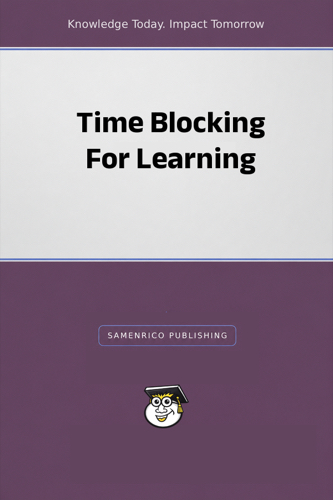
Time Blocking For Learning eBook
Block course work and skill practice into your wee
by Jacob Reyna
Block course work and skill practice into your weekly schedule.
Formats
Free sample
Chapter 1: The Shame Cycle--–- Melissa had done everything right. She bought the textbook two weeks before the semester started. She highlighted nearly every page of the first three chapters in four different colors. She watched the professor's lecture videos at 1.5x speed while eating breakfast, lunch, and dinner. She even downloaded a study app that sent her push notifications every two hours: "Time to study!" By the time the first exam arrived, Melissa felt prepared.
Not just prepared—confident. She had spent more than forty hours on this class. She had sacrificed Friday nights, skipped two social events, and told her roommate she was "in the zone."The exam came back three days later. The grade was a 67. Melissa stared at the paper, then at her calendar, then back at the paper.
How was this possible? She had done the work. She had put in the time. She had the highlighted pages to prove it. Her roommate, who seemed to study only the night before, got an 82.
Melissa did what any reasonable person would do: she decided to try harder. She blocked out entire weekends. She turned her phone off for six-hour stretches. She re-read every chapter twice. The second exam came back: 71.
The third: 68. By the end of the semester, Melissa had logged more study hours than anyone she knew—and she was failing.Melissa is not real. But Melissa is every learner I have worked with over the past decade. She is the medical resident who cannot understand why her board scores do not reflect her effort. She is the coding bootcamp student who has watched 200 hours of tutorials but cannot build a functioning app.
She is the language learner with a 400-day Duolingo streak who freezes when a native speaker asks for directions. She is you, reading this book, wondering why your good intentions never seem to translate into actual progress.The answer is not that you are lazy. The answer is not that you lack discipline or intelligence or grit. The answer is that you are using a broken model of learning—a model that equates time spent with progress made. And no amount of effort can fix a broken model.The Intention Trap Let me name something uncomfortable.
Most learners do not have a motivation problem. They have a structure problem. Melissa was deeply motivated. She wanted to succeed. She sacrificed social time, sleep, and sanity in pursuit of her goal.
Her failure was not a failure of will. Her failure was a failure of scheduling—specifically, the belief that "studying" is a vague, undifferentiated activity that can be done whenever free time appears.This belief is so pervasive that most people never question it. We assume that if we have three free hours on a Sunday afternoon, we will "study" for three hours. We assume that if we cancel our evening plans, those suddenly free hours will automatically convert into productive learning. We assume that our intentions—"I will study more this week"—are enough to overcome the thousand small resistances that actually determine our behavior.They are not enough.
They have never been enough. And pretending otherwise is the fastest path to the exact shame cycle Melissa experienced: effort → disappointment → more effort → more disappointment → quiet belief that you are simply not smart enough.The research calls this the planning fallacy, a term coined by Daniel Kahneman and Amos Tversky. The planning fallacy is our systematic tendency to underestimate how long tasks will take, even when we have direct evidence from the past that they take longer. When Melissa planned to study for six hours on Saturday, she was not lying. She genuinely believed she would study for six hours.
But her belief ignored every previous Saturday, every previous study session, every previous negotiation between her intentions and the reality of a Saturday afternoon with a phone, a tired brain, and the knowledge that her friends were at brunch without her.The planning fallacy is why students consistently underestimate how long a term paper will take, why professionals miss deadlines despite their best efforts, and why learners like Melissa end the semester with fewer completed study hours than they planned—and with a sense of personal failure that is entirely misattributed.But the planning fallacy is only half the problem. The other half is Parkinson's Law: work expands to fill the time allotted for it. If you give yourself three open-ended hours to "study," you will not complete three hours of focused learning. You will complete perhaps ninety minutes of actual learning, surrounded by ninety minutes of phone-checking, snack-getting, note-reorganizing, and staring out the window. The work expands not because you are lazy but because the human brain is not designed for sustained, undirected focus.
Without a container—a specific time limit, a specific outcome, a specific structure—attention leaks out through a thousand small cracks.Melissa's six-hour study sessions were not six hours of learning. They were perhaps two hours of learning, two hours of pseudo-learning (re-reading, highlighting, organizing), and two hours of distraction disguised as breaks. She left those sessions exhausted, having spent six hours in a chair, and mistook her exhaustion for evidence of effort. But exhaustion is not learning. Sitting in a chair is not learning.
Even reading words on a page is not learning, not in the way that actually changes your brain and your abilities.Deep Learning versus Busyness This book draws a line that will run through every chapter, every template, every example from here to the end. On one side of the line is busyness: watching lectures while checking email, highlighting textbooks without closing the book and testing yourself, re-reading notes until they feel familiar, organizing your study space for the tenth time, watching supplementary videos that never end, scrolling through flashcards you already know. Busyness feels productive. Busyness produces the satisfying sensation of effort. But busyness does not produce durable learning.On the other side of the line is deep learning: active, effortful engagement that changes your brain's structure and creates skills that transfer to new situations.
Deep learning requires retrieval (pulling information from memory, not re-reading it), spacing (distributing practice over time, not massing it into marathons), and interleaving (mixing related topics, not blocking them into isolated silos). Deep learning feels harder than busyness—not because it requires more effort in total, but because the effort is concentrated and uncomfortable. Testing yourself on material you have not yet mastered is uncomfortable. Repeating a skill until it becomes automatic is uncomfortable. Sitting with a problem you cannot immediately solve is uncomfortable.
Busyness, by contrast, is comfortable. It is the path of least resistance. And it is the path that leads directly to Melissa's 67.The tragedy of modern learning is that most people mistake busyness for deep learning because they have never been shown the difference. Schools reward busyness: attendance, homework completion, highlighted readings, participation points. Online courses reward busyness: video completion percentages, quiz attempts, forum posts.
Even our own brains reward busyness: the familiarity of re-reading a chapter produces the same dopamine hit as actually knowing the material, which is why so many students walk into exams feeling prepared and walk out shocked.Time blocking—the…
This is the end of the free sample. Get the eBook to keep going. Buy now
About this book
Details
- Author
- Jacob Reyna
- Publisher
- SamEnrico
- Language
- English
- Genre
- Non-Fiction, Self-Help, Lifelong Learning
- Released
- 2026-06-06
- Pages (approx.)
- 142
- Available as
- eBook, Audiobook

Read better in the ZLOADR app
Your eBooks on your phone or tablet. Sign in with your SamEnrico account and start reading.
More by Jacob Reyna
 The Porch Swing MethodJacob Reyna$11.99
 Open Mic to NetflixJacob Reyna$11.99
 Automatic Writing HypnosisJacob Reyna$11.99
 The Lost Dog GriefJacob Reyna$11.99
 Trance for Phobia EliminationJacob Reyna$11.99
 The Air Ambulance Pilot StressJacob Reyna$11.99
 Legal Fee ProvisionJacob Reyna$11.99
 Sex and Pelvic Floor GuideJacob Reyna$11.99
 The Maestro and the Monarch: Handel at the Court of George IJacob Reyna$11.99
 Code Red: The Day the Internet Held a City HostageJacob Reyna$11.99
 The Star Keepers of Ancient Egypt: Unlocking the Secrets of the SkyJacob Reyna$11.99
 Growing Woodwardia (Chain Fern)Jacob Reyna$11.99
You may also like
 Staying Relevant At Any AgeConn Charity$11.99
 Legacy Of Lifelong Learning HandbookLunsford Makeda$11.99
 Senior Learning New SkillsMclemore Johnsie$11.99
 Senior Late Life Learning ConfidenceMcnamara Sung$11.99
 Learning Habit FormationCarey Joline$11.99
 Learning Weekly ReviewMansfield Trula$11.99
 Cultivating A Learner IdentityDunlap Lenna$11.99
 Joyful Learning Gratitude GuideRichey Lynwood$11.99
 Learning Legacy GuideMcafee Ingrid$11.99
 Learning Daily Review GuideLemons Merrilee$11.99
 The Senior New Skill Confidence CourseJean Johanne$11.99
 Learning New Skills SeniorsDill Heriberto$11.99