
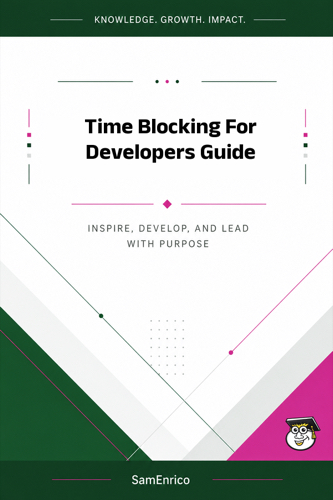
Time Blocking For Developers Guide eBook
Protect coding blocks from meeting interruptions a
by Hook Kena
Protect coding blocks from meeting interruptions and context switching.
Formats
Free sample
Chapter 1: The 45-Minute Head Scramble...--It is 10:47 on a Tuesday morning. You are deep in a refactoring session, rewriting a legacy payment validation module that has been the source of three production bugs in the past two months. You have just traced the data flow from the controller down through a service layer, across two repositories, and into a stored procedure that should have been retired in 2015. The variable names are lies. The comments are worse than lies—they are actively misleading.
But you have found it. Line 187. A null check that does the opposite of what it claims. You highlight the line. Your fingers move to the keyboard to type the fix.Then Slack blinks."Hey, quick question?"You hesitate.
The fix is right there. Thirty seconds of typing. But the notification badge is orange now, and orange means someone is waiting. You are a professional. You are collaborative.
You click.The question is not quick. It is about a different project, a different codebase, a different deadline. You answer as best you can. Two minutes pass. You close Slack.
You return to line 187.And you stare.What were you doing? Why did you highlight this line? What was the variable name again? The data flow you traced—was it from the controller or from the job queue? You scroll up.
Then down. Then up again. The mental model you spent forty-five minutes building is gone. Not模糊. Not partial.
Gone.You have just experienced the most expensive two minutes in software development. And you will experience it again before lunch.The Myth of the Harmless Interruption The software industry has a storytelling problem. We tell ourselves that interruptions are a minor inconvenience—a "cost of doing business" in collaborative environments. We tell ourselves that the fifteen-minute standup meeting costs fifteen minutes. We tell ourselves that the Slack message that takes thirty seconds to read costs thirty seconds.
We tell ourselves that context switching is a skill, and that senior developers are simply better at it.Every single one of these stories is a lie.The truth, supported by decades of cognitive science research and replicated across multiple studies of knowledge workers, is that an interruption of any length costs approximately forty-five minutes of lost productivity. Not fifteen. Not thirty. Forty-five. This number is not a rough estimate.
It is the average recovery time observed in controlled studies of software developers, engineers, and other "deep work" professionals. It is the single most important number in this book, and it will appear in every subsequent chapter.Let me say it again, because you will need to memorize it, share it with your manager, and tape it to your monitor: One interruption costs forty-five minutes.Here is the math. A fifteen-minute meeting consumes fifteen minutes of clock time. But after that meeting ends, the developer requires an average of thirty additional minutes to reload their mental state—to reconstruct the variables, the call stack, the half-written algorithm, the three browser tabs that were open, the terminal output that showed the error, the hypothesis they were testing. Fifteen plus thirty equals forty-five.The thirty-minute reload is not the developer's fault.
It is not a discipline problem. It is not a failure of willpower. It is a cognitive constraint of the human brain, as immutable as the speed of light.Losing Time Versus Losing State To understand why interruptions are so expensive, we must distinguish between two very different kinds of loss.Losing time is simple. You had forty-five minutes on the clock. You spent fifteen in a meeting.
Now you have thirty minutes left. The clock does not care. The clock moves forward regardless.Losing state is the real killer. State is the mental model you hold in your working memory—the map of the codebase that exists only in your head. That map includes:Which variables are in scope and what values they currently hold Which functions call which other functions Which line you are on and what you planned to do next The two or three alternative approaches you have already rejected The bug you suspect but have not yet proven The stack trace you saw three minutes ago that pointed to the real problem This state is fragile.
It is built slowly, through careful reading and incremental exploration. It is stored in a part of the brain called working memory, which has two cruel limitations: it can hold only about four distinct items at once, and it degrades rapidly when attention is diverted.When you are interrupted, you do not simply "pause" your work. Your working memory dumps its contents to make room for the new task. The meeting or Slack conversation requires its own state—the question being asked, the project being discussed, the deadline being mentioned. Your brain, which cannot hold two complex states simultaneously, performs a context switch.
It saves the code state to a slower form of memory (if it saves it at all) and loads the meeting state.When you return to the code, your brain must perform another context switch. But this time, the saved state may have degraded. The variables are fuzzy. The call stack is a blur. The hypothesis you were testing is gone.
You must rebuild from scratch.This is why the recovery time is thirty minutes, not thirty seconds. Rebuilding state is not a linear process. It is a reinvestment—a second mortgage on your cognitive real estate.The Computer Analogy That Actually Works Developers love computer analogies, so let me give you one that is precise rather than inspirational.Your brain is like a CPU with a very small cache. The cache holds the instructions and data you are actively working with. It is fast—extremely fast—but it is also tiny.
You cannot fit an entire codebase in the cache. You can only fit the handful of files, functions, and variables that are immediately relevant to your current task.When you are deep in a coding session, your cache is hot. The relevant data is loaded. The CPU is executing instructions efficiently. This is the state that developers call "flow" or "the zone." It feels effortless because the cache is perfectly primed.An interruption is a cache flush.
The CPU receives an interrupt request—a hardware interrupt, in computer terms—and must save its current register state to memory, handle the interrupt, and then restore the register state from memory to resume execution.But here is where the analogy breaks down in a way that matters. A computer saves its register state perfectly. Every bit is preserved. When the interrupt handler finishes, the CPU restores the exact state it had before.Your brain does not. Your brain's "register state" is fuzzy, approximate, and prone to decay.
When you save your mental state to long-term memory, you lose resolution. The exact line number becomes "somewhere around line 180." The variable name becomes "that thing that held the user ID." The hypothesis becomes "I think there was a null check problem."When you restore, you do not get the original state. You get a degraded approximation. And then you spend thirty minutes repairing it.This is not a metaphor. This is cognitive…
This is the end of the free sample. Get the eBook to keep going. Buy now
About this book
Details
- Author
- Hook Kena
- Publisher
- SamEnrico
- Language
- English
- Genre
- Non-Fiction, Self-Help, Software Development
- Released
- 2026-06-11
- Pages (approx.)
- 151
- Available as
- eBook, Audiobook

Read better in the ZLOADR app
Your eBooks on your phone or tablet. Sign in with your SamEnrico account and start reading.
More by Hook Kena
 Franchise Builder's Bootstrapped StartHook Kena$11.99
 Helplessness Anger Trigger CourseHook Kena$11.99
 NA Step Study GuideHook Kena$11.99
 The Poisoner's ApothecaryHook Kena$11.99
 The Great Airline Heist: The Inside Story of the 1970s Skyjacking WaveHook Kena$11.99
 Understanding Hyperphenylalaninemic EmbryopathyHook Kena$17.99
 Treasury Management APIsHook Kena$12.99
 Grant Writer Portfolio WorkbookHook Kena$12.99
 How to Start a Casting of Heavy Metal and Precious Metal Business (Beginners Guide)Hook Kena$11.99
 Chiropractic AdjustmentHook Kena$11.99
You may also like
 Flow in Programming CodingTeeter Rosita$11.99
 Listening In Software Dev GuideEllison Lavona$11.99
 Software Developer Interruption GuideBurton Ricky$11.99
 Distraction Proof Coding WorkflowBallard Ronald$11.99
 Weekly Review for Software DevelopersGoforth Deandra$11.99
 Working Memory For ProgrammersWeller Alec$11.99
 Developer Flow State ProtectionSells Ressie$11.99
 Pomodoro for Coding FocusPatterson Elisa$11.99
 Flow For ProgrammersLemon Jim$11.99
 The Software Engineer CreativityFerry Desmond$11.99
 Pomodoro For ProgrammersBaugh Jung$11.99
 Developer Code Review RitualSpivey Suellen$11.99