
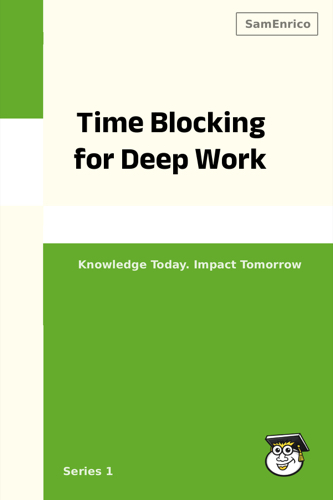
Time Blocking for Deep Work eBook
Reserves uninterrupted hours for cognitively deman
Reserves uninterrupted hours for cognitively demanding tasks without distractions.
Formats
Free sample
Chapter 1: The Anxiety Engine--–- Every morning, millions of professionals perform the same ritual. They sit down at their desks, open a notebook or a digital app, and write a list of everything they need to do. Some use bullet points. Some use checkboxes. Some color-code by priority.
The ritual feels productive. It feels responsible. It feels like the first step toward a good day.And then the anxiety sets in.The list sits there, staring back. Ten items. Fifteen.
Twenty. Each one a small debt owed to the future. By mid-morning, three items are crossed off and seven remain. By afternoon, two more are gone but five have been added. The list never shrinks.
It metastasizes. By Friday, the original twenty items have become thirty, and the professional stares at the accumulation with a familiar sensation: the quiet, nagging sense of having worked hard but accomplished nothing that truly mattered.This chapter dismantles the most sacred cow of productivity: the ubiquitous to-do list. It argues that while to-do lists feel productive to write, they are actually anxiety engines—machines designed to generate endless low-grade stress while delivering the illusion of progress. More importantly, this chapter introduces the critical distinction that will underpin the entire book: the difference between Deep Work and Shallow Work, and why your to-do list is actively preventing you from doing the former.The Hidden Cost of the Open Loop To understand why to-do lists fail, we must first understand how the human brain handles unfinished tasks. In the 1920s, a Russian psychologist named Bluma Zeigarnik made a discovery that would shape our understanding of motivation for the next century.
She noticed that waiters in Vienna seemed to remember unpaid orders with perfect clarity but immediately forgot the same orders once the bill was paid. This observation led to what is now called the Zeigarnik Effect: the human brain has a remarkable capacity to hold unfinished tasks in a state of heightened awareness, while completed tasks are quickly archived and forgotten.On the surface, this sounds like a useful feature. Your brain keeps important unfinished business front and center so you don't forget it. But the Zeigarnik Effect comes with a hidden cost: cognitive load. Every open loop on your to-do list occupies a small but persistent portion of your attentional resources.
The brain does not simply "remember" that you need to send that email or finish that report. It actively rehearses the task, cycling through it repeatedly throughout the day, each time consuming a tiny slice of mental energy.Now consider the average professional to-do list. Ten items. Fifteen. Twenty.
Each one is an open loop. Each one consumes a sliver of attention. Cumulatively, these open loops create a constant background hum of cognitive friction—not loud enough to notice, but powerful enough to degrade performance on every other task you attempt.This is the first and most fundamental problem with the to-do list: it externalizes your obligations without internalizing your peace. You write the list to get tasks out of your head, but the list itself becomes a source of ambient anxiety. Each unchecked box is a reminder of what you have not yet done.
Each item that rolls over to tomorrow is a small admission of failure. The list that was supposed to liberate you becomes a prison.The Calendar vs. The Wish List The deeper problem with to-do lists is not psychological but structural. A to-do list has no relationship to time. It is a flat, two-dimensional inventory of desires.
You can write "write a novel" and "buy toothpaste" on the same list, and the list treats them as equals. It has no mechanism for distinguishing between a task that takes five minutes and a task that takes five weeks. It has no way of knowing that you have only eight hours in a day. It simply accumulates.This is why I call the to-do list an infinite wish list. It exists in a fantasy world where time is unlimited and energy is infinite.
You can add as many items as you want, and the list never pushes back. It never says, "That's impossible." It never says, "You don't have time for that." It just absorbs each new item and waits, patiently, for you to fail to complete it.A calendar is fundamentally different. A calendar is a finite contract with reality. It has hard edges. It has boundaries.
When you put something on a calendar, you are forced to make a choice: what is coming off? The calendar has no infinite capacity. Every hour you block for one task is an hour you cannot block for another. This constraint—this friction—is precisely what makes the calendar a more honest and more effective tool for managing deep work.Consider the difference between writing "work on quarterly report" on a to-do list versus blocking "quarterly report analysis, 9:00 AM to 10:30 AM" on a calendar. The to-do list version is vague and boundless.
When will you work on it? For how long? What does "work on" even mean? The calendar version is specific and bounded. It has a start time, an end time, and an implied commitment.
The calendar version also produces an immediate constraint: if you block 9:00 to 10:30 for the report, you cannot also block that time for something else. You must choose. That choice is the essence of prioritization.The most successful time blockers I have studied do not use to-do lists at all. They use calendars as their primary planning tool. They might maintain a "task backlog" somewhere—a list of things that are not yet scheduled—but they never mistake that backlog for a plan.
The plan lives exclusively on the calendar. Everything else is raw material.Shallow Work vs. Deep Work: The Distinction That Changes Everything Now we arrive at the most important conceptual distinction in this book: the difference between Deep Work and Shallow Work. This framework, popularized by computer science professor Cal Newport and supported by decades of research in cognitive psychology, provides the vocabulary we need to discuss what kind of work actually matters.Shallow Work is defined as logistical, low-value tasks performed while distracted. These are tasks that do not require your full cognitive capacity.
They can often be performed while listening to a podcast, checking your phone, or carrying on a conversation. Examples include: answering routine emails, scheduling meetings, filling out expense reports, moving files between folders, formatting documents, and attending status update meetings where you do not speak. Shallow work is not necessarily bad. Some shallow work is necessary. But shallow work is never the work that advances your career, grows your skills, or creates lasting value.Deep Work is the opposite.
Deep Work is cognitively demanding, high-value tasks that require uninterrupted focus. These tasks engage your full intellectual capacity. They feel effortful. They often produce a sense of resistance before you start and a sense of satisfaction after you finish. Examples include: writing a proposal from scratch, analyzing complex data, learning a new skill, strategic planning, debugging difficult code, designing a presentation that actually persuades, and solving novel problems that have no obvious solution.The critical insight is that Deep Work and Shallow…
This is the end of the free sample. Get the eBook to keep going. Buy now
About this book
Details
- Author
- Frantz Valentin
- Publisher
- SamEnrico
- Language
- English
- Genre
- Non-Fiction, Self-Help, Deep Work
- Released
- 2026-06-05
- Pages (approx.)
- 136
- Available as
- eBook, Audiobook

Read better in the ZLOADR app
Your eBooks on your phone or tablet. Sign in with your SamEnrico account and start reading.
More by Frantz Valentin
 Road Rage Consequences GuideFrantz Valentin$11.99
 The 5 AM Club HandbookFrantz Valentin$11.99
 Bridge Dream SymbolFrantz Valentin$11.99
 Methamphetamine Sobriety WorkbookFrantz Valentin$11.99
 Marma Point TherapyFrantz Valentin$11.99
 SEAL BUDS InstructorFrantz Valentin$11.99
 The Supply Network Creative FixFrantz Valentin$11.99
 FMLA Caregiver GuideFrantz Valentin$11.99
 The Last Great Land Rush: Alaska’s Gold Rush ReckoningFrantz Valentin$11.99
 The Al-Khwarizmi Code: The Birth of Algorithms in the Islamic Golden AgeFrantz Valentin$11.99
 Fenrir's Howl: The Wolf That Birthed RagnarokFrantz Valentin$11.99
 AI Chatbot App Business LaunchFrantz Valentin$11.99
You may also like
 Deep Work Scheduling HandbookRuby Ngoc$11.99
 Long Pomodoro for Deep WorkMetzler Man$11.99
 Deep Work Scheduling StrategiesSoares Raisa$11.99
 The Four-Hour Focus Block CourseLong Ray$11.99
 The 90 Minute Deep MorningMcnabb Apolonia$11.99
 Protect Deep Work BlocksGatlin Vannesa$11.99
 The Deep Work Schedule BlueprintHewitt Eddie$11.99
 Deep Work Block SchedulingSams Willian$11.99
 Individual Contributor FocusLadner Kourtney$11.99
 Deep Work Interruption Protection CourseTorrence Steffanie$11.99
 Deep Work GoalsCasas Jada$11.99
 Deep Concentration GuideDanielson Terese$11.99