
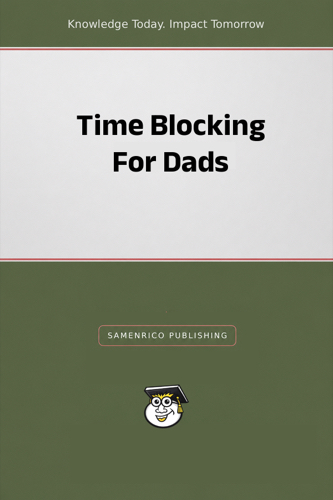
Time Blocking For Dads eBook
Balance work, parenting duties, and personal time
by Place Cathi
Balance work, parenting duties, and personal time without guilt.
Formats
Free sample
Chapter 1: The Unspoken Weight--–- The baby is crying. Not the hungry cry or the tired cry—the I have been abandoned in a dark forest by wolves cry that pierces through noise-canceling headphones, closed doors, and even the dull fog of exhaustion. It is 2:00 AM. You were supposed to take the midnight shift so your partner could sleep. You did.
Mostly. You fed the baby, changed the diaper, and rocked her back to drowsiness. Then you laid her in the crib, tip-toed to the living room, and opened your laptop because that client proposal is due Friday and your boss emailed at 11 PM with “one small change.” Forty-five minutes later, the crying started. And as you walk back to the nursery, your chest tightens. Not from fatigue.
From the weight.You know the weight. Every father reading this knows it. It is not regret for the time you lost. It is not anger at your boss or your baby or your own poor planning. It is something deeper.
It is the quiet, persistent, soul-level certainty that no matter what you are doing, you are failing at something else. You are failing at work because you left early for a doctor’s appointment. You are failing at parenting because you checked your email during bath time. You are failing at your relationship because you fell asleep on the couch again. You are failing at your own health because you cannot remember the last time you ran, or lifted, or sat in silence without a screen.This is the unspoken weight of modern fatherhood.
And this chapter is going to name it, dissect it, and finally—mercifully—release you from it. Because you cannot build a time management system on top of guilt. Guilt is quicksand. The more you struggle, the deeper you sink. Before we talk about calendars, blocks, or productivity, we have to clear the ground.
We have to understand why you feel this way, why it is not your fault, and how a completely different definition of success will change everything.Where the Weight Comes From The weight did not appear overnight. It was assembled, piece by piece, by forces much larger than your household. Let us name three of them.The Provider-Presence Paradox. For most of human history, fathers were judged primarily on one metric: could they feed and protect their family? Being present for bedtime stories was a luxury, not an expectation.
Then, in the last forty years, society added a second metric: fathers must also be emotionally available, playful, gentle, and deeply involved in daily childcare. No one subtracted the first metric. Now you are expected to work like a provider from the 1950s and parent like a idealized mother from a parenting blog. You cannot do both perfectly. The paradox guarantees guilt.The Social Media Highlight Reel.
Your father did not have to watch another dad build a handcrafted wooden play kitchen while running a marathon and writing a novel. You do. Every time you open Instagram or Tik Tok, you are served algorithmically optimized images of fathers who seem to have infinite time, infinite patience, and infinite energy. You know rationally that these are curated moments, not real life. But your lizard brain does not know that.
Your lizard brain sees another dad smiling at a pumpkin patch and thinks, Why are you not smiling at a pumpkin patch? You are failing.The Internalized Voice of Your Own Father. Regardless of how you were raised, you carry a script. Maybe your dad worked 80 hours a week and was never home, and you swore you would be different—so now every hour at work feels like betrayal. Maybe your dad was present but broke, and you swore you would provide financial stability—so now every hour with your kids feels like you are letting them down for the future.
The script says, “A good father does X.” But X changes depending on which ghost you are listening to. And the ghosts never agree.These three forces—the provider-presence paradox, social comparison, and inherited scripts—collude to create a psychological trap. No matter what you do, something whispers that you are doing the wrong thing. That whisper is the unspoken weight.Why Guilt Is a Terrible Time Manager You might think guilt is useful. Guilt, after all, signals that your actions are misaligned with your values.
A little guilt can motivate change. But dad guilt is not a scalpel—it is a sledgehammer. It does not fine-tune behavior. It crushes your ability to think clearly.Here is what guilt actually does to your time management:Guilt encourages multitasking. You feel bad about being at work, so you answer a few family texts during a meeting.
You feel bad about being at home, so you answer a few work emails during dinner. You are not being productive. You are being fractionally present everywhere and fully present nowhere. Research on task-switching shows that bouncing between work and family thoughts can cost up to 40% of your cognitive efficiency. Guilt is not helping you work harder.
Guilt is making you dumber.Guilt steals your rest. Have you ever sat down to watch a movie or play a video game, only to feel a creeping sense that you should be cleaning the garage, exercising, or calling your mother? That is personal guilt. And it does not just make rest unpleasant—it makes rest ineffective. You cannot recharge while feeling guilty.
So you end up “resting” for two hours but gaining zero restoration. Then you wake up tired the next day, perform poorly at work, snap at your kids, and feel more guilty. The cycle accelerates.Guilt destroys decision-making. When you are guilty, you are reactive. You say yes to a last-minute work request because you feel bad about leaving early yesterday.
You agree to coach the soccer team because you feel bad about missing the last game. You buy an expensive toy because you feel bad about being distracted during playtime. Each yes is a vote against your own priorities. Each yes adds more weight. Eventually, your calendar is a monument to guilt-driven decisions, and you have no idea how you got there.The Guilt Audit Exercise Before you can block your time, you need to map your guilt.
For the next seven days, you will conduct a Guilt Audit. This is not a journaling exercise for people who like journaling. This is data collection. You are a scientist studying the behavior of a fascinating specimen: you.Equipment needed: A small notebook, a notes app, or a voice memo on your phone. Anything that is always with you.Protocol: Every time you feel a pang of guilt—not deep existential shame, just that little “ugh” of self-judgment—record three pieces of information:The timestamp.
(e.g., “Tuesday, 6:15 PM”)What you were actually doing. (e.g., “Sitting on the floor building Legos with my son.”)What you felt you should be doing instead. (e.g., “Answering the emails I missed during the afternoon meeting.”)That is it. Do not judge the entries. Do not try to change your behavior.
Just record. At the end of seven days, you will have a log of your guilt triggers.What you will likely…
This is the end of the free sample. Get the eBook to keep going. Buy now
About this book
Details
- Author
- Place Cathi
- Publisher
- SamEnrico
- Language
- English
- Genre
- Non-Fiction, Self-Help, Fatherhood
- Released
- 2026-06-05
- Pages (approx.)
- 130
- Available as
- eBook, Audiobook

Read better in the ZLOADR app
Your eBooks on your phone or tablet. Sign in with your SamEnrico account and start reading.
More by Place Cathi
 OCD Myths DebunkedPlace Cathi$11.99
 Pet Loss For JewsPlace Cathi$11.99
 Sunset Horizon VisualizationPlace Cathi$11.99
 Self Hypnosis for Sleep InductionPlace Cathi$11.99
 Participation Rights AnalysisPlace Cathi$11.99
 The Midwife Critical StressPlace Cathi$11.99
 Script Customization WorkshopPlace Cathi$11.99
 Anger And NeurodivergencePlace Cathi$11.99
 The Jade Emperor's Celestial Bureaucracy: How Myth Shaped China's Cosmic OrderPlace Cathi$11.99
 The Bitten Apple: Steve Jobs and the Birth of the iPod RevolutionPlace Cathi$11.99
 Growing VrieseaPlace Cathi$11.99
 The 101 Handbook: ForestryPlace Cathi$11.99
You may also like
 Father Specific Self CareSkelton Etta$11.99
 Dad Burnout Recovery GuideNeville Adrianne$11.99
 Body Image And Self Esteem For New DadsCounts Jamar$11.99
 Mindfulness Meditation for Dads HandbookCarlos Starla$11.99
 Fatherhood Isolation GuideDouglass Rudolf$11.99
 The Listening Father GuideCarrier Veronika$11.99
 Growth Mindset For New DadsPaige Lawanda$11.99
 Dad Anger Management GuideCloud Violeta$11.99
 Paternal Anger ControlGallo Kennith$11.99
 Parenting Stress Workbook for DadsVelazquez Joeann$11.99
 Fathers And Anger HandbookBlake Willard$11.99
 Assertiveness for New FathersRogers Domingo$11.99