
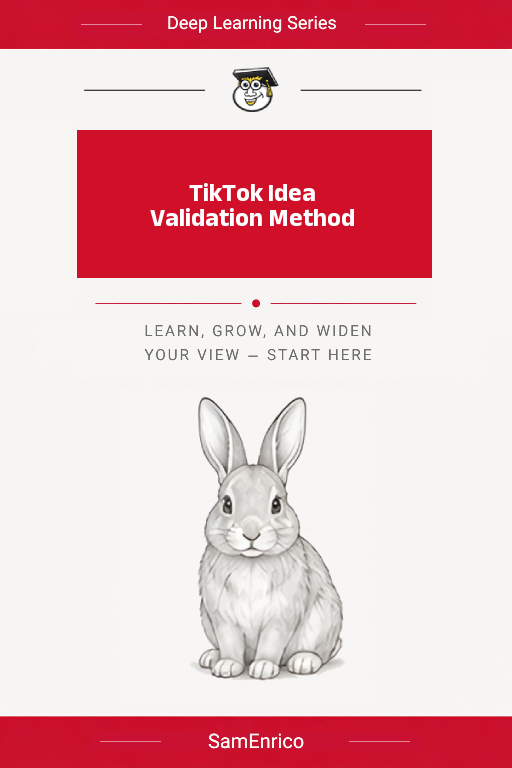
Non-FictionStartup GuideTikTokShort Form
TikTok Idea Validation Method eBook
Post free TikTok videos about your idea concept to
Post free TikTok videos about your idea concept to measure engagement and collect comments from Gen Z.
Formats
Free sample
Chapter 1: The Algorithm Whispers--–- The first time I saw a Tik Tok video with 47 views and 12 “shut up and take my money” comments, I realized everything I thought I knew about market research was wrong.I had spent the previous six years as a product consultant, charging clients 15,000to15,000 to 15,000to50,000 for what I called “comprehensive validation packages.” These packages included focus groups, surveys, competitive analysis, and detailed market reports. I would fly to different cities, rent conference rooms with one-way mirrors, and pay strangers $150 each to sit behind a desk and tell my clients whether they would buy their product.Almost every single one of those focus groups lied to my clients.Not maliciously. Not even consciously. They lied politely. They lied because they were being watched.
They lied because they had been given free coffee and a gift card and felt obligated to be nice. They lied because the person next to them said “that sounds interesting” and humans are social creatures who crave harmony. One focus group participant once told me, off the record while packing her bag, “I wouldn’t actually buy that, but I didn’t want to hurt anyone’s feelings in front of the group.”That conversation cost my client $8,000. The product failed eighteen months later.I stopped trusting traditional validation methods in 2021, not because of some brilliant insight, but because I was humiliated. A nineteen-year-old with a ring light and 200 followers posted a video about a product idea I had spent three months researching.
She used no fancy graphics, no script, no market data. She just looked into her phone camera and said: “Has anyone else thrown away half an avocado every single morning because they only want one half?”Three thousand comments. Four hundred and twenty “yes, every day.” Eighty-seven “I would buy a solution to this immediately.”She built a silicone avocado saver, launched it on Tik Tok Shop four weeks later, and sold fourteen thousand units in her first month. Her total pre-launch investment: a $12 ring light and three hours of her time.That was the moment I understood that the algorithm had become something far more powerful than a content distribution system. It had become a truth-telling machine.
And truth, as it turns out, is the only thing that matters when you are trying to decide whether to build something.The Death of the Polite Lie Every traditional validation method shares a single fatal flaw: they ask people to predict their future behavior. And humans are terrible at predicting their future behavior.Surveys ask “would you buy this?” and people say yes because they want to be helpful, because they like the idea of themselves as early adopters, because the question costs them nothing. Focus groups ask “what do you think of this concept?” and people give opinions that are heavily influenced by the moderator, the group dynamics, and the free pastries. Friends and family are the worst of all. They will tell you your idea is brilliant because they love you and they are terrified of hurting your feelings.I call this phenomenon the Polite Lie Curve.
The closer someone is to you emotionally, the more they will lie to protect your feelings. Your mother will tell you your app idea is genius. Your best friend will say they would absolutely buy your product. Your spouse will nod along as you describe your business plan at 11 PM on a Tuesday. None of these people are lying to be cruel.
They are lying because they care about you.The Polite Lie Curve looks like this:Strangers on the internet → Most honest (they owe you nothing)Acquaintances → Moderately honest (they don't want awkwardness)Friends → Low honesty (they want to be supportive)Family → Lowest honesty (they want to protect you)Paid focus group participants → Artificially inflated (they want to please the moderator)This is why Tik Tok is revolutionary for validation. Tik Tok serves your video to strangers. Not just any strangers—strangers who have been algorithmically selected because their past behavior suggests they might care about your topic. These strangers owe you nothing. They will never see you at a dinner party.
They will never feel awkward running into you at the grocery store. They will scroll past your video in 0.4 seconds if it bores them, and they will tell you exactly why your idea sucks in the comments if it offends them.The algorithm does not have feelings. The algorithm does not care about your feelings. The algorithm simply connects your content to the people most likely to have a reaction to it, and then measures that reaction in milliseconds.How the For You Page Became a Focus Group To understand why Tik Tok works for validation, you have to understand how the For You Page (FYP) algorithm actually works. Most people think Tik Tok shows you what you already like.
That is only half the story.Tik Tok’s algorithm is behavior-based, not demographic-based. It does not care how old you are, where you live, or how much money you make. It cares about what you watch, how long you watch it, what you skip, what you save, what you share, and what you comment on. It cares about the split-second micro-movements of your attention.When you post a validation video, the algorithm does not wait for you to build an audience. It immediately shows your video to a small test group of people—usually 200 to 500 users—whose past behavior suggests they might be interested.
If those users engage (watch longer than average, save, share, comment), the algorithm expands the circle. If they scroll past, the algorithm stops showing your video.This is the opposite of how traditional market research works. Traditional research requires you to find your audience. Tik Tok’s algorithm brings your audience to you. You do not need followers.
You do not need an existing brand. You do not need to buy ads. You just need to create a video that triggers the algorithm’s attention signals.I have seen validation videos from accounts with zero followers get 100,000 views in 24 hours because the algorithm correctly identified the audience. I have seen accounts with 50,000 followers get 200 views because their content did not trigger engagement. Followers do not matter.
The algorithm is a meritocracy of attention.This is what makes Tik Tok the world’s largest, fastest, and cheapest focus group. A traditional focus group costs 5,000to5,000 to 5,000to15,000, takes two to four weeks to schedule, and gives you the opinions of 8 to 12 people in a room. A Tik Tok validation sprint costs $0, takes 7 days, and gives you the behavioral data of thousands or millions of people in their natural environment.Why Gen Z Is the Canary in the Coal Mine You might be thinking: “I am not building a product for Gen Z. My customers are older. Why should I care about Tik Tok?”This is the single most common objection I hear from entrepreneurs, and it reveals a fundamental misunderstanding of how adoption curves work.
Gen Z is not just a demographic. They are the leading indicator for every consumer trend that will hit the mainstream in the next three to five…
This is the end of the free sample. Get the eBook to keep going. Buy now
About this book
Details
- Author
- Chisolm Melda
- Publisher
- SamEnrico
- Language
- English
- Genre
- Non-Fiction, Startup Guide, TikTok, Short Form
- Released
- 2026-05-29
- Pages (approx.)
- 140
- Available as
- eBook, Audiobook

Read better in the ZLOADR app
Your eBooks on your phone or tablet. Sign in with your SamEnrico account and start reading.
More by Chisolm Melda
 Facilitating Creative Sessions ManualChisolm Melda$11.99
 Bodyweight Circuit TrainingChisolm Melda$11.99
 Filipino Nursing Migration TrendsChisolm Melda$11.99
 Gambling Relationship HealingChisolm Melda$11.99
 Relationship Anger Pattern MappingChisolm Melda$11.99
 Silk and Shadows: The Double Life of Mata Hari’s InformantChisolm Melda$11.99
 Codebreaker’s Legacy: The Untold Rise of the First Female Tech TycoonChisolm Melda$11.99
 Tech Sector Buyer ProfilesChisolm Melda$12.99
 Understanding Chromosome 6, Monosomy 6p23Chisolm Melda$17.99
 Procurement AgentChisolm Melda$11.99
 How to Start a Constructional Toy Business (Beginners Guide)Chisolm Melda$11.99
You may also like
 Hong Kong Handover 1997Dunn Johnnie$11.99
 Zumba For Postnatal Recovery CourseNeal Christian$11.99
 Zumba for BeginnersLadner Nikia$11.99
 YouTube Comment Mining GuideHumes Pandora$12.99
 Worry Box MeditationCarlin Rudy$11.99
 Workplace Stress MeditationNguyen Lynn$11.99
 Workplace Stress and Sleep RepairHawley Ivory$11.99
 Workplace Perfectionism CureDelaney Jeffry$11.99
 Workplace Injustice Anger GuideWallen Isabelle$11.99
 Work Addiction and Burnout LinkGreenwood Ester$11.99
 Women in Yoga and WellnessBeattie Galina$11.99
 Women in Stand Up ComedyChun Evangeline$11.99