
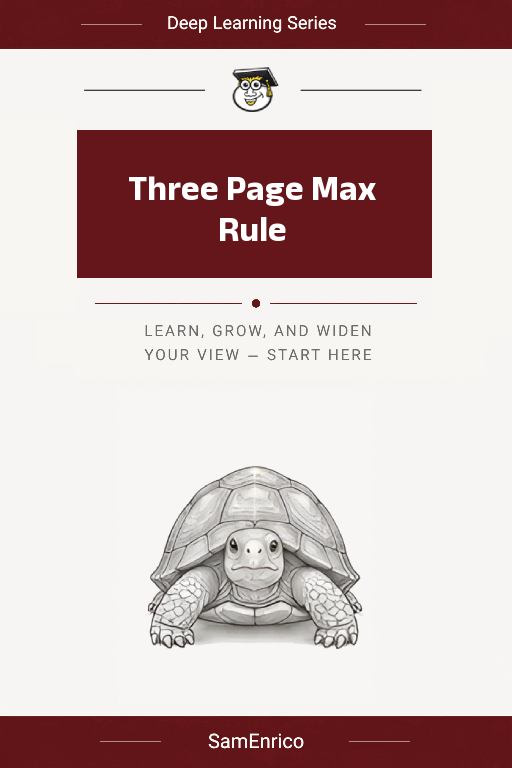
Non-FictionProfessional's Cheat SheetReport LengthBrevity
Three Page Max Rule eBook
Keep board reports to three pages: highlights, met
Keep board reports to three pages: highlights, metrics, and one ask per page.
Formats
Free sample
Chapter 1: The $4 Million Graveyard--–- The email arrived at 11:47 PM on a Friday. Subject line: “Board Pack – Q3 Final.” Attachment size: 18.7 megabytes. Page count: 247. The CFO had been awake for thirty-one hours. The CEO had approved the draft without reading it.
The board chair would open it on Monday morning, forty-five minutes before the meeting, while sipping hotel coffee in a conference room that smelled like stale carpet.No one would read all 247 pages. No one ever did.Yet the company had spent an estimated 387,000onthatsingleboardpack—inexecutivetime,financeteamovertime,boardmemberpreparationhours,andthequiet,unspokencostofdecisionsdelayedornevermade.Multiplythatbyfourquarterlymeetingsandoneannualstrategicoffsite,andthecompanywasburningnearly387,000 on that single board pack—in executive time, finance team overtime, board member preparation hours, and the quiet, unspoken cost of decisions delayed or never made. Multiply that by four quarterly meetings and one annual strategic offsite, and the company was burning nearly 387,000onthatsingleboardpack—inexecutivetime,financeteamovertime,boardmemberpreparationhours,andthequiet,unspokencostofdecisionsdelayedornevermade.Multiplythatbyfourquarterlymeetingsandoneannualstrategicoffsite,andthecompanywasburningnearly2 million per year on a ritual that almost everyone involved secretly despised.This is not an outlier. This is the norm.The Statistic That Should Keep You Up at Night The average board pack in corporate America has ballooned to 226 pages. Not a typo.
Two hundred and twenty-six pages of spreadsheets, Power Point slides, legal disclosures, risk registers, compliance checklists, ESG updates, and enough footnotes to qualify as a doctoral dissertation. The cost of producing and consuming this behemoth? Approximately $4 million annually for a mid-sized public company, according to a 2023 study by the Governance Institute and the Harvard Law School Forum on Corporate Governance.Let that number land. Four million dollars. Per company.
Per year.That is not the cost of good governance. That is the cost of governance theater—a performative ritual where everyone plays their part without anyone asking the obvious question: Is any of this actually working?The answer, according to the same study, is a resounding no. Two-thirds of directors rate their board reports as “weak” or “poor.” Not average. Not “could use improvement.” Weak or poor. The documents that are supposed to enable strategic oversight are failing at their primary job.Directors report that they spend an average of four hours preparing for each board meeting.
Four hours. For a fiduciary role that carries personal liability, that is not preparation—that is negligence dressed up as diligence. But the directors are not the villains here. They are victims of an information architecture that has collapsed under its own weight.The Paradox of More Data, Less Wisdom Here is the cruel irony of the modern board pack. Every additional page you add reduces the probability that the board will remember any of it.
Cognitive science has a name for this: the information overload paradox. When you exceed the brain’s working memory capacity—which is roughly three to five discrete items for most adults—retention and comprehension collapse exponentially, not linearly.A board member who receives fifty pages remembers perhaps 30 percent of the key points. A board member who receives 226 pages remembers less than 10 percent. So you are adding pages and losing insight. You are working harder to achieve worse outcomes.This is not a failure of effort.
It is a failure of design.Consider what actually happens during a typical board meeting. The CEO or CFO walks through a 120-slide deck. Directors flip pages, searching for the numbers that matter. Someone asks a question that was answered on page 143. Someone else asks a question that reveals they never read page 47.
The meeting runs two hours over schedule. Decisions are deferred to “follow-up calls.” The one truly important strategic question—the one that could determine the company’s future—gets squeezed into the last seven minutes.Then everyone flies home, exhausted and vaguely disappointed, having spent thousands of dollars in travel and opportunity cost to achieve what could have been accomplished in a ninety-minute video call with a well-designed three-page document.The Stakeholder Gap That Nobody Talks About Why does this happen? Why do intelligent, experienced, well-intentioned executives continue to produce board packs that they themselves would hate to receive?The answer lies in what I call the Stakeholder Gap—a fundamental confusion about who the board report is for and what it is supposed to accomplish.Management reporting is designed for employees who need operational detail. A production manager needs to know which specific machine went down at 3:47 PM. A sales director needs to know which specific rep missed their quota by how many dollars.
These reports are granular, frequent, and action-oriented. They are designed for people who are in the arena, fighting the daily battles.Board reporting, by contrast, is designed for oversight and governance. Board members are not in the arena. They are in the stands, watching the game, responsible for deciding whether to change the coach, sell the team, or build a new stadium. They do not need to know which machine broke.
They need to know that unplanned downtime has increased by 40 percent over two quarters and that management has a plan to fix it.The Stakeholder Gap is the chasm between “what happened” and “so what.” Most board packs fall into the chasm. They report the activity without the interpretation, the data without the narrative, the past without the future.Here is the test. Look at your most recent board pack. Pick any three numbers. Ask yourself: Does this number allow the board to make a better decision?
If the answer is not an immediate, confident yes, that number is noise. And noise is not harmless. Noise drowns out signal.The Cognitive Cost of Bad Board Packs There is a hidden cost that never appears on any income statement. Call it the cognitive tax. Every hour a board member spends sifting through irrelevant data is an hour they are not thinking about strategy, risk, or competition.
Every question they ask to clarify a confusing metric is a question they are not asking about the company’s long-term viability.I have watched boards spend forty-five minutes debating whether a variance explanation was worded correctly. Forty-five minutes. That is not governance. That is grammar review at a thousand dollars per minute.I have watched CEOs spend three days assembling board packs, only to have the board ask questions that revealed they had read none of it. The CEO returns to the office demoralized, the finance team resents the wasted effort, and the board feels vaguely guilty but cannot articulate why.This is the death spiral of board reporting.
Bad reports lead to bad meetings. Bad meetings lead to low trust. Low trust leads to more reporting—because the board asks for more data to compensate for the lack of clarity. More reporting leads to longer reports. Longer reports lead to worse comprehension.
Worse comprehension leads to lower trust.Repeat until bankruptcy, scandal, or the quiet resignation of everyone involved.The Financial Cost (Beyond the $4 Million)Let me put real numbers on this, not because I enjoy math, but because executives respect what they can measure.A typical board cycle consumes approximately 120 hours of finance team time: gathering data, formatting slides, reconciling inconsistencies, and formatting the final pack. At an average loaded cost of 120perhourforaseniorfinanceprofessional,thatis120 per hour for a senior finance professional, that is 120perhourforaseniorfinanceprofessional,thatis14,400 per cycle. Multiply by five cycles…
This is the end of the free sample. Get the eBook to keep going. Buy now
About this book
Details
- Author
- Edmond Jesenia
- Publisher
- SamEnrico
- Language
- English
- Genre
- Non-Fiction, Professional's Cheat Sheet, Report Length, Brevity
- Released
- 2026-06-01
- Pages (approx.)
- 117
- Available as
- eBook, Audiobook

Read better in the ZLOADR app
Your eBooks on your phone or tablet. Sign in with your SamEnrico account and start reading.
More by Edmond Jesenia
 Strategic Relationship Mapping GuideEdmond Jesenia$11.99
 Loneliness After Trauma HealingEdmond Jesenia$11.99
 Wholesaling Dialer Systems GuideEdmond Jesenia$11.99
 Pedestrian Crossing RageEdmond Jesenia$11.99
 The Robotics Capital ForecastEdmond Jesenia$11.99
 CrossFit Injury Prevention GuideEdmond Jesenia$11.99
 Mentorship for Nonprofit FundraisersEdmond Jesenia$11.99
 Smoky Mountain DisappearancesEdmond Jesenia$11.99
 OCD Breath for Urge SurfingEdmond Jesenia$11.99
 The Lost Tapes of Sun Ra: Cosmic Jazz and the Birth of AfrofuturismEdmond Jesenia$11.99
 Odysseus: The Spy of IthacaEdmond Jesenia$11.99
 The Ballot Hackers: How a Small Town Exposed a Global Cyber ThreatEdmond Jesenia$11.99
You may also like
 Hong Kong Handover 1997Dunn Johnnie$11.99
 Zumba For Postnatal Recovery CourseNeal Christian$11.99
 Zumba for BeginnersLadner Nikia$11.99
 YouTube Comment Mining GuideHumes Pandora$12.99
 Worry Box MeditationCarlin Rudy$11.99
 Workplace Stress MeditationNguyen Lynn$11.99
 Workplace Stress and Sleep RepairHawley Ivory$11.99
 Workplace Perfectionism CureDelaney Jeffry$11.99
 Workplace Injustice Anger GuideWallen Isabelle$11.99
 Work Addiction and Burnout LinkGreenwood Ester$11.99
 Women in Yoga and WellnessBeattie Galina$11.99
 Women in Stand Up ComedyChun Evangeline$11.99