
Non-FictionSelf-HelpPsychotherapy
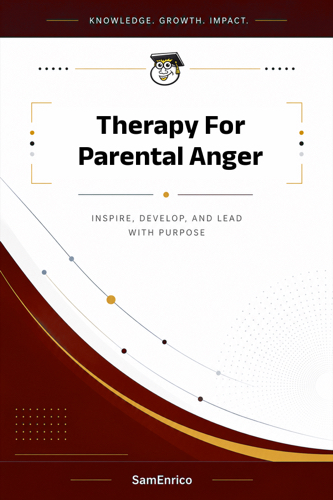
Therapy For Parental Anger eBook
Uses CBT and DBT for chronic rage at children.
Uses CBT and DBT for chronic rage at children.
Formats
Free sample
Chapter 1: The Explosion Autopsy--–- The first time I screamed at my three-year-old until she stopped crying and simply stared at me—not with fear, but with a kind of confused emptiness—I told myself the lie that every rage-prone parent tells: That wasn't me. That was the stress. That was the lack of sleep. That was her fault for pushing every single button I have.It took me three more years to admit the truth: it was me. And the screaming didn't come from nowhere.
It came from a predictable, patterned, almost mechanical sequence of events that I had never stopped to examine. This chapter teaches you how to perform an explosion autopsy—a systematic, non-shaming dissection of what happens in the seconds and minutes before you lose control. You will learn why you explode specifically with your children (not with your boss or a stranger), what the Latent Rage Model reveals about stored frustration, and how to use the CBT ABC Model to identify your personal "hot buttons." By the end, you will understand that your rage is not random. It is a conditioned response. And conditioned responses can be unconditioned.The Great Paradox: Calm at Work, Volcano at Home You are likely reading this book because you have experienced a particular kind of humiliation: the humiliation of being utterly competent everywhere except at home.
Perhaps you run a team at work. Perhaps you are the calm friend that others call in a crisis. Perhaps you have never thrown an object or raised your voice at an adult in fifteen years. And yet, your child—a small person you love more than anything—can reduce you to a screaming, shame-filled version of yourself in under sixty seconds.This is not a sign that you are a bad parent. It is a sign that you have been operating under a misunderstanding of how anger works.Most parenting books assume that anger is a general state: if you learn to manage stress better, you will stop yelling.
But chronic, targeted rage at one's own children is not general stress. It is a relationship-specific phenomenon. Consider this: a rude stranger cuts you off in traffic, and you mutter under your breath and move on. Your toddler whines for thirty seconds about the wrong color cup, and you feel heat rising up your neck. Your teenager rolls their eyes, and you are suddenly screaming about disrespect.
Why? Because intimacy lowers our psychological filters. The more we love someone, the more vulnerable we are to being triggered by them. And the more exhausted we are by the constant demands of parenting, the more that stored frustration leaks out.The Latent Rage Model Imagine a pressure cooker. Every time you suppress frustration—every time you smile through a hard day at work, every time you bite your tongue during an argument with your partner, every time you feel helpless watching your child struggle—the pressure increases.
Most of the time, the lid holds. But your children, because they are always there, because they need you constantly, because they have not yet learned to modulate their own emotions, act as a release valve. The pressure doesn't escape in a controlled stream. It explodes.This is the Latent Rage Model: we store unresolved frustration, exhaustion, and resentment over time. Our children's proximity, vulnerability, and constant demands trigger that stored rage more than any other relationship.
The rage was not caused by the whining or the backtalk. The whining was simply the match that lit a fuel tank you did not know you had been filling.The good news is that once you understand this model, you stop asking the wrong question. The wrong question is: Why does my child make me so angry? The right question is: What specific sequence of events leads from calm to explosion, and where can I interrupt it? That sequence is what we will dissect in this chapter.The Explosion Autopsy: A No-Shame Investigation In medicine, an autopsy is performed not to assign blame but to understand cause of death.
An explosion autopsy does the same for a rage episode. You are not conducting this investigation to prove you are a monster. You are conducting it to prove that your rage is predictable. And what is predictable can be prevented.The tool we will use is the CBT ABC Model, adapted for parent-child interactions. CBT stands for Cognitive Behavioral Therapy, one of the most researched and effective approaches for changing emotional reactions.
The ABC model is deceptively simple:A = Antecedent (the trigger that happens right before you feel the rage)B = Behavior (your internal experience and external reaction—the rage itself)C = Consequence (what happens after—your child's response, your shame, the cleanup)Most parents focus obsessively on B. They replay the explosion over and over: I screamed. I slammed the door. I said something terrible. But the explosion (B) is actually the least useful place to focus.
The real leverage points are A (the trigger) and C (the consequence). Change those, and B changes automatically.Let me walk you through an explosion autopsy using a real example from a parent I worked with (identifying details changed, as with all examples in this book).Case Example: Marcus and the Homework Incident Marcus, a father of a nine-year-old daughter, came to me after throwing a textbook across the room. He was mortified. "I have never thrown anything in my life," he said. "I don't even throw trash without walking to the bin.
But she refused to do her homework for the fourth night in a row, and I just lost it."We performed an explosion autopsy together.Antecedent (A): We broke this down further than Marcus had ever considered. The immediate antecedent was his daughter saying, "I'm not doing it. You can't make me." But the chain of antecedents stretched back: she had refused the previous three nights. He had argued with his wife about whose turn it was to handle homework. He had skipped lunch that day and was hungry.
He had received a critical email from his boss an hour earlier. The "hot button"—the specific trigger that activated the rage—was the phrase "You can't make me." But the vulnerability factors (hunger, accumulated exhaustion from previous nights, marital tension) were what made that button so sensitive.Behavior (B): Marcus described a sequence: a flash of heat in his chest, clenched fists, the thought "She is doing this on purpose to hurt me," then the yell, then the throw. Total time from antecedent to throw: approximately eight seconds.Consequence (C): His daughter cried and ran to her room. Marcus felt immediate shame, then numbness. He did not apologize that night.
The next morning, she was distant. The homework refusal cycle continued, now with added fear.When Marcus looked at this autopsy, he saw something he had never noticed: the rage was not a single event. It was a chain of events, and there were multiple places where the chain could have been broken. He could have eaten lunch. He could have handed off homework duty to his wife when he felt the first flash of heat.
He could have said, "I am too angry to talk about this right now," instead of throwing the book. The…
This is the end of the free sample. Get the eBook to keep going. Buy now
About this book
Details
- Author
- Reilly Marlena
- Publisher
- SamEnrico
- Language
- English
- Genre
- Non-Fiction, Self-Help, Psychotherapy
- Released
- 2026-06-06
- Pages (approx.)
- 144
- Available as
- eBook, Audiobook

Read better in the ZLOADR app
Your eBooks on your phone or tablet. Sign in with your SamEnrico account and start reading.
More by Reilly Marlena
 The NEAT Increase MethodReilly Marlena$11.99
 Bipolar Sleep Management GuideReilly Marlena$11.99
 Sustainability PositioningReilly Marlena$11.99
 Public Speaking for YouTubersReilly Marlena$11.99
 Improv for ParentsReilly Marlena$11.99
 The Infertility Difficult TalkReilly Marlena$11.99
 Gratitude for WorkReilly Marlena$11.99
 Silk and Steel: The Love That Defied the XiongnuReilly Marlena$11.99
 Woodstock '99: The Festival That Almost Burned Down the WorldReilly Marlena$11.99
 How to Become a Aviation Support Equipment RepairerReilly Marlena$11.99
 A Collector's Handbook to the Talbot 45, 65Reilly Marlena$11.99
 Workers Compensation Even for OneReilly Marlena$12.99
You may also like
 Hong Kong Handover 1997Dunn Johnnie$11.99
 Zumba For Postnatal Recovery CourseNeal Christian$11.99
 Zumba for BeginnersLadner Nikia$11.99
 YouTube Comment Mining GuideHumes Pandora$12.99
 Worry Box MeditationCarlin Rudy$11.99
 Workplace Stress MeditationNguyen Lynn$11.99
 Workplace Stress and Sleep RepairHawley Ivory$11.99
 Workplace Perfectionism CureDelaney Jeffry$11.99
 Workplace Injustice Anger GuideWallen Isabelle$11.99
 Work Addiction and Burnout LinkGreenwood Ester$11.99
 Women in Yoga and WellnessBeattie Galina$11.99
 Women in Stand Up ComedyChun Evangeline$11.99