
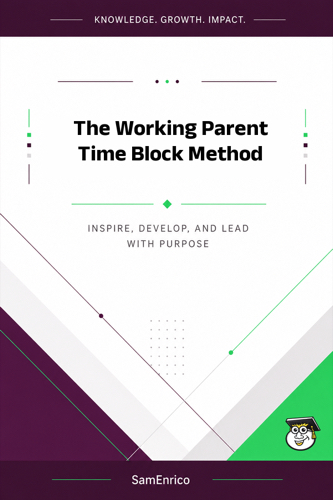
Non-FictionSelf-HelpWork Life Balance
The Working Parent Time Block Method eBook
Shows how to segment work, childcare, and househol
Shows how to segment work, childcare, and household tasks into focused blocks.
Formats
Free sample
Chapter 1: The Fragmented Day--–- I cried over cold macaroni and cheese on a Tuesday at 9:47 PM.Not because the macaroni was tragic. It was fine. Average. Slightly congealed. I cried because it was the first thing I had put in my mouth since 11:00 that morning, and I was eating it standing up over the kitchen sink while the dishwasher hummed and the baby monitor crackled static and my laptop sat open on the counter with seventeen unread emails glowing on the screen.I had been "working" for nine hours.
Nine hours. My calendar showed a full day. I had attended four meetings, replied to twelve emails, drafted two paragraphs of a report, and unloaded the dishwasher twice. I had also changed three diapers, made two snacks, broken up one fight about a red crayon, located a missing left shoe, signed a permission slip while on mute during a Zoom call, and spent twenty-seven minutes searching for the pediatrician's phone number because my toddler had developed a mysterious rash that turned out to be marker.In nine hours, I had accomplished approximately forty-five minutes of actual paid work. The rest was switching.
Switching between contexts. Switching between identities. Switching between the urgent and the important and the merely loud.The cold macaroni was not the problem. The cold macaroni was the symptom.This book is about what I learned after that Tuesday. After I realized that the problem was not my work ethic, my motivation, or my calendar.
The problem was that I was trying to parent and work and manage a household inside a productivity system designed for someone with a stay-at-home partner, a private office, and no one pounding on the door during a budget meeting.The problem was time fragmentation. And the solution—the only solution that actually works for working parents—is not more discipline. It is not waking up earlier. It is not the miraculous four-hour workweek or the perfectly optimized Notion dashboard.The solution is accepting that your day is not a straight line. It is a jagged edge.
And once you stop trying to flatten it, you can start building something that actually works.This chapter is the diagnosis. It will hurt. It will feel like someone has been watching you through your kitchen window. And then it will give you the vocabulary to name what is happening to you—because you cannot fix what you cannot name.The Great Productivity Lie Let me tell you what the productivity industry sold you.They sold you the idea that time is a container. That you have twenty-four hours, and your job is to fill them efficiently.
That interruptions are failures of boundary-setting. That if you just optimized your morning routine, batch-processed your emails, and used the Pomodoro technique correctly, you would achieve the mythical state of "flow" and everything would click into place.This is a lie. It is a beautiful, seductive, deeply privileged lie.The productivity industry was built by people who control their own schedules. People who can close a door. People who do not have a toddler who learned how to open doors.
People whose work does not come with a simultaneous second job called "keeping another human alive."Look at the best-selling productivity books of the past decade. Count how many mention childcare. Count how many include a chapter on what to do when your child wakes up from a nap twenty minutes early. Count how many acknowledge that "deep work" is a hilarious concept when you are also responsible for a creature who has just discovered that throwing a sippy cup creates a very satisfying sound.I am not saying these books are useless. I am saying they were not written for you.
They were written for someone with a partner who handles the invisible load, a house cleaner who comes every two weeks, and the ability to ignore the laundry for three days without the house collapsing into a biohazard.You are not that person. I am not that person. And until we admit that, we will keep failing at productivity systems designed for a life we do not have.The Concept of Fragmented Time Here is what your day actually looks like.You sit down to work at 9:00 AM. You open your laptop. You read an email.
You begin typing a response. At 9:07, your child calls your name. You get up. You solve the problem (water refill, lost toy, mysterious complaint about the "air"). You sit back down at 9:12.
You spend three minutes remembering where you were in the email. You resume typing. At 9:18, your phone buzzes—a Slack message from your boss. You answer it. At 9:22, you return to the email.
At 9:25, the baby wakes up from their nap, thirty minutes early.You repeat this pattern for nine hours. At the end of the day, you have been "working" for nine hours, but your actual focused work time—the time when your brain was engaged in paid labor without interruption—adds up to maybe ninety minutes.That is fragmented time.Fragmented time is not the same as busy time. Busy time feels productive. You are moving, responding, checking boxes. Fragmented time feels exhausting.
You are starting, stopping, restarting, and getting whiplash from the constant switching. The psychological term is "context switching tax"—the cognitive cost of shifting your attention from one task to another. Every time you switch, you lose something. Focus. Momentum.
The thread of your thought.The research on context switching is brutal. Studies suggest that it takes an average of twenty-three minutes to fully return to a task after an interruption. Twenty-three minutes. If you are interrupted every fifteen minutes—which is conservative for a working parent—you never return. You just ricochet from one half-finished task to the next, leaving a trail of open tabs and unresolved thoughts.This is not a personal failing.
This is the architecture of your day. And until you understand that architecture, you will keep blaming yourself for a system that was never designed for your reality.The Invisible Load Inventory Before we go any further, I want you to do something.Get a piece of paper. Or open a note on your phone. Set a timer for two minutes. Write down every single thing you are currently responsible for remembering that is not on a calendar or a to-do list.Do not overthink it.
Just write.I will wait....Welcome back. How many items did you write?If you are a working parent with children under twelve, I would guess you wrote somewhere between twelve and twenty-five items. If you are a single parent, add five to ten more. If you have a child with medical needs or a learning difference, add another handful.Here is what my list looked like when I first did this exercise, on a random Wednesday, with nothing particularly unusual happening:Preschool permission slip due Friday Pediatrician appointment for 2-year-old shots on Monday Order more diapers (we have twelve left)Call back the dentist about my 5-year-old's cavity Schedule the annual HVAC maintenance (they emailed two weeks ago)Buy birthday gift for Saturday party (child from daycare, name unknown)Find the lost library book (it is somewhere under the…
This is the end of the free sample. Get the eBook to keep going. Buy now
About this book
Details
- Author
- Rider Demetria
- Publisher
- SamEnrico
- Language
- English
- Genre
- Non-Fiction, Self-Help, Work Life Balance
- Released
- 2026-06-06
- Pages (approx.)
- 140
- Available as
- eBook, Audiobook

Read better in the ZLOADR app
Your eBooks on your phone or tablet. Sign in with your SamEnrico account and start reading.
More by Rider Demetria
 Kanban for Multiple ProjectsRider Demetria$11.99
 Waitlist And Deferral Stress GuideRider Demetria$11.99
 The Singing VoiceRider Demetria$11.99
 Whole Grain Vegan GuideRider Demetria$11.99
 The Lion and the Rose: The Golden Age of CastileRider Demetria$11.99
 OptometristRider Demetria$11.99
 Understanding Neuropathy Congenital Sensory Neurotrophic KeratitisRider Demetria$17.99
 A Beginners Guide to Fireball Island (Volume 1)Rider Demetria$11.99
 AI Receipt Management for Small BusinessRider Demetria$12.99
 Scholarships for African EntrepreneursRider Demetria$12.99
You may also like
 Hong Kong Handover 1997Dunn Johnnie$11.99
 Zumba For Postnatal Recovery CourseNeal Christian$11.99
 Zumba for BeginnersLadner Nikia$11.99
 YouTube Comment Mining GuideHumes Pandora$12.99
 Worry Box MeditationCarlin Rudy$11.99
 Workplace Stress MeditationNguyen Lynn$11.99
 Workplace Stress and Sleep RepairHawley Ivory$11.99
 Workplace Perfectionism CureDelaney Jeffry$11.99
 Workplace Injustice Anger GuideWallen Isabelle$11.99
 Work Addiction and Burnout LinkGreenwood Ester$11.99
 Women in Yoga and WellnessBeattie Galina$11.99
 Women in Stand Up ComedyChun Evangeline$11.99