
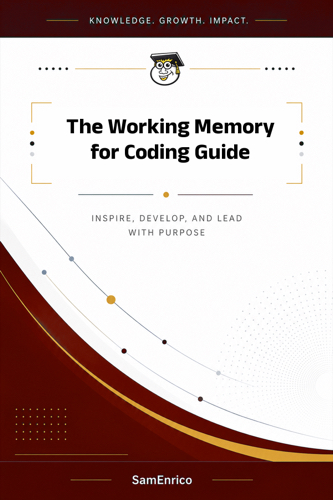
The Working Memory for Coding Guide eBook
Maintains variables and logic flows.
Maintains variables and logic flows.
Formats
Free sample
Chapter 1: The Four-Slot Lie--–- Every programmer has felt it. The cursor blinks at you from line 47. You know the bug is somewhere between line 42 and line 52 – you were just there, you swear – but now you cannot remember what the variable status was supposed to hold. Was it the user's account state or the transaction flag? You scroll up.
You scroll down. You add a console.log. Nothing makes sense. So you start over.This moment – the moment you lose the thread of your own code – is not a sign of inexperience. It is not a memory problem.
It is not burnout, lack of focus, or evidence that you are secretly bad at your job. It is physics.Your brain has a hard limit on how much active information it can hold at once. That limit is approximately four items. Not forty. Not fourteen.
Four. And every time you exceed that limit, your brain silently, predictably, and ruthlessly discards information without asking permission.The myth that "good programmers just hold everything in their heads" is one of the most damaging lies in software development. It makes you feel inadequate for having a normal human brain. It makes you spend hours debugging simple problems that could be solved in minutes. And it prevents you from learning the actual skill of expert programming: not holding more in your head, but designing your code and your process so you do not have to.This chapter reveals the true architecture of your memory systems, the exact limit of your processing capacity, and the hidden costs of switching attention between variables.
By the end, you will understand why you keep losing track of x – and why that is not your fault.The Three Memory Systems You Did Not Know You Had Your brain is not a single storage unit. It is three distinct systems working in parallel, each with different capacities, different purposes, and different failure modes. Understanding these systems is the first step to working with them instead of against them.Long-Term Memory: The Hard Drive Long-term memory stores everything you have learned that does not require active holding. Syntax rules (for loop syntax in Java Script), design patterns (singleton, factory, observer), past experiences ("last time I used recursion here, it caused a stack overflow"), and language keywords all live in long-term memory.The key property of long-term memory is that its capacity is effectively unlimited. You can learn a dozen programming languages, thousands of functions, and millions of lines of code without filling it up.
However, long-term memory is slow to access – retrieving a piece of information takes hundreds of milliseconds, and the retrieval can fail if the memory was not properly encoded in the first place.When you "know" that Python uses indentation for blocks, that knowledge is in long-term memory. You do not need to hold it actively; it is just there when you need it.Working Memory: The RAMWorking memory holds the small set of information you are actively manipulating right now. The three variables in your current function, the two conditions of the if statement you are writing, the return value you are expecting from the function call on line 23 – these live in working memory.The key property of working memory is that its capacity is extremely limited – approximately four items for most adults. And working memory is fragile; if you are interrupted, if you switch to a different task, or if you simply try to hold too many items, information falls out.When you are debugging and you suddenly cannot remember what total was supposed to represent, you have just experienced a working memory failure. You did not forget permanently (the knowledge is still in long-term memory).
You just dropped the active item.The Focus of Attention: The CPU Register The focus of attention is the single operation you are executing right now. The line of code you are reading, the variable you are updating, the comparison you are evaluating – only one thing can be in the focus of attention at any given moment.The key property of the focus of attention is that it is strictly singular. You cannot simultaneously evaluate x > y and z < w. You must evaluate one, then the other, then combine the results. This is not a limitation you can overcome with practice; it is a fundamental property of how attention works.When you switch from thinking about variable x to variable y, you are moving the focus of attention.
That move takes time and energy – and as we will see, it takes more than you think.Why Programmers Confuse These Systems Most programmers have never heard of these three systems. They just know that sometimes they can track complex logic effortlessly, and sometimes they get lost in a three-line function. This inconsistency feels like a personal failing.It is not.When you are working in familiar code, with well-named variables, in a domain you understand, your long-term memory does most of the work. You are not "holding" the syntax in working memory; it is retrieved automatically from long-term memory. Your working memory is free to focus on just the few novel variables and relationships.
This feels easy.When you are working in unfamiliar code, with poorly named variables, in a domain you do not understand, your long-term memory cannot help. You must hold syntax, variable meanings, relationships, and logic branches all in working memory simultaneously. This exceeds your capacity. You get lost. You feel stupid.The difference is not your intelligence.
The difference is how much work your long-term memory is doing.The Magical Number Four – And Why It Is Actually Four In 1956, cognitive psychologist George Miller published one of the most cited papers in psychology: "The Magical Number Seven, Plus or Minus Two." Miller argued that the number of items an average person can hold in working memory is approximately seven.For forty years, this was the accepted wisdom. Then in 2001, Nelson Cowan reanalyzed the data and found a problem. Miller's "seven" counted everything people could recall, including items they had rehearsed or chunked together. When you eliminate rehearsal and chunking – when you measure raw, simultaneous holding capacity – the number drops to approximately four.Further research has refined this to 3-5 items for most adults, with 4 being the most common individual capacity. Some people can hold 3.
Some can hold 5. Very few can hold 6, and almost no one can hold 7 without using strategies like chunking (which we will discuss later).For the rest of this book, we will use "4" as the working number. If your personal limit is 3, the techniques still work – you just have a slightly tighter constraint. If your limit is 5, congratulations, but do not rely on it; fatigue, stress, and interruptions will reduce your effective capacity to 4 or lower.What Counts as One Item?Not everything takes up one slot in working memory. A single variable name (like count) takes one slot.
A single condition (like user.is Active) takes one slot. A single operation (like sum += value) takes one slot.However, chunking allows you to group multiple items into a single slot if they are strongly associated in long-term memory. For example, the three lines of a for loop…
This is the end of the free sample. Get the eBook to keep going. Buy now
About this book
Details
- Author
- Escalante Gabriele
- Publisher
- SamEnrico
- Language
- English
- Genre
- Non-Fiction, Self-Help, Programming
- Released
- 2026-06-09
- Pages (approx.)
- 146
- Available as
- eBook, Audiobook

Read better in the ZLOADR app
Your eBooks on your phone or tablet. Sign in with your SamEnrico account and start reading.
More by Escalante Gabriele
 Treatment Resistant DepressionEscalante Gabriele$11.99
 The Self Care Parent GuideEscalante Gabriele$11.99
 The Kind Foster MotherEscalante Gabriele$11.99
 Sleep Apnea ED LinkEscalante Gabriele$11.99
 Anansi and the Moonlit Vow: A Spider’s Web of Love and DeceitEscalante Gabriele$11.99
 The Breeder's Guide to Red Poll CattleEscalante Gabriele$11.99
 WHOIS Privacy Protection GuideEscalante Gabriele$12.99
 Equity for First CTO GuideEscalante Gabriele$12.99
 Optical Particle Counter TechnicianEscalante Gabriele$11.99
 How to Become a Oven-heater HelperEscalante Gabriele$11.99
You may also like
 Pomodoro for Coding PracticePearson Enrique$11.99
 Growth Mindset In CodingBray Silas$11.99
 Method of Loci For Software CodeStine Alva$11.99
 Coding Syntax CardsElias Rusty$11.99
 Emotional Intelligence for ProgrammersMcneill Shantae$11.99
 Dream Incubation For Coders Programmers WorkbookSalas Cori$11.99
 Coding Syntax PegsHook Ina$11.99
 Anki For Coding SyntaxCoates Carlyn$11.99
 Pattern Recognition in DebuggingGould Ellie$11.99
 Programmer Coding BlocksStanfield Chanda$11.99
 Dream Incubation for Coding BugsKimbrell Wilhelmina$11.99
 Time Blocking for CodersClifford Jann$11.99