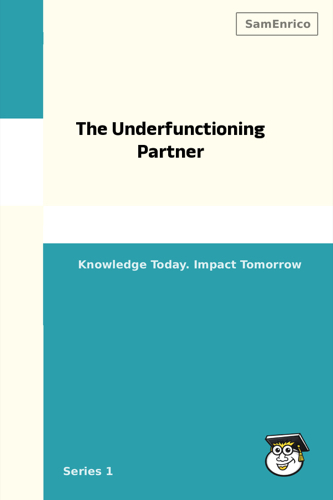
The Underfunctioning Partner eBook
Supports the partner who avoids stress to step up
by Monroe Vania
Supports the partner who avoids stress to step up without shame or blame.
Formats
Free sample
Chapter 1: The Hidden Dance...--Most couples who find themselves trapped in the overfunctioner–underfunctioner pattern do not arrive there because someone is lazy, manipulative, or broken. They arrive there because two people, each trying their best with the tools they have, accidentally build a cage together. The overfunctioner builds the bars out of anxiety and good intentions. The underfunctioner builds the floor out of shame and exhaustion. Neither one notices the door closing until they cannot breathe.If you picked up this book, you likely recognize something of yourself or your partner in that image.
Perhaps you are the one who carries the mental load—tracking bills, scheduling appointments, reminding, nudging, rescuing, and secretly resenting every moment of it. Or perhaps you are the one who feels your chest tighten when your partner asks, "Did you handle that thing I asked about?" You meant to. You wanted to. But something between the intention and the action swallowed the task whole, and now the only thing you feel is the familiar pull of shame and the desperate wish to disappear into your phone, a nap, or anywhere else.Neither of these positions is comfortable. Neither is sustainable.
And yet, millions of couples live inside this dynamic for years, decades, or entire lifetimes—because they do not have a name for what is happening, and they do not have a map out.This chapter gives you both.The Names We Use When We Don't Know What Else to Say Before we can dismantle the trap, we have to name it. The term overfunctioner describes the partner who responds to anxiety by taking on more responsibility—more tasks, more emotional labor, more planning, more worrying. They are the ones who notice the pile of mail before it tips over, who schedule the dentist appointments, who remind their partner three times to call the plumber, and who eventually just call the plumber themselves because it is easier than waiting. Overfunctioners are often praised for being responsible, capable, and dependable. But beneath that praise, they are exhausted, resentful, and secretly terrified that if they stop holding everything together, the entire structure will collapse.The term underfunctioner describes the partner who responds to anxiety by withdrawing from responsibility.
They are not lazy in the conventional sense—most underfunctioners work hard at jobs, hobbies, or other domains where they feel competent. But in the specific arena of shared domestic or emotional responsibility, they freeze, avoid, procrastinate, and wait. They wait for direction, for reminders, for the "right" moment, or for their partner to just do it already. Underfunctioners are often labeled as lazy, immature, or inconsiderate. But beneath that label, they are drowning in shame, convinced that they are fundamentally broken, and desperately wishing they could just make themselves do the thing without the crushing weight of dread.These terms are not diagnoses.
They are not identities. They are descriptions of patterns—reliable, predictable ways that two people respond to stress in relation to each other. And crucially, neither role is fixed. The same person can be an overfunctioner at work and an underfunctioner at home. A person who underfunctions in one relationship may overfunction in another.
These roles are not who you are. They are what you learned to do to survive.Why "Lazy" and "Controlling" Are Lies Let us pause here and say something important: almost everything you have been told about the overfunctioner–underfunctioner dynamic is wrong. Not slightly inaccurate—fundamentally, structurally wrong.The overfunctioner has been told they are "controlling" or "codependent" or "enabling." The underfunctioner has been told they are "lazy" or "irresponsible" or "immature." These labels feel true in moments of frustration. They match the surface-level experience: one partner does too much, the other does too little. But labels like these are what therapists call pathologizing—they turn a relational pattern into a character flaw.
And once you believe you are fundamentally controlling or fundamentally lazy, you stop looking for solutions. You just hate yourself or your partner more quietly.Here is what the research actually shows. Overfunctioning is typically a learned response to early environments where the child had to take on adult responsibilities—managing a parent's emotions, caring for younger siblings, or preventing chaos. These children learned that love is conditional on being useful. They learned that safety comes from being indispensable.
As adults, they cannot stop overfunctioning because stopping triggers the original terror: if I am not fixing everything, I will be abandoned, criticized, or worthless.Underfunctioning is typically a learned response to early environments where the child was criticized no matter what they did, or where their efforts were never enough, or where they were punished for trying and failing. These children learned that trying is dangerous. They learned that safety comes from hiding, waiting, and doing nothing until someone tells them exactly what to do. As adults, they cannot start tasks because starting triggers the original terror: if I try and fail, I will be humiliated, rejected, or confirmed as the failure I already believe I am.Neither of these is laziness. Neither is control for the sake of control.
Both are survival strategies—brilliant, adaptive solutions that kept a child safe in an unsafe environment. The problem is that these strategies do not work in adult partnerships. They create exactly the pain they were designed to avoid.The Dance That Feeds Itself Now let us watch the pattern in motion, because understanding how it unfolds moment by moment is the first step to interrupting it.Imagine a weekday evening. The overfunctioner comes home from work and immediately notices three things: the dishes in the sink, the unopened mail on the counter, and the underfunctioner sitting on the couch scrolling on their phone. The overfunctioner's nervous system shifts into sympathetic activation—the "fight or flight" state.
They feel tightness in their chest, a sense of urgency, and the familiar whisper: If I don't handle this, no one will.So they start doing the dishes. They sigh—not to be passive-aggressive, but because they genuinely cannot contain the physical pressure of the anxiety. The underfunctioner hears the sigh. Their nervous system, already primed for threat, shifts into dorsal vagal activation—the "freeze" state. They feel their limbs go heavy, their thoughts slow down, and the familiar whisper: Here it comes.
I've failed again. I should just stay out of the way.The overfunctioner, sensing the underfunctioner's withdrawal, feels even more alone. They work faster, harder, and more resentfully. The underfunctioner, sensing the overfunctioner's resentment, feels even more convinced that any attempt to help will be criticized or rejected. So they stay frozen.
The overfunctioner finishes the dishes, adds "call the plumber" to their mental list, and goes to bed exhausted. The underfunctioner stays on the couch, hating themselves and wondering why they cannot just be normal.Neither person is the villain. Neither person is trying to hurt the other. And yet, the pattern continues because each person's solution to the anxiety becomes the other person's trigger. The overfunctioner's rescuing triggers the underfunctioner's shame.
The underfunctioner's withdrawal triggers the overfunctioner's abandonment fear. Round and round, night after night, until the couple either breaks up or settles into a…
This is the end of the free sample. Get the eBook to keep going. Buy now
About this book
Details
- Author
- Monroe Vania
- Publisher
- SamEnrico
- Language
- English
- Genre
- Non-Fiction, Self-Help, Avoidance
- Released
- 2026-06-09
- Pages (approx.)
- 131
- Available as
- eBook, Audiobook

Read better in the ZLOADR app
Your eBooks on your phone or tablet. Sign in with your SamEnrico account and start reading.
More by Monroe Vania
 Name Recall for In LawsMonroe Vania$11.99
 Emmylou Harris Wrecking BallMonroe Vania$11.99
 F1 Driver Manager RoleMonroe Vania$11.99
 Time Outs for AngerMonroe Vania$11.99
 Sleep Quality Memory ConnectionMonroe Vania$11.99
 Pregnancy Alcohol DetoxMonroe Vania$11.99
 Group Therapy For Low LiteracyMonroe Vania$11.99
 The Silk and Stone Bridge: How an 18th-Century African Architect Defied the ImpossibleMonroe Vania$11.99
 The Shanghai Express Heist: A Prohibition-Era Hostage CrisisMonroe Vania$11.99
 How to Produce For Kids ProductsMonroe Vania$11.99
 Understanding CraniosynostosisMonroe Vania$11.99
 Argumentative Essay Prompt LibraryMonroe Vania$12.99