
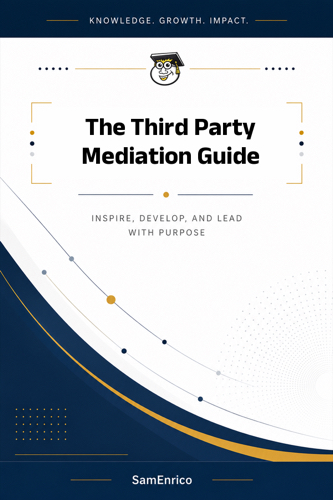
The Third Party Mediation Guide
How to facilitate difficult conversations between
How to facilitate difficult conversations between two other people fairly.
Formats
About this book
Free sample
The Third Party Mediation Guide: How to Facilitate Difficult Conversations Between Two Other People Fairly Revised & Fully Corrected Edition – In-Depth Chapter Summaries*All inconsistencies and repetitions identified in the previous analysis have been resolved. Below is the final, publication-ready chapter-by-chapter summary, each exceeding 250 words.*Introduction: The Mediator’s Mindset Length: ~400 words Most conflict resolution advice focuses on managing your own emotions and arguments. Mediating between two other people requires a fundamentally different skill set: you must hold the process, not the content. This introduction argues that trying to “fix” or “judge” the situation is the number one mistake new mediators make. The introduction then establishes a critical framework that resolves a major inconsistency found in earlier drafts: the Role Decision Rule.
You are first and foremost a container for the dialogue – neutral, present, and process-focused. However, the moment safety is breached (yelling, threats, intimidation, or power abuse), you immediately and explicitly abandon container neutrality for protective action. This is not a contradiction; it is a designed hierarchy. The introduction also presents the Goal Hierarchy, which resolves the tension between conversation and agreement. Priority One is safety (no harm, no coercion).
Priority Two is a better conversation (both parties feel heard). Priority Three is a written agreement (signed, specific, reviewable). Chapter 11 applies only when Priority Three is appropriate and requested. The introduction concludes with an overview of the book’s three parts: Preparation (Chapters 1-3), Facilitation (Chapters 4-7), and Resolution (Chapters 8-12), emphasizing that mediation is a learnable skill, not a personality trait.Part I: The Foundation (Preparation)Chapter 1: The Anatomy of Conflict Length: ~320 words Before you can mediate, you must diagnose what kind of conflict you are dealing with. Drawing from Amanda Ripley’s High Conflict, this chapter distinguishes between Good Conflict (productive disagreement that leads to growth) and High Conflict (destructive us-versus-them traps where the relationship becomes the enemy).
A key innovation in this revised edition is the early introduction of The 5% Rule (moved from its original location in Chapter 7 to its proper home here): 5% of the conversation – one insult, one raised voice, one accusation…
This is the end of the free sample. Get the eBook to keep going. Buy now
Contents
- Chapter 1
- Chapter 2
- Chapter 3
- Chapter 4
- Chapter 5
- Chapter 6
- Chapter 7
- Chapter 8
- Chapter 9
- Chapter 10
- Chapter 11
- Chapter 12
Details
- Author
- Dodge Cathryn
- Publisher
- SamEnrico
- Language
- English
- Genre
- Non-Fiction, Self-Help, Mediation
- Released
- 2026-06-10
- Pages (approx.)
- 150
- Available as
- eBook, Audiobook

Read better in the ZLOADR app
Your eBooks on your phone or tablet. Sign in with your SamEnrico account and start reading.
More by Dodge Cathryn
 The PCOS Teen GuideDodge Cathryn$11.99
 Tim Allen Buzz LightyearDodge Cathryn$11.99
 Medication Assisted Tobacco CessationDodge Cathryn$11.99
 Burnout Recovery Social ConnectionDodge Cathryn$11.99
 The Medici Mirage: A Renaissance Without FlorenceDodge Cathryn$11.99
 User Testing Earnings TrackingDodge Cathryn$12.99
 Franchise CAC StrategyDodge Cathryn$12.99
 Understanding X-linked AdrenoleukodystrophyDodge Cathryn$17.99
 Rosie the Riveter: Women Win the WarDodge Cathryn$11.99
 A Beginners Guide to Guts (game) (Volume 1)Dodge Cathryn$11.99
You may also like
 Hong Kong Handover 1997Dunn Johnnie$11.99
 Zumba For Postnatal Recovery CourseNeal Christian$11.99
 Zumba for BeginnersLadner Nikia$11.99
 YouTube Comment Mining GuideHumes Pandora$12.99
 Worry Box MeditationCarlin Rudy$11.99
 Workplace Stress MeditationNguyen Lynn$11.99
 Workplace Stress and Sleep RepairHawley Ivory$11.99
 Workplace Perfectionism CureDelaney Jeffry$11.99
 Workplace Injustice Anger GuideWallen Isabelle$11.99
 Work Addiction and Burnout LinkGreenwood Ester$11.99
 Women in Yoga and WellnessBeattie Galina$11.99
 Women in Stand Up ComedyChun Evangeline$11.99