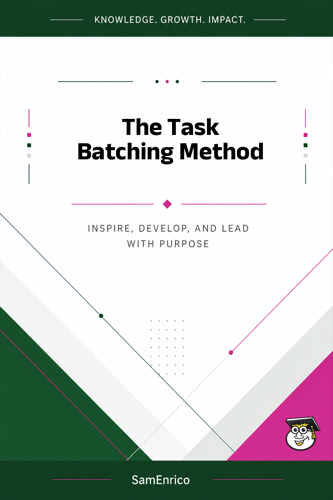
The Task Batching Method eBook
Group similar shallow tasks to protect deep work b
Group similar shallow tasks to protect deep work blocks.
Formats
Free sample
Chapter 1: The Fragmented Mind--You are sitting at your desk. The clock reads 9:17 AM. You have a clear goal for the morning: finish the quarterly report. It is important. It will determine budget approvals for the next three months.
Your reputation is attached to it. You have blocked two hours on your calendar specifically for this task.By 9:22 AM, you have checked your email.By 9:27 AM, you have responded to a Slack message from a colleague asking about a meeting time.By 9:31 AM, you have glanced at your phone because it buzzed. It was a news alert. You do not remember what it said.By 9:38 AM, you have opened the report again, stared at the cursor blinking on an incomplete paragraph, and closed it to check something else.By 9:45 AM, you cannot remember what you were trying to write. You feel a low hum of anxiety.
You are busy. You are stressed. You have typed forty-two words.This is not a story about a lazy worker. This is not a story about poor self-discipline. This is the story of the modern knowledge worker, and it is happening to you, to your colleagues, to your competitors, and to the vast majority of people who sit in front of screens trying to produce valuable work.The problem is not you.
The problem is the architecture of your attention, and the invisible tax that every single task switch extracts from your cognitive bank account.The Discovery That Should Have Changed Everything In the early 2000s, a researcher named Sophie Leroy made a discovery that should have upended the way we think about work. She was studying how people transition between tasks, and she noticed something strange. When people stopped working on one thing to start another, they did not fully disengage from the first task. Something lingered. Something sticky.
Something that dragged down their performance on whatever came next.She called this phenomenon attention residue.Here is how it works. Imagine you are driving a car. You are focused on the road ahead. Then someone calls you. You answer.
You are now driving and talking. You think you are doing both, but your brain is actually switching rapidly between the two tasks. Now imagine you hang up the phone. You are still driving. But for the next several minutes, part of your brain is still processing that conversation.
You are not fully present on the road. You are driving with a shadow.That shadow is attention residue.In her experiments, Leroy asked participants to work on a complex task. Then she interrupted them and asked them to switch to a different complex task. When she measured their performance on the second task, they were significantly worse than a control group who had not been interrupted. Their brains were still partially stuck on the first task.
They could not give the second task their full cognitive capacity.Sophie Leroy, “Why Is It So Hard to Do My Work?” Academy of Management Journal 52, no. 5 (2009): 964–980.This finding was replicated across multiple studies. The more cognitively demanding the first task, the heavier the residue. The more similar the tasks, the greater the interference. And the longer you worked on the first task before being interrupted, the harder it was to let go.Here is what this means for your daily life.
Every time you switch tasks, you do not simply move cleanly from A to B. You drag a portion of A along with you. That dragging consumes mental energy. It slows you down. It makes you more error-prone.
And it prevents you from achieving the state of deep focus where your best work happens.Leroy’s research was published in a top academic journal. It should have been front-page news. Instead, it was read by a handful of organizational psychologists and then buried under the weight of a thousand new productivity apps designed to help you switch even faster.The Twenty-Three Minute Recovery Tax While Leroy was studying the residue of switching, a different team of researchers was measuring its cost.Gloria Mark, a professor at the University of California, Irvine, did something radical. She went into real workplaces, equipped knowledge workers with tracking software and sensors, and watched them work. Not in a lab with artificial tasks.
In their actual offices, with their actual interruptions, their actual email, their actual Slack channels, their actual chaotic Tuesday mornings.What she found was almost unbelievable.The average knowledge worker switched tasks every three minutes and five seconds. That is roughly twenty switches per hour. But the real shock came when Mark measured how long it took to return to full focus after a switch. She found that it took an average of twenty-three minutes and fifteen seconds to get back to the original task at the same level of cognitive engagement.Twenty-three minutes. For a single interruption.Gloria Mark, Victor M.
Gonzalez, and Justin Harris, “No Task Left Behind? Examining the Nature of Fragmented Work,” Proceedings of the SIGCHI Conference on Human Factors in Computing Systems (2005): 321–330.Let me walk you through what this actually means for your day.You are writing that report. A Slack notification appears. You glance at it. You do not even respond.
Just glancing is enough to trigger a switch. Your brain registers the new input. It shifts attention from the report to the notification. Even if you look away immediately, the damage is done.You look back at the report. But you are not the same person who was writing thirty seconds ago.
Your brain is now partially occupied with the Slack message. Who was it from? What did it say? Do you need to respond? This background processing consumes cognitive resources.
Your working memory is diminished. Your focus is shallower.You continue writing, but slower. You re-read the last sentence twice. You lose your train of thought. You check the clock.
You feel a little frustrated. Gradually, over the next twenty-three minutes, the residue of that Slack notification fades. Your cognitive resources return to full capacity. You are finally in the flow again.Then another notification arrives. And the clock resets.Now multiply this by twenty switches per hour.
By one hundred switches per day. By the thousand small fractures that shatter your attention across a week, a month, a year.Mark’s research found that workers who experienced frequent interruptions reported higher stress, lower satisfaction, and significantly lower creative output. They worked more hours but produced less meaningful work. They felt busy but accomplished little.The average knowledge worker loses between two and five hours per day to switching recovery. That is ten to twenty-five hours per week.
That is five hundred to over a thousand hours per year. That is the equivalent of twelve to twenty-five full forty-hour work weeks lost to the space between tasks.You are not tired because you work too hard. You are tired because you switch too often.The Myth You Have Been Sold Here is the lie that has been sold to you by every productivity guru, every tech company, and every workplace culture that values speed over depth. The lie is that multitasking is a skill. That some people are naturally good at it.…
This is the end of the free sample. Get the eBook to keep going. Buy now
About this book
Details
- Author
- Dorris Sharyl
- Publisher
- SamEnrico
- Language
- English
- Genre
- Non-Fiction, Self-Help, Batching
- Released
- 2026-06-07
- Pages (approx.)
- 131
- Available as
- eBook, Audiobook

Read better in the ZLOADR app
Your eBooks on your phone or tablet. Sign in with your SamEnrico account and start reading.
More by Dorris Sharyl
 Parental Stress And Picky EatingDorris Sharyl$11.99
 Fear Of Choking On FoodDorris Sharyl$11.99
 The Empathy for ManipulatorsDorris Sharyl$11.99
 Family Meal Prep CoordinationDorris Sharyl$11.99
 Tennis Mental GameDorris Sharyl$11.99
 TCM Master GuideDorris Sharyl$11.99
 Supply Chain AttacksDorris Sharyl$11.99
 Nefertiti’s Lost Sun: The Pharaoh’s Forgotten HeirDorris Sharyl$11.99
 Hippocrates and the Birth of Medicine: The Greek Legacy of HealingDorris Sharyl$11.99
 How to Produce FertilizersDorris Sharyl$11.99
 Patent Law: Inventions, Prosecution & InfringementDorris Sharyl$11.99
 Pinterest VA Crisis Management PlanDorris Sharyl$12.99