
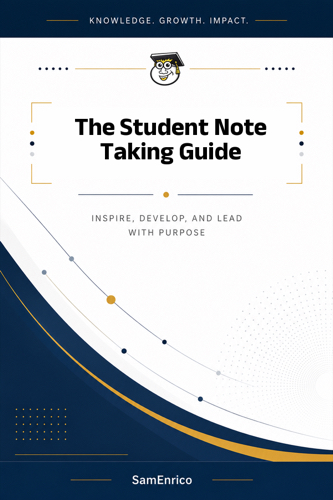
The Student Note Taking Guide eBook
Take effective notes that reduce last minute study
by Scanlon Rema
Take effective notes that reduce last minute study panic.
Formats
Free sample
Chapter 1: The Familiarity Trap--–- You are about to fail your next exam. Not because you are lazy, not because you are stupid, and not because you didn't study. You are going to fail because you have been lying to yourself about what it means to "know" something.This is not an exaggeration. It is a prediction based on decades of cognitive psychology research. Every semester, millions of students walk into exam halls feeling confident.
They have re-read their notes three times. They have highlighted key passages in four different colors. They have watched the lecture recording at 1.5x speed while eating dinner. They have done everything their intuition told them to do. And then they stare at the exam paper and realize they cannot actually answer the question.Their brain recognizes the term.
It feels familiar. But it cannot produce the answer.That gap—between "I have seen this before" and "I can explain this from memory"—is the Familiarity Trap. And until you understand it, no note-taking system in the world will save you.This entire book exists to close that gap. But before we build a better system, we must first demolish the one you are currently using without knowing it. Because the way most students take notes is not merely inefficient.
It is actively harmful. It trains your brain to mistake passive exposure for genuine learning.Let us begin by performing an autopsy on your current study habits. Do not be defensive. Do not make excuses. Every single successful student you admire once made the exact same mistakes.
The difference is that they stopped trusting their intuition and started trusting the science.The Day Everything Changed In 2010, a psychology professor named Jeffrey Karpicke conducted a simple experiment that should have ended the highlighting industry forever.He took two groups of students. Group A studied a passage of text normally. Then they studied it again. And again. Four times total.
By the end, they felt very confident. The text was familiar. They could almost recite it.Group B studied the same passage once. Then they put the text away and tried to write down everything they remembered. Then they studied again.
Then they put it away and wrote again. Four study sessions total, but alternated with retrieval attempts.One week later, Karpicke tested both groups.Group A (the re-readers) remembered about 40 percent of the material.Group B (the retrievers) remembered nearly 80 percent.Double the retention. Same amount of time. Different results.This is not a small difference. This is the difference between a C and an A.
Between passing the NCLEX and failing it. Between getting into graduate school and receiving a rejection letter.Yet almost every student in the world still studies like Group A. They re-read. They highlight. They watch videos.
They passively consume information and call it studying. They are not studying. They are performing the rituals of studying without the substance.The Familiarity Trap is not a character flaw. It is a design flaw in the human brain. Your brain is wired to conserve energy.
When you re-read a sentence you have seen before, your brain recognizes it quickly and gives you a small hit of dopamine—a reward for "knowing" something. But recognition is not recall. Your brain is rewarding you for the wrong behavior.This chapter will teach you to recognize that feeling of false confidence for what it is: a trap. And then it will teach you the first small step out of that trap, which does not require any new technology, any expensive software, or any special talent. It requires only that you stop lying to yourself.Recognition vs.
Recall: The Most Important Distinction You Will Ever Learn Let us perform a small experiment right now.Read this sentence: The hippocampus is the part of the brain responsible for transferring information from short-term memory to long-term memory.Now look away from the page. Do not peek. What did that sentence say?If you are like most people, you remember the word "hippocampus." You might remember something about memory. But can you recite the full sentence? Can you explain in your own words what the hippocampus does?Try again.
This time, close your eyes after reading and say the sentence aloud from memory.Most students cannot do this. They read the sentence, feel that they understand it, and move on. But when tested five minutes later, they remember almost nothing. This is not because they have bad memories. It is because they have never trained the distinction between recognition and recall.Recognition is the ability to identify something you have seen before.
You use recognition when you take a multiple-choice test. The correct answer is right there on the page. You just need to pick it out of a lineup. Recognition feels easy because the answer is provided for you. Your brain does not have to generate anything from scratch.
It just has to match a pattern.Recall is the ability to produce information from memory with no cues. You use recall when you take an essay exam, when you give a presentation, when you solve a problem without looking at the solution, or when a patient asks you a question in a clinical setting. Recall is harder. It requires your brain to reconstruct knowledge from its component parts, like building a house from a pile of lumber rather than recognizing a house from a photograph.Here is the problem: most students study for recognition but are tested on recall.You re-read your notes. You watch the lecture again.
You look over your flashcards with the answers visible. All of these activities train recognition. You are teaching your brain to say "Oh yes, I have seen that term before" rather than "Let me explain that concept from scratch."Then you sit down for the exam, and the question does not say "Which of these four options is the definition of photosynthesis?" It says "Explain photosynthesis in your own words." Or worse, "A plant is placed in a dark closet for one week. What happens and why?"That question requires recall. It requires you to retrieve the concept of photosynthesis, connect it to the concept of cellular respiration, apply it to a novel scenario, and produce an answer.
None of that can be done with recognition alone.The students who perform well on those exams are not the ones who re-read the most times. They are the ones who practice recall. They close the book and test themselves. They teach the material to an imaginary audience. They do not trust the feeling of familiarity.This book will teach you how to build recall practice into your note-taking system from the very first moment you capture information.
But first, you must accept a hard truth: you probably do not know as much as you think you do.The Fluency Illusion: Why Your Brain Lies to You Psychologists have a name for the feeling that you know something when you actually do not. They call it the fluency illusion.The fluency illusion occurs when information feels easy to process. When you read a sentence that is well-written, familiar, or similar to something you have read…
This is the end of the free sample. Get the eBook to keep going. Buy now
About this book
Details
- Author
- Scanlon Rema
- Publisher
- SamEnrico
- Language
- English
- Genre
- Non-Fiction, Self-Help, Notes
- Released
- 2026-06-10
- Pages (approx.)
- 148
- Available as
- eBook, Audiobook

Read better in the ZLOADR app
Your eBooks on your phone or tablet. Sign in with your SamEnrico account and start reading.
More by Scanlon Rema
 The Open Question MasteryScanlon Rema$11.99
 Incubating Solutions For Writer Block CourseScanlon Rema$11.99
 The Email Automation Workflow GuideScanlon Rema$11.99
 DBT For Incarceration ReentryScanlon Rema$11.99
 The Star Charts of the Dogon: Astronomy Before the StarsScanlon Rema$11.99
 Madrid Fees Calculation GuideScanlon Rema$12.99
 Green Retrofit Credit MaximizerScanlon Rema$12.99
 Understanding TeratomaScanlon Rema$17.99
 How to Start a Academic Consultancy Business (Beginners Guide)Scanlon Rema$11.99
 Monetization AnalystScanlon Rema$11.99
You may also like
 Hong Kong Handover 1997Dunn Johnnie$11.99
 Zumba For Postnatal Recovery CourseNeal Christian$11.99
 Zumba for BeginnersLadner Nikia$11.99
 YouTube Comment Mining GuideHumes Pandora$12.99
 Worry Box MeditationCarlin Rudy$11.99
 Workplace Stress MeditationNguyen Lynn$11.99
 Workplace Stress and Sleep RepairHawley Ivory$11.99
 Workplace Perfectionism CureDelaney Jeffry$11.99
 Workplace Injustice Anger GuideWallen Isabelle$11.99
 Work Addiction and Burnout LinkGreenwood Ester$11.99
 Women in Yoga and WellnessBeattie Galina$11.99
 Women in Stand Up ComedyChun Evangeline$11.99