
Non-FictionSelf-HelpVisualization
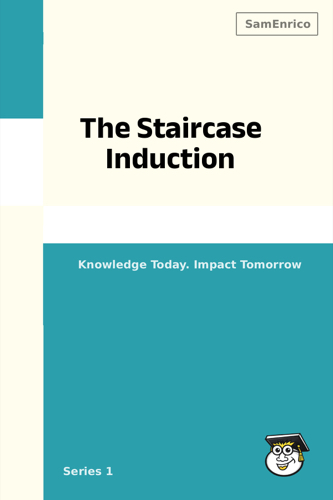
The Staircase Induction eBook
Imagine walking down ten steps, descending deeper
by Ebert Elicia
Imagine walking down ten steps, descending deeper into trance with each step.
Formats
Free sample
Chapter 1: The Architecture of Trance...--–- Hypnosis has a public relations problem. Mention the word in casual conversation, and most people will conjure images of a swinging pocket watch, a stage performer making someone bark like a dog, or a sinister figure whispering “you are getting very sleepy.” These caricatures are not only misleading—they are actively harmful to anyone who wishes to use the mind’s natural abilities for healing, growth, or change. The staircase induction, which you will master through this book, bears almost no resemblance to those theatrical performances. Instead, it draws upon something far more reliable: the way your brain already uses rhythm, expectation, and symbolic movement to shift states of consciousness dozens of times each day without your conscious awareness.Every morning, you drift out of sleep through a series of micro-states—hypnopompic imagery, fleeting dreams, body paralysis giving way to movement. Every evening, you reverse the process, descending through hypnagogic twilight into rest.
These natural transitions follow a pattern: gradual, rhythmic, and deeply embodied. You do not fall asleep by an act of will. You let go. The staircase induction simply amplifies this innate ability, giving it structure, direction, and therapeutic precision.Before we build that staircase, however, we must understand what trance actually is—and what it is not.Defining the Undefinable Hypnosis has been described as a “state of focused absorption with selective attention,” a definition that sounds academic but captures something you already know. Have you ever driven a familiar route and arrived home with no memory of the past ten minutes?
That is a form of trance. Have you ever become so lost in a novel that the room around you disappeared? Trance. Have you ever watched a film so gripping that you gasped, wept, or laughed as if the characters were real? Trance again.In each case, your conscious mind narrowed its focus to a single channel of experience while excluding everything else.
The traffic lights, the room temperature, the creaking of your chair—all faded into irrelevance. Simultaneously, your body responded as if the imagined events were real: heart rate changed, palms sweated, muscles tensed. This is the central mystery of trance, and the staircase induction exploits it ruthlessly. When a subject imagines walking down ten steps, their body reacts as though genuine descent is occurring—muscles relax incrementally, breathing deepens, the parasympathetic nervous system activates. The symbol becomes the experience.The staircase works because it gives the brain exactly what it craves: predictable rhythm, clear spatial mapping, and a sense of safe progression toward a goal.
Counting down from ten to one, by itself, has some effect. Adding the image of descending steps multiplies that effect. Adding sensory details—the coolness of a stone railing, the sound of each footfall, the dimming of lights with each step—transforms a simple relaxation exercise into a profound neurological event.The Critical Factor: Why Your Conscious Mind Steps Aside Every hypnotic induction must solve one problem: the critical factor. This is the part of your conscious mind that evaluates incoming suggestions, compares them to past experience, and either accepts or rejects them. If I tell you that your left hand is becoming lighter than a feather and floating upward, your critical factor immediately objects: “No, it isn’t.
My hand is resting on my lap. I can feel it.” The suggestion fails.The staircase induction bypasses the critical factor not by overpowering it but by distracting it. While your conscious mind is busy counting steps, imagining textures, listening for creaks, and noting the dimming lights, it has no resources left to reject the underlying suggestion of descent and relaxation. This is why the staircase induction works so well for analytical subjects—people who pride themselves on being “unhypnotizable.” Their critical factor is strong, but it can only focus on one thing at a time. Give it ten steps to count, ten sensory details to track, and it happily ignores the fact that trance is occurring.Dave Elman, whose rapid induction methods shaped modern hypnotherapy, understood this principle intuitively.
His famous induction uses rapid counting, eye closure, and hand lowering to overload the conscious mind before it can resist. Milton Erickson, in contrast, used indirect language, metaphors, and confusion techniques to achieve the same bypass. The staircase induction synthesizes both approaches: it has the clear structure of Elman (ten steps, numbered, progressive) with the permissive, sensory-rich invitation of Erickson (“you may notice… perhaps… and when you’re ready…”).The Neurological Orchestra What happens inside the brain during a staircase induction? Neuroimaging studies of hypnosis, though still developing, reveal a consistent pattern. The default mode network—a set of brain regions active during self-referential thinking, mind-wandering, and rumination—begins to quiet down.
The executive control network, centered in the prefrontal cortex, reduces its monitoring activity. Meanwhile, the salience network, which decides what deserves conscious attention, shifts its focus inward.Rhythmic counting triggers the reticular activating system, a brainstem structure that regulates arousal. When you hear a slow, regular count, your RAS begins to synchronize with that rhythm, gradually reducing cortical arousal. This is the same mechanism by which a slow heartbeat or a metronome induces calm. The staircase adds a spatial dimension: the hippocampus, which contains place cells that fire in response to physical location, activates during imagined movement as well.
Your brain literally maps the imaginary staircase as a real environment, complete with a “top” and a “bottom.”The relaxation response, first described by Herbert Benson, involves decreased heart rate, reduced blood pressure, slower breathing, and altered brain wave activity. During deep staircase work, subjects typically shift from beta waves (alert, active) to alpha waves (relaxed, meditative) by step four, then to theta waves (deep relaxation, hypnagogic imagery) by step seven. Step ten, somnambulism, shows a unique pattern: theta persists alongside delta-like slow waves, but the subject remains responsive and aware—a state not found in natural sleep.Symbols Shape Experience The most important principle in this book, and the one that will guide every subsequent chapter, is this: symbols shape experience. A staircase is not just a staircase. It is a symbol of descent, of going inward, of leaving the surface world behind.
Every human culture has used descent metaphors for spiritual and psychological transformation—descending into a cave to receive a vision, climbing down a ladder into the underworld, walking steps into a healing temple. The symbol carries meaning before you add a single word of suggestion.When you tell a subject to walk down ten steps, you are not merely asking them to count backward. You are inviting them into a story that their unconscious mind already understands. Descent means letting go of surface awareness. Descent means moving toward a source of wisdom or healing.
Descent means leaving the noise of the upper world behind. The staircase induction works not because of the words you say but because of the meaning the subject’s own mind attaches to those words.This is why personalization matters. A subject who grew up in a house with a creaky wooden staircase will respond differently than someone who only knows modern concrete stairs with carpet. A subject who once fell down stairs will…
This is the end of the free sample. Get the eBook to keep going. Buy now
About this book
Details
- Author
- Ebert Elicia
- Publisher
- SamEnrico
- Language
- English
- Genre
- Non-Fiction, Self-Help, Visualization
- Released
- 2026-06-06
- Pages (approx.)
- 132
- Available as
- eBook, Audiobook

Read better in the ZLOADR app
Your eBooks on your phone or tablet. Sign in with your SamEnrico account and start reading.
More by Ebert Elicia
 Niche Selection for Upwork SuccessEbert Elicia$11.99
 Low Frustration Tolerance CBTEbert Elicia$11.99
 NamUs Presumptive IdentificationsEbert Elicia$11.99
 The Hero Rescript MethodEbert Elicia$11.99
 Technical Presentation SkillsEbert Elicia$11.99
 Night Sweat GuideEbert Elicia$11.99
 Albanian Jewelry Apprentice To DealerEbert Elicia$11.99
 The Last Breath of Cleopatra: A Funeral Fit for a QueenEbert Elicia$11.99
 The Dragon of the Black Forest: A Knight’s Last OathEbert Elicia$11.99
 How to Produce Non-metallic Mineral DepositEbert Elicia$11.99
 A Collector's Handbook to the Singer Nine RoadsterEbert Elicia$11.99
 Philippines Remote Team Communication ToolsEbert Elicia$12.99
You may also like
 Hong Kong Handover 1997Dunn Johnnie$11.99
 Zumba For Postnatal Recovery CourseNeal Christian$11.99
 Zumba for BeginnersLadner Nikia$11.99
 YouTube Comment Mining GuideHumes Pandora$12.99
 Worry Box MeditationCarlin Rudy$11.99
 Workplace Stress MeditationNguyen Lynn$11.99
 Workplace Stress and Sleep RepairHawley Ivory$11.99
 Workplace Perfectionism CureDelaney Jeffry$11.99
 Workplace Injustice Anger GuideWallen Isabelle$11.99
 Work Addiction and Burnout LinkGreenwood Ester$11.99
 Women in Yoga and WellnessBeattie Galina$11.99
 Women in Stand Up ComedyChun Evangeline$11.99