
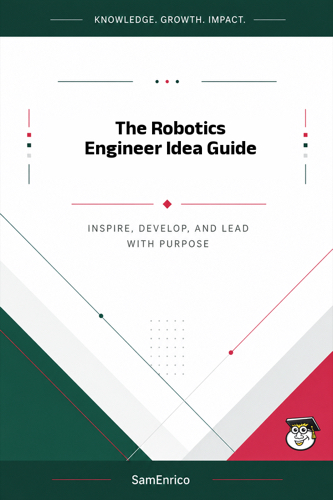
The Robotics Engineer Idea Guide eBook
Design novel robot behaviors using emergent system
Design novel robot behaviors using emergent systems, sensor fusion, and minimalism.
Formats
Free sample
Chapter 1: The Paradox of Complexity--Every failed robot I have ever seen—and I have seen thousands—died from the same cause: overfeeding.Not too little power. Not too few sensors. Not simplistic code. The opposite. Engineers starve robots of simplicity and stuff them with complexity until their computational guts burst.
A cleaning robot that navigates perfectly in a laboratory will spin in confused circles in a living room because someone added a "redundant" sixth ultrasonic sensor that creates conflicting echoes. A drone that flies flawlessly in open air will oscillate itself into a crash the moment it enters a slightly gusty courtyard because its 47 control parameters, each tuned in isolation, begin resonating against each other like a scream in a tiled bathroom. A robotic arm that can sort LEGO bricks by color with 99.9% accuracy will freeze completely when a brick is placed slightly askew because its neural network was never trained on "askew."This is the paradox of complexity that this entire book exists to dismantle: adding more sensors, more code, and more sophisticated algorithms to a robot does not make it more robust. It makes it more brittle.Brittleness is the tendency of a system to fail catastrophically when conditions deviate slightly from expectations. A brittle robot works perfectly right up until the moment it fails completely.
Think of a wine glass: flawless structure, elegant design, instantly shattered by a single unexpected tap. Now think of a sponge: messy, soft, ugly—and almost impossible to break. Minimalist robots are sponges. Maximalist robots are wine glasses. And most robotics engineers are building wine glasses because they have been taught that sophistication equals resilience.They are wrong.The Laboratory Lie Every robotics engineer learns the same painful lesson, usually in graduate school or during their first industry job.
I call it the Laboratory Lie. It goes like this: you spend six months building a robot. You test it in a clean, controlled environment with perfect lighting, flat floors, no obstacles except the ones you intentionally place, and no interference from radio signals or temperature fluctuations or curious pets. The robot performs beautifully. Your advisor or manager is impressed.
You publish a paper or ship a prototype.Then you take the robot outside.Or into a warehouse. Or a hospital corridor. Or someone's living room. And within thirty seconds, your beautiful, sophisticated machine does something so stupid, so inexplicable, so infantile that you want to cry. It drives into a wall and keeps driving.
It detects a shadow as an obstacle and refuses to move. It spins in place until its batteries die. It interprets a sunbeam as a cliff and shuts down in fear.The problem is not that you built a bad robot. The problem is that you built a robot that was too good for the laboratory and therefore too fragile for the world.Real environments are not controlled. They are messy, chaotic, unpredictable, and filled with edge cases that no sensor suite can anticipate.
A hospital corridor has IV poles that move, cables that appear overnight, spilled liquids that reflect light differently than dry floors, and patients in wheelchairs who do not follow any predictable path. A warehouse has shifting pallets, fork lifts that block entire aisles, dust that settles on camera lenses, and lighting that changes dramatically between day shift and night shift. A living room has children's toys that appear and disappear, rugs that slide, sunlight that moves across the floor over hours, and cats that are, as far as any sensor can tell, small furry demons specifically designed to confuse obstacle avoidance algorithms.The robot that survives in these environments is not the robot with the most sensors. It is the robot with the right sensors, arranged in the right way, fused with the right philosophy, and stripped of everything else.The Invention of Negative Engineering Most engineers have been trained in what I call positive engineering. Positive engineering asks: "What can I add to solve this problem?" The robot crashes into walls?
Add a bumper sensor. Still crashes? Add ultrasonic rangefinders. Still crashes? Add a depth camera.
Still crashes? Add a second depth camera for redundancy. Still crashes? Add a machine learning model to predict wall trajectories. Still crashes?
Add more training data. Still crashes? Add a faster processor to run more complex models. Still crashes? Add more sensors.
More code. More complexity.Positive engineering is addictive because each addition produces a short-term improvement. You add a bumper sensor, and the robot stops crashing. You feel smart. You add ultrasonic sensors, and the robot navigates narrow corridors.
You feel even smarter. You add a depth camera, and the robot detects glass walls. You feel like a genius. You publish a paper with a beautiful block diagram showing all your sensors working in harmony.But you have not solved the fundamental problem. You have only postponed it.
Because each new sensor adds new failure modes. The bumper sensor gets stuck in the pressed position. The ultrasonic sensors interfere with each other's signals. The depth camera blinds in direct sunlight. The machine learning model was trained on walls that look like walls and fails on walls painted with murals.
The faster processor generates more heat, requiring a fan, which adds noise, which confuses the microphone you added for voice commands.This is the complexity death spiral. I have seen it destroy million-dollar research projects and hundred-million-dollar commercial products. The spiral has five stages, and once you enter it, escape is almost impossible without starting over from scratch:Stage 1: The Initial Success – Your simple robot works. It has three sensors and 500 lines of code. It completes its task 80% of the time.
You are happy.Stage 2: The Edge Case Hunt – You discover that 20% failure rate is unacceptable. You begin adding sensors and code to handle specific failures. The robot now has six sensors and 2,000 lines of code. It completes its task 90% of the time.Stage 3: The Interaction Nightmare – Your new sensors interact in unexpected ways. The ultrasonic sensor and the infrared sensor conflict.
The camera and the LIDAR disagree. You add a sensor fusion algorithm to resolve conflicts. The robot now has nine sensors and 8,000 lines of code. It completes its task 85% of the time because the fusion algorithm introduces its own failures.Stage 4: The Tuning Trap – You have too many parameters to tune manually. You add an optimization algorithm (often machine learning) to tune them automatically.
The robot now has twelve sensors, 20,000 lines of code, and a neural network with 2 million parameters. It completes its task 95% of the time in the specific environment where it was tuned, and 50% of the time elsewhere.Stage 5: The Brittle Collapse – Your robot encounters an environment slightly different from any in its training data. The neural network hallucinates. The sensor fusion algorithm deadlocks. The robot freezes, crashes, or runs away.
You have no idea why because the system is now too complex to debug. You start over.The alternative is negative engineering. Negative engineering asks a different question: "What can I remove to solve this problem?" The robot crashes into walls? Remove the assumption that walls are static. Still crashes?
Remove the path planning algorithm that requires a map. Still crashes? Remove the global coordinate system that breaks when the…
This is the end of the free sample. Get the eBook to keep going. Buy now
About this book
Details
- Author
- Sanborn Yevette
- Publisher
- SamEnrico
- Language
- English
- Genre
- Non-Fiction, Self-Help, Robotics
- Released
- 2026-06-06
- Pages (approx.)
- 160
- Available as
- eBook, Audiobook

Read better in the ZLOADR app
Your eBooks on your phone or tablet. Sign in with your SamEnrico account and start reading.
More by Sanborn Yevette
 MRI Scan MindfulnessSanborn Yevette$11.99
 Spouse Loss Dreams GuideSanborn Yevette$11.99
 Self Hypnosis For Performance Anxiety GuideSanborn Yevette$11.99
 Ayurvedic Sleep GuideSanborn Yevette$11.99
 Storm Dream ArchetypeSanborn Yevette$11.99
 Loving Kindness for a MicromanagerSanborn Yevette$11.99
 Yakuza in ThailandSanborn Yevette$11.99
 Anki For Literature QuotesSanborn Yevette$11.99
 The Philosophers of the Savannah: Ancient African Naturalists and the Birth of Scientific InquirySanborn Yevette$11.99
 The Czarina’s Secret War: Rasputin, the Romanovs, and the Plot to Save RussiaSanborn Yevette$11.99
 The Complete Guide to the Fast Food DietSanborn Yevette$11.99
 How to Start a Crustacean Freezing Business (Beginners Guide)Sanborn Yevette$11.99
You may also like
 Hong Kong Handover 1997Dunn Johnnie$11.99
 Zumba For Postnatal Recovery CourseNeal Christian$11.99
 Zumba for BeginnersLadner Nikia$11.99
 YouTube Comment Mining GuideHumes Pandora$12.99
 Worry Box MeditationCarlin Rudy$11.99
 Workplace Stress MeditationNguyen Lynn$11.99
 Workplace Stress and Sleep RepairHawley Ivory$11.99
 Workplace Perfectionism CureDelaney Jeffry$11.99
 Workplace Injustice Anger GuideWallen Isabelle$11.99
 Work Addiction and Burnout LinkGreenwood Ester$11.99
 Women in Yoga and WellnessBeattie Galina$11.99
 Women in Stand Up ComedyChun Evangeline$11.99