
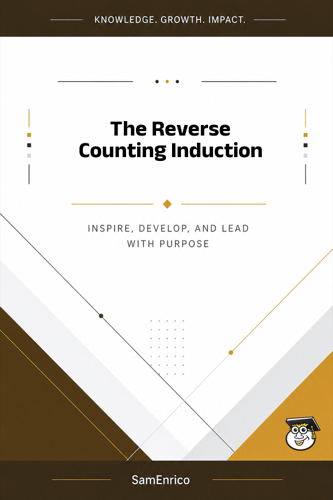
The Reverse Counting Induction Audiobook
Counts backward from 100 while allowing numbers to
Counts backward from 100 while allowing numbers to blur and fade into trance.
Formats
Free sample
Chapter 1: The Predictable Unpredictable...–- The first time I watched a stage hypnotist count backward from ten to one and watched a dozen volunteers slump into what looked like sleep, I assumed the numbers themselves were magic. Ten, nine, eight—each syllable a tiny hammer driving them deeper. But when I tried the same count on myself, lying on my bedroom floor at midnight, nothing happened. I reached one and felt embarrassingly awake. The numbers had been clear, crisp, and perfectly pronounced.
That was the problem.Most people believe that reverse counting works because it is relaxing, or because it is familiar, or because it gives the mind something simple to follow while the body lets go. These are all partly true, but they miss the deeper mechanism entirely. Reverse counting works for the same reason a magician’s patter works: it exploits the brain’s desperate need to predict what comes next, then quietly uses that need against itself. This chapter reveals the dual engine behind every effective countdown—the strange marriage of predictable repetition and strategic surprise—and explains why counting backward from one hundred creates a fractal template that can carry you into states ranging from light relaxation to somnambulistic trance without ever changing the basic structure.The Historical Roots of Counting in Trance Work Long before neuroscience confirmed what hypnotists had observed for centuries, counting was recognized as a reliable pathway to altered consciousness. In the 1840s, Scottish surgeon James Esdaile performed hundreds of painless operations using mesmerism, and his primary induction method was a slow, repetitive count backward from one hundred.
Esdaile noticed that patients who fixated on descending numbers became progressively less responsive to external stimuli, their breathing slowed, and their eyelids grew heavy in a predictable sequence. He could not explain why, but he trusted the pattern.A century later, Milton Erickson transformed clinical hypnosis by demonstrating that counting need not be rigid. Erickson would sometimes count forward, sometimes backward, sometimes skip numbers, sometimes repeat them—always adapting to the subject’s responses. His genius lay in understanding that the structure of counting mattered more than the numbers themselves. The brain, confronted with a predictable descending sequence, begins to habituate.
The same number, repeated in the same rhythm, loses its informational value. And in that loss of value, something unexpected happens: the critical factor relaxes.The critical factor is the mind’s gatekeeper, that part…
This is the end of the free sample. Get the Audiobook to keep going. Buy now
About this book
Details
- Author
- Jacobsen Kala
- Publisher
- SamEnrico
- Language
- English
- Genre
- Non-Fiction, Self-Help, Classical
- Released
- 2026-06-10
- Pages (approx.)
- 151
- Available as
- eBook, Audiobook

Listen in the VoxFlicks app
Audiobooks and audio dramas wherever you go. Sign in with your SamEnrico account and press play.
More by Jacobsen Kala
 Mohammad Reza Pahlavi ExileJacobsen Kala$11.99
 ABCDE for Graduate StudentsJacobsen Kala$11.99
 GAD Parenting With AnxietyJacobsen Kala$11.99
 Executive Pay PositioningJacobsen Kala$11.99
 The Last Empress: The Secret Succession of China's Dowager EmpressJacobsen Kala$11.99
 Tangaroa’s Oath: The Knight of the Pacific TidesJacobsen Kala$11.99
 UX ExecutiveJacobsen Kala$11.99
 Economics Exam Excel Crash CourseJacobsen Kala$12.99
 Artificial Intelligence China Outlook 2030Jacobsen Kala$12.99
 How to Start a Buckets Made of Metal Business (Beginners Guide)Jacobsen Kala$11.99
 Understanding Hairy Cell LeukemiaJacobsen Kala$17.99
You may also like
 Hong Kong Handover 1997Dunn Johnnie$11.99
 Zumba For Postnatal Recovery CourseNeal Christian$11.99
 Zumba for BeginnersLadner Nikia$11.99
 YouTube Comment Mining GuideHumes Pandora$12.99
 Worry Box MeditationCarlin Rudy$11.99
 Workplace Stress MeditationNguyen Lynn$11.99
 Workplace Stress and Sleep RepairHawley Ivory$11.99
 Workplace Perfectionism CureDelaney Jeffry$11.99
 Workplace Injustice Anger GuideWallen Isabelle$11.99
 Work Addiction and Burnout LinkGreenwood Ester$11.99
 Women in Yoga and WellnessBeattie Galina$11.99
 Women in Stand Up ComedyChun Evangeline$11.99