
Non-FictionSelf-HelpReparenting
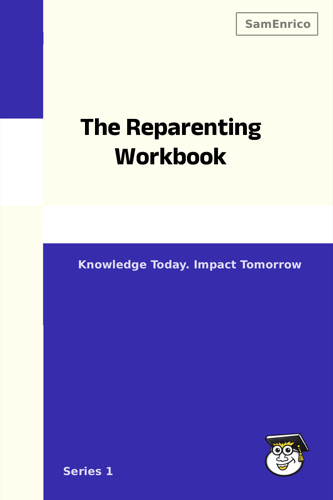
The Reparenting Workbook eBook
Learn to give yourself what you didn't receive as
by Pittman Troy
Learn to give yourself what you didn't receive as a child.
Formats
Free sample
Chapter 1: The Childhood Snapshot...--–- You were a perfectly good child who learned perfectly reasonable strategies to survive an imperfect environment. Those strategies are not your fault. They are also not serving you anymore.The Longing You Mistook for Weakness Let me ask you something you have probably never said out loud, because saying it feels like admitting a shameful secret.Do you ever feel like you are parenting everyone except yourself?Think about your average week. You manage your boss’s emotions so they don’t explode during the Monday meeting. You soothe your partner when they come home stressed.
You anticipate your friends’ needs before they voice them. You keep the household running, the projects on track, the relationships stable. You are the responsible one, the dependable one, the one who holds it together while everyone else falls apart.And at the end of that week, when you finally collapse into bed, there is a quiet voice somewhere in the back of your mind that whispers: “But who is taking care of you?”That whisper is not weakness. That whisper is the truth. And for most of your life, you have probably been told to ignore it.This book exists because that whisper deserves to be heard.The Myth You Were Sold We live in a culture that worships independence.
From a very young age, we are told that growing up means becoming self-sufficient. It means not needing anyone. It means handling your own problems, regulating your own emotions, and showing up as a fully functional adult who has somehow figured out how to reparent themselves without ever being taught how.Here is the lie: “Time heals all wounds.”Here is an even bigger lie: “Everyone had a difficult childhood. Just get over it.”These statements are not just unhelpful. They are actively destructive.
Because time does not heal wounds. Time simply buries them deeper, where they rot and infect everything else. A broken bone does not heal just because you wait long enough. It heals because someone sets it, immobilizes it, and gives it the conditions to grow back stronger. An emotional wound is no different.
Without active intervention, without the right conditions, without someone showing you how to tend to the injury, that wound becomes a permanent part of your operating system. It becomes the lens through which you see every relationship, every challenge, every opportunity.Here is what the research actually shows: childhood emotional neglect and trauma do not disappear with age. They become adult coping mechanisms. The child who learned to be invisible grows into the adult who cannot ask for help. The child who was criticized relentlessly grows into the adult with a savage inner critic.
The child who had to manage an unstable parent grows into the adult who cannot rest because they are always waiting for the other shoe to drop.You did not become this way because you are broken. You became this way because you are adaptable. And your adaptations were genius. When you were small and powerless, you figured out exactly what you needed to do to survive. You became the people-pleaser because keeping everyone happy kept you safe.
You became the perfectionist because never making a mistake meant never getting yelled at. You became the invisible one because being seen was dangerous. These strategies saved you.But they are now costing you everything.A Note Before You Begin This chapter is called “The Childhood Snapshot” because that is exactly what you are about to take: a single, specific, frozen moment from your past. Not a vague story. Not a general impression.
A photograph in words.Before you do that work, however, I need to tell you something important about the inner child you are about to meet.In this chapter, I will use the phrase “your inner child” as if there is only one. That is a simplification for ease of reading. The truth—which we will explore in detail in Chapter 2—is that most people have multiple inner child parts. There may be the five-year-old who was afraid of the dark. There may be the eight-year-old who was humiliated in front of the class.
There may be the twelve-year-old who learned that crying was not allowed. There may be the teenager who was told their dreams were stupid. All of these are different parts, different wounds, different ages, different needs.For now, do not worry about whether you have one or many. Just trust that whatever comes up in this chapter is valid. And know that the age range we will focus on—ages 5 to 12—is a starting point, not a limitation.
If a memory from before age 5 (pre-verbal, body-based) or from adolescence (13 to 18) rises to the surface instead, follow that memory. Reparenting applies to all developmental stages. We will address pre-verbal wounds in Chapter 8 and adolescent patterns in Chapter 9.For now, let us begin where the memories are most accessible.The Three Deficits: What You Needed and Did Not Get Before we can reparent ourselves, we have to understand what was missing. Imagine trying to fill a bucket with holes without knowing where the holes are. You would pour and pour, and the water would keep draining out, and you would feel exhausted and confused, wondering why nothing ever feels like enough.The holes in your emotional bucket fall into three categories.
Almost every childhood emotional wound can be traced back to one of these three deficits:Deficit 1: Lack of Safety Safety is the most fundamental human need. Before a child can learn, explore, or form healthy relationships, they need to know that they are physically and emotionally protected. Safety means:No one will hit, shove, or threaten you.No one will scream at you unpredictably.No one will abandon you or threaten to leave.The adults in charge are stable, not volatile.You are allowed to make mistakes without catastrophe.When a child grows up without safety, their nervous system becomes wired for hypervigilance. They are always scanning for danger. They cannot relax because relaxing is dangerous.
As an adult, this shows up as chronic anxiety, panic attacks, difficulty sleeping, a startle response that never calms down, and a deep, unshakable sense that something bad is about to happen.If this is your primary deficit, you learned to survive by becoming the hyper-aware one. You could read a room in three seconds. You could predict your parent’s mood by the way they closed the refrigerator door. You became an expert at managing other people’s emotions because their dysregulation meant danger for you.Deficit 2: Lack of Validation Validation is the experience of being seen and accepted for who you actually are. It means:Your feelings are acknowledged, not dismissed (“You’re not sad, you’tired”).Your thoughts are taken seriously, not ridiculed.Your preferences matter (“I see you don’t like broccoli.
That’s fine”).Your pain is witnessed (“That must have hurt. I’m sorry”).You are allowed to be a full person, not just a reflection of what your parents wanted.When a child grows up without validation, they learn that their internal world is wrong, inconvenient, or shameful. They stop trusting their own feelings.…
This is the end of the free sample. Get the eBook to keep going. Buy now
About this book
Details
- Author
- Pittman Troy
- Publisher
- SamEnrico
- Language
- English
- Genre
- Non-Fiction, Self-Help, Reparenting
- Released
- 2026-06-11
- Pages (approx.)
- 156
- Available as
- eBook, Audiobook

Read better in the ZLOADR app
Your eBooks on your phone or tablet. Sign in with your SamEnrico account and start reading.
More by Pittman Troy
 Alcoholism and Legal IssuesPittman Troy$11.99
 Dream Council Meeting LogPittman Troy$11.99
 Green Beret Detachment AlphaPittman Troy$11.99
 The Bloodless Conquest: Emperor Wu's Silent War of Diplomacy and DeceptionPittman Troy$11.99
 Store Merchandising AssociatePittman Troy$11.99
 How to Produce Cleaner and DeodorizerPittman Troy$11.99
 Data Security for Global Remote TeamsPittman Troy$12.99
 Ultimate Handbook Guide to Zhengzhou : (China) Travel GuidePittman Troy$11.99
You may also like
 Hong Kong Handover 1997Dunn Johnnie$11.99
 Zumba For Postnatal Recovery CourseNeal Christian$11.99
 Zumba for BeginnersLadner Nikia$11.99
 YouTube Comment Mining GuideHumes Pandora$12.99
 Worry Box MeditationCarlin Rudy$11.99
 Workplace Stress MeditationNguyen Lynn$11.99
 Workplace Stress and Sleep RepairHawley Ivory$11.99
 Workplace Perfectionism CureDelaney Jeffry$11.99
 Workplace Injustice Anger GuideWallen Isabelle$11.99
 Work Addiction and Burnout LinkGreenwood Ester$11.99
 Women in Yoga and WellnessBeattie Galina$11.99
 Women in Stand Up ComedyChun Evangeline$11.99