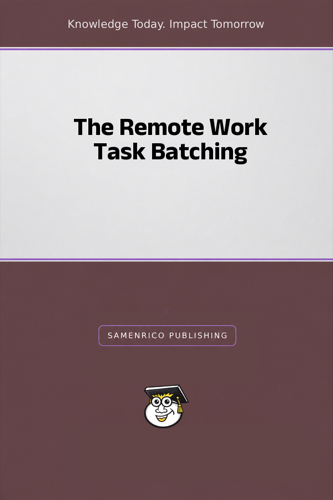
The Remote Work Task Batching eBook
Groups similar activities into themed half days.
Groups similar activities into themed half days.
Formats
Free sample
Chapter 1: The Fragmentation Epidemic--–- Sarah’s cursor blinked at her from an open email she had been trying to answer for forty-seven minutes. In that time, she had also replied to two Slack messages, glanced at a spreadsheet, checked her phone for no reason, opened a news tab, and completely forgotten what the email originally asked. It was 10:14 AM on a Tuesday, and she already felt like she had worked a full day but produced nothing she could point to with pride. Sarah is a senior marketing manager who has worked from home for two years. She closes her laptop at night exhausted but cannot name a single hour of uninterrupted focus.
She is not lazy. She is not disorganized. She is a victim of the fragmentation epidemic.The scene above is not an exception. It is the rule. Across the remote work landscape, millions of professionals wake up, open their laptops, and immediately begin a dance of chaos: Slack here, email there, a spreadsheet in the middle, a quick check of social media, a meeting that could have been an email, then back to Slack, then back to email, then to a document that now feels foreign because the last time they looked at it was seven interruptions ago.
By the time the workday ends, the calendar shows eight hours logged, but the brain feels like it ran a marathon through mud. This is the fragmentation epidemic, and it is quietly destroying the promise of remote work.Remote work was supposed to be liberation—freedom from the commute, control over your environment, the ability to focus deeply without the open-office cacophony of ringing phones and hovering managers. For many, it delivered something else: the dissolution of boundaries, the expectation of constant availability, and a digital leash that never stops tugging. The very tools designed to connect us have become instruments of fracture. We are more reachable and less focused than ever before.
The fragmentation epidemic is the single greatest threat to remote productivity, and it operates silently because we mistake busyness for effectiveness.The Switching Cost You Never Knew You Were Paying Every time you switch from one task to another—from writing a report to answering a Slack message, from analyzing data to checking email—you pay a toll. Cognitive neuroscientists call this the switching cost. It is not a metaphor. It is a measurable, repeatable drain on mental resources that has been documented in dozens of peer-reviewed studies. The most famous of these, conducted by Gloria Mark at the University of California, Irvine, found that it takes an average of twenty-three minutes and fifteen seconds to fully return to a task after an interruption.
Twenty-three minutes. That means if you check your email for ninety seconds and then go back to your report, you are not losing ninety seconds. You are losing nearly half an hour of focused cognitive function.Worse, the switching cost accumulates. A study published in the journal Experimental Psychology showed that participants who switched between two tasks completed them in fifty percent more time than those who completed the same tasks sequentially. Fifty percent.
An eight-hour day of constant switching yields the same output as four hours of focused work. This is not a productivity tip. It is a mathematical reality. The fragmentation epidemic means that most remote workers are effectively giving their employers half of their cognitive capacity for free while feeling completely exhausted at the end of each day.The mechanism behind the switching cost is called goal-activation decay. When you work on a task, your brain activates a specific set of neural pathways—a mental “workspace” that includes the task’s goals, context, tools, and next steps.
When you switch to a different task, that workspace does not disappear. It lingers, consuming mental energy in the background while you try to activate a new workspace for the next task. This lingering is called context residue, a term coined by researcher Sophie Leroy. She found that when people switch tasks under time pressure, the residue of the previous task significantly impairs performance on the new one. You are not multitasking.
You are rapidly switching between half-finished thoughts, leaving a trail of cognitive debris behind you.The remote work environment supercharges context residue because the switching is often involuntary. In an office, interruptions are at least social and often visible—someone walks to your desk, you see them coming, you have a brief transition. At home, interruptions come from a flashing icon in your dock, a buzz from your pocket, a notification that slides into the corner of your screen. These micro-interruptions are insidious because they seem harmless. You glance at a Slack message for three seconds and look back at your work.
Three seconds, you think. No big deal. But the research says otherwise. That three-second glance triggers a partial context switch, leaving residue that takes minutes to clear. Over a hundred such glances in a day, you have lost hours.The Myth of the Always-On Professional Remote work has birthed a toxic mythology: that responsiveness equals reliability, that speed equals skill, that the best worker is the one who replies fastest.
This is the myth of the always-on professional, and it is a lie sold by the very tools that profit from your fragmentation. Slack, email, Teams, and their ilk have designed notification systems that prey on the brain’s reward pathways. Every buzz, every badge icon, every unread count triggers a small dopamine release—the same chemical involved in gambling addiction. You are not being productive. You are being conditioned.Consider the language we have adopted.
“I’ll ping you.” “Just looping you in.” “Circling back.” “Touch base.” These are not neutral phrases. They are the vocabulary of interruption dressed up as collaboration. The always-on professional wears their responsiveness like a badge of honor: “I reply to emails within five minutes.” “I never let a Slack message go unanswered for more than an hour.” “I’m always available.” What these professionals do not realize is that they are also always unavailable. Available for others. Unavailable for themselves.
Unavailable for deep thought, creative problem-solving, strategic planning, or any activity that requires sustained attention.The irony is that the analog office of the past—the one we romanticize as inefficient—actually had natural batching baked into its rhythms. Consider the typical office worker in 1995. They arrived at work, hung up their coat, walked to the mailroom, collected their physical inbox, and spent the first thirty minutes of the day opening envelopes and sorting paper. That was a batch. Then they attended a morning meeting.
That was a batch. Then they worked at their desk for two hours without interruption because no one could reach them except by walking across the office, which required effort. That was a batch. Then lunch. Then an afternoon of focused work or phone calls, which were scheduled and discrete.
The structure of the physical office imposed thematic blocks whether the worker intended them or not.Remote work removed those structures without replacing them. Now you check email at 7:15 AM from your phone while still in bed. You answer Slack at 8:00 AM while eating breakfast.…
This is the end of the free sample. Get the eBook to keep going. Buy now
About this book
Details
- Author
- Fournier Charmaine
- Publisher
- SamEnrico
- Language
- English
- Genre
- Non-Fiction, Self-Help, Batching
- Released
- 2026-06-08
- Pages (approx.)
- 157
- Available as
- eBook, Audiobook

Read better in the ZLOADR app
Your eBooks on your phone or tablet. Sign in with your SamEnrico account and start reading.
More by Fournier Charmaine
 Plant Based Liver Health HandbookFournier Charmaine$11.99
 Email Signature GuideFournier Charmaine$11.99Email Signature GuideFournier Charmaine$11.99
 The Pre-Sleep Relaxation StretchFournier Charmaine$11.99
 Chester Arthur Unexpected ReformerFournier Charmaine$11.99
 The Lost Pharaoh's Secret: Decoding the Rosetta Stone's Hidden CluesFournier Charmaine$11.99
 How to Become a Spiral-machine OperatorFournier Charmaine$11.99
 Amazonite (Variety of Microcline) MiningFournier Charmaine$11.99
 Sales Scripts for AgenciesFournier Charmaine$12.99
 Canada Clean Energy IncentivesFournier Charmaine$12.99
 Understanding Cutaneous Photosensitivity Colitis LethalFournier Charmaine$17.99