
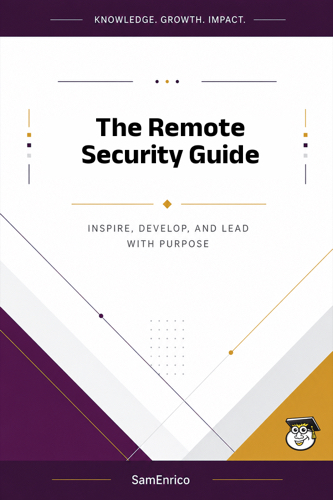
The Remote Security Guide eBook
Protect company data when everyone works from home
Protect company data when everyone works from home networks.
Formats
Free sample
Chapter 1: The Perimeter Illusion...–- It was 2:00 AM when my phone buzzed with an alert that would change how I thought about security forever.The alert read: “Possible data exfiltration – 47GB – source IP: residential.” I was the on-call incident responder for a regional bank, and my first thought was that someone’s teenager was streaming movies on a work laptop. My second thought, as I dug deeper, was that we had a much bigger problem.The laptop belonged to a senior accountant named Margaret. She had worked for the bank for twenty-two years, had never had a security incident, and was considered one of the most trustworthy employees in the finance department. She was also working from her home in a suburb outside Portland, Oregon, where she lived with her husband and two college-aged children who were home for the summer.What I discovered over the next six hours still keeps me up at night. The attacker hadn’t broken into our corporate network.
They hadn’t sent Margaret a phishing email. They hadn’t exploited a vulnerability in our VPN. Instead, they had compromised her husband’s smart TV—a cheap, unpatched device he bought on Amazon—and used it as a launching pad to intercept her VPN traffic. They watched her type her password. They waited until she connected to the bank’s systems.
And then they spent three weeks quietly extracting customer account details, internal reports, and board meeting minutes.The breach cost the bank $7 million in remediation, legal settlements, and lost customer trust. Margaret was devastated. She asked me, through tears, “What did I do wrong?”I told her the truth: “Nothing. You did nothing wrong. The security model failed you.”That was the moment I realized that most organizations are defending a perimeter that no longer exists.
They are building castles in the air, spending millions on firewalls and intrusion detection systems, while ignoring the simple, painful truth: the office is no longer the center of work. The home is. And we have almost no control over what happens there.The Myth That Refuses to Die Let me name the myth explicitly: “The corporate network is a safe space, and anything outside it is dangerous.”This myth is the foundation of what security professionals call “perimeter-based security” or the “castle-and-moat” model. For decades, it made sense. Employees worked inside physical buildings.
The building had walls, locks, and guards. The network inside those walls had firewalls, access controls, and monitoring. If you were inside the building and on the corporate network, you were trusted. If you were outside, you were suspect.The problem is that this model stopped working the moment employees started working from home. But like a ghost that refuses to leave, the myth persists.
I still see it in boardroom presentations, in security RFPs, and in the way organizations allocate their budgets. They spend 80% of their security dollars defending a perimeter that now contains less than 20% of their workforce.Here is the data point that should terrify every CEO: According to a 2024 industry survey, the average organization now has over 60% of its employees working remotely at least part-time. Yet the average organization still spends only 12% of its security budget on remote-specific controls. That is a recipe for disaster.The gap between where work happens and where security is focused has never been wider. And attackers know it.The Three Breaches That Changed My Mind Before I started researching this book, I believed that home networks were a manageable risk.
I thought that with good policies, strong endpoint protection, and employee training, organizations could safely support remote work. I was wrong. Let me tell you about three breaches that changed my thinking.The Baby Monitor Breach (2021)A software development company with 300 employees had a robust remote work policy. Employees received company-managed laptops with full-disk encryption and endpoint detection. The company required VPNs for all sensitive access.
They ran phishing simulations every quarter. By most measures, they were ahead of the curve.The breach began in a product manager’s home. His wife had set up a smart baby monitor in their newborn’s room. The monitor, a budget brand, had a known vulnerability that allowed remote access to its camera and, more dangerously, its network configuration. The attacker scanned for vulnerable Io T devices, found the monitor, and compromised it.
From there, they discovered the product manager’s laptop on the same network and used a technique called ARP spoofing to intercept his traffic. They captured his VPN credentials when he connected to the corporate network.The attacker spent six months inside the company’s systems, stealing source code for their flagship product. The company only discovered the breach when the source code appeared on a hacking forum.The lesson? A baby monitor—a device designed to keep a child safe—became the attack vector for a multi-million dollar IP theft. And no amount of employee training could have prevented it.The Smart Lightbulb Incident (2022)A marketing agency in Chicago allowed employees to work remotely full-time.
One employee, a creative director, was an early adopter of smart home technology. His apartment had smart lightbulbs, smart plugs, a smart thermostat, and a voice assistant. He thought he was living in the future. He was actually living in a security nightmare.An attacker compromised a smart lightbulb—yes, a lightbulb—through a vulnerability in its Bluetooth pairing protocol. The lightbulb became a node on the home network, and the attacker used it to scan for other devices.
They found the creative director’s work laptop and, because he had saved his passwords in his browser, accessed his corporate cloud storage. They downloaded client presentations, campaign strategies, and financial forecasts.The agency’s clients included several Fortune 500 companies. When news of the breach broke, two clients terminated their contracts immediately. The agency went out of business within a year.The lesson? When a lightbulb can bring down a company, the perimeter is officially meaningless.The Teenager’s Gaming PC (2023)A healthcare technology company had what they believed was the gold standard of remote security.
They used Zero Trust architecture, required hardware security keys for authentication, and had 24/7 security monitoring. They had never been breached.Then an executive’s teenage son downloaded a game cheat from a shady forum. The cheat contained malware that infected the son’s gaming PC. The gaming PC shared the home network with the executive’s work laptop. The malware scanned the network, found the work laptop, and attempted to exploit a known vulnerability in its Bluetooth stack.
The exploit succeeded, giving the attacker access to the laptop even though it had endpoint protection.The attacker didn’t need the executive’s credentials because they had direct access to the laptop. From there, they moved to the corporate network, bypassing the Zero Trust controls that assumed the laptop itself was trustworthy.The breach exposed 200,000 patient records and resulted in a $5 million HIPAA fine.The lesson? Your employee’s family members are not your employees. Their devices are not your devices. But they can still destroy your company.Why Home Networks Are Perfect Attack Vectors After reading those case studies, you might be wondering: what makes home networks so…
This is the end of the free sample. Get the eBook to keep going. Buy now
About this book
Details
- Author
- Jaynes Alphonso
- Publisher
- SamEnrico
- Language
- English
- Genre
- Non-Fiction, Business Brief, Security
- Released
- 2026-06-06
- Pages (approx.)
- 147
- Available as
- eBook, Audiobook

Read better in the ZLOADR app
Your eBooks on your phone or tablet. Sign in with your SamEnrico account and start reading.
More by Jaynes Alphonso
 Brokerage Trade Settlement GuideJaynes Alphonso$11.99Brokerage Trade Settlement GuideJaynes Alphonso$11.99
 Scalp Micropigmentation GuideJaynes Alphonso$11.99
 Toddler CPR ModificationJaynes Alphonso$11.99
 The Shadow of the Lion: The Copycat Murders Inspired by Chaka ZuluJaynes Alphonso$11.99
 How to Produce Blood Glucose Meter AccessoriesJaynes Alphonso$11.99
 SA Business Credit BuilderJaynes Alphonso$12.99
 AWS Solutions ArchitectJaynes Alphonso$11.99
 10 Ways to Use Glucose-fructose (Recipe Book)Jaynes Alphonso$11.99
You may also like
 Email Phishing Awareness GuideWicker Rosina$11.99
 Lagos Security PlanningStockton Ward$11.99
 Security Team Alert FatigueEnnis Lily$11.99
 Hybrid Team Data SecurityCary Mozell$11.99
 Security Services Government ContractsHulsey Margrett$12.99
 Lagos Pop Up Security PlanningDubois Lezlie$12.99
 Freemium Security for Low BandwidthMcintyre Shaunte$12.99
 Security for Temporary StoresApplegate Pok$12.99
 Pop Up Loss Prevention GuideTurk Gracia$12.99
 Open Banking Security Best PracticesNewell Corinna$12.99
 Lagos Security Planning GuideWaldron Kami$12.99
 BPO Data Security GuideCathey Christopher$12.99