
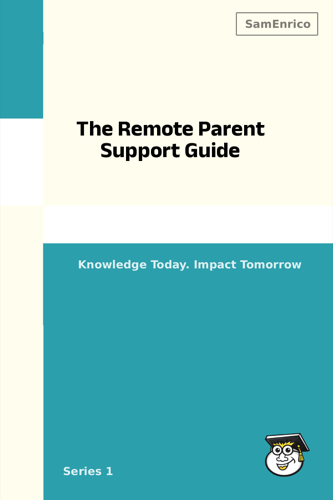
Non-FictionBusiness BriefParents
The Remote Parent Support Guide eBook
Help working parents succeed in distributed enviro
by Mims Sandi
Help working parents succeed in distributed environments.
Formats
Free sample
Chapter 1: The Collision Course--–- You are about to read something that no one tells working parents. Not your boss. Not your spouse. Not your own exhausted mother who somehow “made it work” in the 1990s with a corded phone and a commute. Here it is: The idea that you can be fully present at work and fully present at home in the same twenty-four-hour cycle is not just difficult.
It is structurally impossible. And the harder you try, the more you will suffer.This is not a confession of failure. It is a statement of physics.You are one human being. You have one brain. One attention span.
One pool of patience that drains whether you are on a Zoom call or wiping peanut butter off a toddler’s forehead. For decades, the physical separation between office and home created the illusion that these two versions of you could coexist without collision. You left work at work. You came home to home. The commute was not wasted time—it was a decompression chamber, a ritual boundary that allowed you to shed one identity before putting on the other.That commute is gone.
The boundary is gone. And most working parents are still trying to live as if it exists.This chapter is about why you feel like you are failing even when you are working harder than ever. It is about the macroeconomic shift that stole your separation without asking permission. And it is about the first, most important distinction you will make in this book: the difference between healthy integration and destructive collision. By the end of this chapter, you will have a clear diagnostic of where you currently stand—and a roadmap for the rest of the book to build something better.The Great Unraveling of the Nine-to-Five Let us begin with a truth that feels obvious but is rarely stated aloud: The traditional workday was designed for a world where someone else was watching the children.
The nine-to-five assumed a stay-at-home parent, a nearby grandparent, or at least a neighbor who could collect your kid from the bus stop. That world has not existed for most families since the 1980s, yet the architecture of work barely changed. We simply added more coffee and more guilt.Then the pandemic arrived.Between March 2020 and June 2022, the percentage of employed parents working from home tripled in most developed economies. In the United States alone, the number of remote workers jumped from roughly six percent to nearly fifty percent within eight weeks. What was supposed to be a temporary emergency measure became, for millions of families, a permanent reconfiguration of daily life.
Companies realized they could save money on office space. Employees realized they could reclaim two hours of commute time. And everyone collectively ignored the screaming elephant in the room: children still needed care, schools still closed unexpectedly, and no one had designed a home for two full-time jobs and a full-time childhood.The term “work-life balance” died somewhere between the third Zoom meeting and the fourth diaper change.What replaced it is something researchers now call Collective Home-Based Working—a polite academic phrase for a profoundly chaotic reality. Collective Home-Based Working means that multiple family members (two parents working, one or two children remote schooling, perhaps a grandparent video-calling for help) are all occupying the same finite space, competing for the same finite resources: bandwidth (internet and mental), attention (focused and divided), and patience (the invisible currency that runs out precisely when you need it most).Here is what the data shows about families who live this reality every day. According to a 2023 study published in the Journal of Applied Psychology, working parents in distributed environments report 47 percent higher emotional exhaustion than their childless colleagues.
They are three times more likely to consider quitting their jobs. And they experience what psychologists call “role blurring” at nearly double the rate of remote workers without children. Role blurring is the technical term for not knowing whether you are a parent or an employee at any given moment—and the constant, grinding exhaustion of trying to be both at the same time.You have felt this. You know this.The Myth of the Closed Laptop Before we go further, we need to kill a myth. It is the myth of the closed laptop.The myth says: If you set clear hours—say, nine to five—and close your laptop at five o’clock sharp, you can have separation.
Just turn it off. Just walk away. Just be present with your family.This advice is not wrong. It is simply irrelevant to the reality of most working parents. Because the laptop is not the problem.
The problem is what happens inside your head after you close it.Let me give you an example. You finish a tense meeting at 4:55 PM. Your boss implied that your last report was inadequate. You spent the entire call suppressing the sound of your six-year-old practicing the recorder in the next room. You close the laptop at 5:00 PM exactly.
You walk into the kitchen. Your child asks for help with math homework. And you feel it—a hot, low-grade rage that has nothing to do with the homework and everything to do with the meeting you just left. You are not angry at your child. You are still at work.
Your brain has not arrived.That is role blurring. That is the absence of boundary transitions. And no amount of laptop-closing discipline will fix it unless you address what happens in the minutes between roles.The pandemic generation of working parents has become expert at physical separation rituals—closing the laptop, silencing notifications, leaving the home office. But psychological separation is a different muscle entirely, and most of us have let it atrophy. We have confused “being home” with “being done.” We have confused “off the clock” with “off the hook.” And we are paying the price in bedtime stories ruined by intrusive thoughts about quarterly reports and dinner conversations hijacked by unspoken resentment about the afternoon’s interruptions.The Collision vs.
Integration Framework Here is the central distinction that will guide this entire book.Most working parents live in a state of collision. Collision is what happens when work and family responsibilities compete for the same moment of time, and neither wins cleanly. In collision, you are answering emails while spooning oatmeal into a toddler’s mouth. You are on a client call while your child signs “hungry” from the doorway. You are lying awake at 2 AM mentally reorganizing the family calendar while also reviewing tomorrow’s presentation.
Collision feels like chaos. It feels like failure. And it feels like everyone else has figured out something you have not.But collision is not your fault. Collision is the natural result of trying to pour two gallons of responsibility into a one-gallon container. The only way to avoid collision—truly avoid it—would be to have fewer responsibilities.
That is not an option for most readers of this book. So we need a different goal.That goal is integration.Integration is not balance. Balance implies equal weight, equal time, equal attention. Integration is something messier and more honest. Integration…
This is the end of the free sample. Get the eBook to keep going. Buy now
About this book
Details
- Author
- Mims Sandi
- Publisher
- SamEnrico
- Language
- English
- Genre
- Non-Fiction, Business Brief, Parents
- Released
- 2026-06-09
- Pages (approx.)
- 108
- Available as
- eBook, Audiobook

Read better in the ZLOADR app
Your eBooks on your phone or tablet. Sign in with your SamEnrico account and start reading.
More by Mims Sandi
 Sicily Invasion ParatrooperMims Sandi$11.99
 Hair Loss and Steroid UseMims Sandi$11.99
 Stress Management for New ParentsMims Sandi$11.99
 The Devil’s Mark: The Last Witch Trial of Victorian EnglandMims Sandi$11.99
 How to Produce Body and Hair GlitterMims Sandi$11.99
 Business Systems ManagerMims Sandi$11.99
 Cultural Adaptation at ScaleMims Sandi$12.99
 How to Become a Cork GrinderMims Sandi$11.99
You may also like
 Hong Kong Handover 1997Dunn Johnnie$11.99
 Zumba For Postnatal Recovery CourseNeal Christian$11.99
 Zumba for BeginnersLadner Nikia$11.99
 YouTube Comment Mining GuideHumes Pandora$12.99
 Worry Box MeditationCarlin Rudy$11.99
 Workplace Stress MeditationNguyen Lynn$11.99
 Workplace Stress and Sleep RepairHawley Ivory$11.99
 Workplace Perfectionism CureDelaney Jeffry$11.99
 Workplace Injustice Anger GuideWallen Isabelle$11.99
 Work Addiction and Burnout LinkGreenwood Ester$11.99
 Women in Yoga and WellnessBeattie Galina$11.99
 Women in Stand Up ComedyChun Evangeline$11.99