
Non-FictionSelf-HelpDecision Making
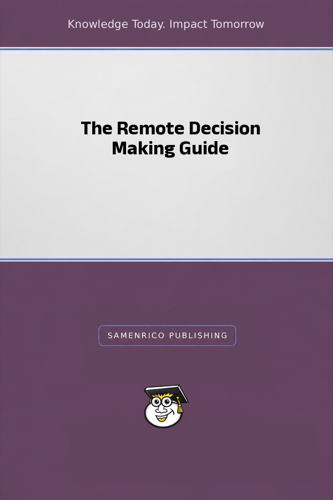
The Remote Decision Making Guide eBook
Reaches consensus without in person meetings.
Reaches consensus without in person meetings.
Formats
Free sample
Chapter 1: The Mute Button Lie--–- The video call had forty-seven people on it. Forty-seven green circles, most with cameras off, some with blurry backgrounds of home offices, one with a screaming toddler in the background that no one acknowledged. The CEO was asking a question, his face frozen in that slightly-too-close webcam framing that made him look like a news anchor broadcasting from a bunker.“Does anyone have any objections to moving forward with the Q3 roadmap?”Silence.The kind of silence that, in a physical room, would have been deafening. In a physical room, silence has texture. You can see who is looking at their shoes.
You can see who is exchanging glances with a colleague across the table. You can see who has their arms crossed, who is leaning back, who is chewing on a pen because they want to speak but are afraid to.On Zoom, silence is just silence. The mute buttons glow green. The grid of faces—those who have their cameras on—stares back with the frozen, slightly-awkward expressions of people who are also checking their email, texting their spouse, or wondering when this meeting will end.“Alright then,” the CEO said. “Looks like we have consensus.
Great work, team.”Forty-seven people logged off. Forty-seven people had just witnessed a decision being made. And forty-six of them, as we would later discover in the post-mortem interviews conducted for this book, knew something the CEO did not.The roadmap was flawed. Not just slightly—catastrophically. It allocated engineering resources to a feature that three different customer success managers had explicitly said was dead on arrival.
It deprioritized a security update that would, six weeks later, become the subject of an urgent incident report. And it assumed a timeline that every senior developer in the room knew was impossible.But no one said anything.Not because they were lazy. Not because they were malicious. Not because they didn't care. They said nothing for reasons that cut to the very heart of how remote decision-making fails, and why this book exists.They said nothing because the social cost of speaking felt too high.
They said nothing because they weren't sure if their objection was worth derailing a meeting that had already run over. They said nothing because they assumed someone else would speak up. They said nothing because the CEO had asked the question in a way that did not invite disagreement but demanded compliance.And they said nothing because on a video call, dissent feels like performance.This chapter is called The Mute Button Lie. It is called that because the most dangerous sound in remote work is not someone yelling or arguing or fighting. The most dangerous sound in remote work is silence that everyone mistakes for agreement.The Anatomy of a Fake Consensus Let us name the phenomenon that killed that Q3 roadmap.
Let us give it a label so that you can recognize it in your own team, in your own meetings, in your own carefully constructed decision-making processes.The Consensus Trap occurs when remote participants agree verbally—or, more commonly, through silence—to end the discomfort of being watched, while disengaging internally from the decision. They say yes with their mouths or their mute buttons. They say no with their actions, their delayed deliverables, their passive resistance, and their eventual "I knew this would happen" conversations in Slack DMs after the fact.The Consensus Trap has three distinct components, each of which is amplified by the remote environment:First, the Social Cost Illusion. In a physical room, disagreeing with a leader requires a specific kind of courage. You have to raise your hand, or lean forward, or speak over someone, or interrupt.
But these physical actions have a kind of social gravity. They feel real because they are real. In a video call, however, the social cost feels higher, not lower. Why? Because the camera creates a frame.
When you speak on video, you are not just disagreeing—you are performing disagreement for a grid of forty-seven faces. Your face fills the screen for anyone who is in gallery view. Your voice comes through everyone's headphones. There is no turning to a neighbor and muttering a quiet objection. There is no catching the speaker in the hallway afterward.
There is only the cold, bright rectangle of the camera lens and the knowledge that your objection will be recorded, archived, and potentially replayed.Second, the Interpretation Asymmetry. In person, silence is ambiguous but legible. A skilled facilitator can read the room: the crossed arms, the averted eyes, the subtle shift in posture that signals discomfort. On video, those signals disappear or become so compressed as to be meaningless. A participant who is leaning back in their chair with their arms crossed looks exactly like a participant who is leaning back in their chair because their back hurts.
A participant who is looking away from the camera looks exactly like a participant who is reading a Slack message. The facilitator loses the ability to distinguish thoughtful silence from uncomfortable silence from checked-out silence. And so they default to assuming agreement, because that is the path of least resistance.Third, the Mute Button Freeze. This is the most pernicious and least understood mechanism of the Consensus Trap. When a leader asks a question on a video call—"Any objections?"—there is a two-to-three-second window in which participants can unmute and speak.
But that window creates a freeze response. Participants begin to unmute, hesitate, wonder if someone else will speak first, worry about the awkwardness of interrupting, and then decide to stay muted. The mute button, designed to reduce noise, becomes a psychological barrier to dissent. It is easier to say nothing than to break the silence.The software team's Q3 roadmap died because all three mechanisms fired at once. The social cost felt too high (forty-seven people watching).
The facilitator misinterpreted the silence as agreement. And the mute button freeze prevented anyone from being the first to break the quiet. Forty-six people left that meeting thinking, "Someone should have said something." And forty-six people included themselves in that "someone."The Case Study: Recorded Unanimity, Silent Failure Let me take you inside the actual post-mortem of that meeting. The names have been changed, but the numbers are real, and the quotes are verbatim from interviews conducted three weeks after the roadmap was approved and two weeks before the first signs of failure began to show.The Setup: A mid-sized B2B software company with one hundred twenty employees, fully remote since 2020. The CEO, whom we will call Marcus, had been running the company for eight years.
He was generally well-liked, generally competent, and generally unaware of how his meeting style suppressed dissent.The Q3 roadmap meeting lasted ninety minutes. The first sixty were a slide deck—thirty-eight slides, each dense with charts and timelines and dependencies. The last thirty were supposed to be discussion. Marcus asked for objections three times: once after the engineering lead presented, once after the product lead presented, and once at the very end. Each time, silence.
Each time, Marcus said, "Great, looks like we're aligned." The meeting was recorded. The vote—such as it was—was unanimous.The Aftermath…
This is the end of the free sample. Get the eBook to keep going. Buy now
About this book
Details
- Author
- Richmond Colette
- Publisher
- SamEnrico
- Language
- English
- Genre
- Non-Fiction, Self-Help, Decision Making
- Released
- 2026-06-11
- Pages (approx.)
- 159
- Available as
- eBook, Audiobook

Read better in the ZLOADR app
Your eBooks on your phone or tablet. Sign in with your SamEnrico account and start reading.
More by Richmond Colette
 Mindful Driving for BeginnersRichmond Colette$11.99
 Losing A Reptile GuideRichmond Colette$11.99
 The Complicated Grief Prevention GuideRichmond Colette$11.99
 Oral Roberts Healing RevivalRichmond Colette$11.99
 The Death Dealer of Detroit: The Nurse Who Stole Lives and IdentitiesRichmond Colette$11.99
 Demand Planning SpecialistRichmond Colette$11.99
 How to Start a Bamboo Preparation Business (Beginners Guide)Richmond Colette$11.99
 Understanding Subpulmonary StenosisRichmond Colette$17.99
 Customer Relationship ValuationRichmond Colette$12.99
 Organic Shea Butter ExportRichmond Colette$12.99
You may also like
 Hong Kong Handover 1997Dunn Johnnie$11.99
 Zumba For Postnatal Recovery CourseNeal Christian$11.99
 Zumba for BeginnersLadner Nikia$11.99
 YouTube Comment Mining GuideHumes Pandora$12.99
 Worry Box MeditationCarlin Rudy$11.99
 Workplace Stress MeditationNguyen Lynn$11.99
 Workplace Stress and Sleep RepairHawley Ivory$11.99
 Workplace Perfectionism CureDelaney Jeffry$11.99
 Workplace Injustice Anger GuideWallen Isabelle$11.99
 Work Addiction and Burnout LinkGreenwood Ester$11.99
 Women in Yoga and WellnessBeattie Galina$11.99
 Women in Stand Up ComedyChun Evangeline$11.99