
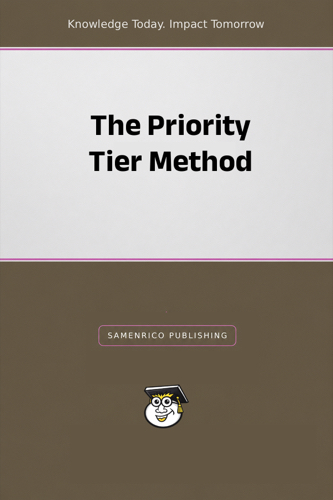
The Priority Tier Method eBook
Group tasks into three tiers before applying ABCDE
Group tasks into three tiers before applying ABCDE sub ranking.
Formats
Free sample
Chapter 1: The 24-Hour Consequence--If I asked you to list everything on your plate right now — every task, every obligation, every nagging “should” — how many items would you write down? Twenty? Fifty? More? Now let me ask you a harder question: How many of those tasks would genuinely cause a significant negative outcome if you simply… didn’t do them in the next twenty-four hours?Not a pleasant question, I know.
Most people avoid it because the answer is uncomfortable. The truth is that the vast majority of your to-do list — probably eighty to ninety percent of it — could sit untouched for a full day without any real consequence. Your inbox would fill up. People might feel mildly annoyed. A few low-stakes deadlines would slip.
But catastrophe? Ruin? Missed opportunities that change the trajectory of your career or life? No.And yet you treat most of your tasks as if they are urgent. You wake up, look at your list, and feel the weight of everything pressing down on you equally.
You answer emails before thinking about the proposal that could land a new client. You reorganize your files instead of finishing the presentation that your boss needs. You attend meetings about meetings while the one strategic initiative that actually matters collects dust.This is not a productivity problem. This is a tiering problem.Before you can prioritize anything, you need to know what league each task plays in. A minor league baseball player and a major league all-star both play baseball, but they do not belong in the same conversation.
The same is true for your tasks. Some tasks belong in the major leagues — Tier 1. Some belong in the minors — Tier 2. And some belong in the parking lot, because they are not even playing the same sport — Tier 3.This chapter defines those three tiers with absolute clarity. By the time you finish reading, you will never look at your to-do list the same way again.
You will have a framework for instantly recognizing which tasks deserve your best energy, which tasks need only your leftover attention, and which tasks deserve to be deleted outright.The Three Tiers Defined Let us start with the simplest and most important definition.Tier 1 tasks are mission-critical. They directly impact your top one to three goals. They are high-leverage, meaning a small amount of effort produces a disproportionate result. And most importantly for daily application, a Tier 1 task will cause severe negative consequences if delayed beyond twenty-four hours. Not a week.
Not forty-eight hours. Twenty-four hours.Why twenty-four hours? Because a day is the natural unit of human urgency. When something absolutely must happen today, you feel it in your bones. When it can wait until tomorrow, the urgency evaporates.
The twenty-four hour rule forces you to confront the difference between genuine importance and manufactured busyness.Examples of true Tier 1 tasks include closing a deal with a deadline of tomorrow morning, submitting a regulatory filing before a midnight cutoff, attending a critical health appointment that you have already rescheduled twice, or resolving a system outage that is costing your company money by the minute. Notice something about these examples? They are rare. Most people have between three and seven Tier 1 tasks per week, not per day.Tier 2 tasks are conditional and supporting. They are important but not existential.
They keep the machinery running smoothly, but the machinery will not explode if they wait a day or two. Delaying a Tier 2 task causes mild friction — a slightly annoyed colleague, a missed opportunity to align schedules, a small delay in a longer project — but no catastrophe.Examples of Tier 2 tasks include sending a team status update, scheduling a non-urgent meeting for next week, processing routine emails that do not require immediate action, updating a project management board, or preparing a draft of a document that is not due for several days. These tasks feel productive. They give you a sense of motion. But they are not moving the needle on your most important goals.Tier 3 tasks are optional or dumpable.
These are low-value activities that you do out of habit, guilt, or social pressure. They have no meaningful consequence if delayed indefinitely. In fact, most of them have no consequence if deleted permanently.Examples of Tier 3 tasks include reorganizing your hard drive by color-coding folders, reading every email you have ever been CC’d on, perfecting the formatting of a low-stakes internal document, cleaning up your desk for the third time this week, or attending a meeting where you have no role and no decision-making authority. These tasks are seductive because they are easy. They offer quick dopamine hits.
They let you feel busy without being effective.The 80/20 Rule Applied Across Tiers You have probably heard of the Pareto Principle — the idea that roughly eighty percent of results come from twenty percent of efforts. This is true. But most people misapply it. They take their entire to-do list, look for the twenty percent of tasks that will deliver eighty percent of results, and then try to prioritize within that flat list. This fails because the twenty percent is not distributed evenly across a single list.
It is concentrated almost entirely in Tier 1.Here is the truth that will change how you work: Eighty percent of your meaningful results come from twenty percent of your tasks, and that twenty percent lives exclusively in Tier 1. The remaining eighty percent of your tasks — the ones that are not in that high-leverage twenty percent — are split between Tier 2 and Tier 3. Most of them are Tier 3. Almost none of them are Tier 1.Think about your own work over the past month. What three or four accomplishments actually advanced your career, your business, or your personal life?
Write them down. Now ask yourself: How many hours did you spend on tasks that had nothing to do with those accomplishments? The gap between these two numbers is the cost of not having a tiering system.The Productivity Shelter Analogy Imagine you are in charge of emergency preparedness for a town. A storm is coming. You have three buildings: a reinforced concrete shelter (Tier 1), a wooden community center (Tier 2), and a flimsy garden shed (Tier 3).
You have limited time and resources. Where do you focus your attention?Obviously, you focus on the concrete shelter. You check its walls. You stock it with supplies. You make sure it can withstand the storm.
The wooden community center might need a quick once-over, but it is not where people will survive a real crisis. The garden shed? You ignore it entirely. If it blows away, nothing of value is lost.Your work is exactly the same. Your Tier 1 tasks are the concrete shelter.
They are where your survival and success live. Your Tier 2 tasks are the wooden community center — nice to have in good weather but not essential in a storm. Your Tier 3 tasks are the garden shed. Stop pretending they matter.The problem is that most people spend their time reinforcing the garden shed. They do the easy, comfortable, low-stakes tasks because those tasks offer immediate gratification.
Then they wonder why they feel overwhelmed and unproductive. You cannot feel productive when you are spending eighty percent of…
This is the end of the free sample. Get the eBook to keep going. Buy now
About this book
Details
- Author
- Downing Scarlet
- Publisher
- SamEnrico
- Language
- English
- Genre
- Non-Fiction, Self-Help
- Released
- 2026-06-06
- Pages (approx.)
- 142
- Available as
- eBook, Audiobook

Read better in the ZLOADR app
Your eBooks on your phone or tablet. Sign in with your SamEnrico account and start reading.
More by Downing Scarlet
 Anger At Picky Eating GuideDowning Scarlet$11.99
 ABC Method for Social WorkersDowning Scarlet$11.99
 Coursera Credential PressureDowning Scarlet$11.99
 Sobriety For Women GuideDowning Scarlet$11.99
 Design Thinking For Personal GrowthDowning Scarlet$11.99
 Home Office Deduction GuideDowning Scarlet$11.99
 Childhood Secret Keeping BurdenDowning Scarlet$11.99
 The Forbidden Stroke: The Renaissance Swimmer Who Defied the ChurchDowning Scarlet$11.99
 The Last Storm of the Shoguns: The Naval Siege of Shimabara (1637-1638)Downing Scarlet$11.99
 Mastering The Art of Mok Gar (莫家拳) Mok Family StyleDowning Scarlet$11.99
 How to Produce SunscreenDowning Scarlet$11.99
 How to Produce Hanging Chair Replacement PartsDowning Scarlet$11.99
You may also like
 Workplace Stress MeditationNguyen Lynn$11.99
 Volcano Monitoring ScientistCox Alexis$11.99
 The Tech Professional NetAguiar Nevada$11.99
 The Morning Metta RitualCanales Anya$11.99
 The Chunking Memory TechniqueClanton Hyacinth$11.99
 The Beginner Mistake FixAmmons Cassondra$11.99
 Surrendering to What IsGrimm Reatha$11.99
 Self Hypnosis for Fear of FireBillups Eli$11.99
 Road Rage for Professional DriversBrackett Janise$11.99
 Psychiatric Ward Nurse StressDunning Wyatt$11.99
 Observation vs Evaluation NVCTimmons Alda$11.99
 Networking for Nonprofit ProfessionalsPoole Jesse$11.99