
Non-FictionHealth & WellnessSleep
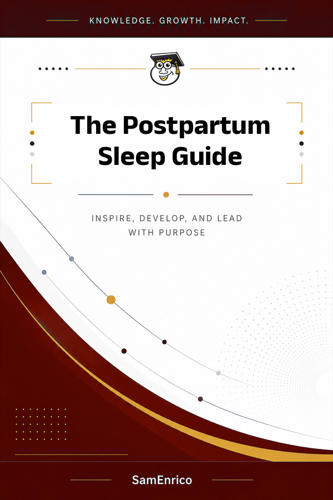
The Postpartum Sleep Guide eBook
Protect rest to reduce depression and anxiety symp
Protect rest to reduce depression and anxiety symptoms.
Formats
Free sample
Chapter 1: The Great Lie...--–- You have just been handed a screaming, seven-pound miracle. The nurse is smiling. Your partner is crying. And somewhere in that stack of discharge papers, wedged between the nipple cream instructions and the pediatrician’s business card, lies the single most useless piece of advice in the history of human parenting. Sleep when the baby sleeps.The person who gave you that advice meant well.
They probably still believe it works. But here is the truth no one tells you in the hospital: that advice is technically correct and practically useless. It is like telling someone who is drowning to breathe once they surface. It is not wrong. It is just that the person saying it has never had their head held underwater for three consecutive hours, four times a night, for six weeks straight.You are about to enter a world where sleep becomes a form of advanced mathematics.
You will calculate in minutes instead of hours. You will trade a twenty-minute nap for the chance to brush your teeth without a baby attached to your body. You will discover that the human body can, in fact, cry and walk at the same time, often while attempting to pour coffee that has been sitting on the counter since yesterday. And you will hear the phrase “sleep when the baby sleeps” so many times that you may consider screaming into a pillow—which, for the record, is a perfectly acceptable coping mechanism and one I have personally used more than once.This book exists because that advice is not enough. Worse, it is dangerous.
Not because it is incorrect, but because it ignores the psychological reality of new motherhood. When someone says “sleep when the baby sleeps,” they assume the problem is opportunity. They assume that if you simply had the chance to close your eyes, you would. They do not understand the war happening inside your exhausted brain the moment the baby’s eyes finally close. They do not understand that the phrase itself has become a weapon we turn against ourselves.That war is the subject of this chapter.
Understanding it is the first step toward protecting your rest. And protecting your rest, as we will explore throughout this book, is the single most effective thing you can do to prevent postpartum depression and anxiety. Not therapy alone. Not medication alone. Not “self-care” in the form of scented candles and bubble baths, though those have their place.
Sleep. Uninterrupted, protected, biologically mandated sleep.Let us begin by naming the enemy, because you cannot defeat something you cannot name.The Mental Tug-of-War: Why Rest Becomes Resistance Let me paint a scene you will recognize.It is 2:47 on a Tuesday afternoon. The baby has been fussy since the 6 AM feeding. Not hungry-fussy. Not tired-fussy.
Not sick-fussy. Just fussy—that particular flavor of infant discontent that seems designed by evolution to make you question every life choice that led to this moment. You have tried rocking. You have tried shushing. You have tried the expensive white noise machine your sister swore by, the one with the heartbeat setting that makes you feel vaguely sad.
You have tried putting the baby down, picking the baby up, and, briefly, holding the baby at arm’s length to see if that helped. It did not.Your back hurts. Your hair has not been washed in three days. You cannot remember if you ate lunch or just thought about eating lunch. The coffee you poured an hour ago is still sitting on the counter, now cold, a monument to interrupted intentions.And then, suddenly, miraculously, without any warning or explanation, the baby sleeps.Their tiny fists unclench.
Their breathing slows. Their face relaxes into that angelic expression that makes you forget, for approximately four seconds, that they have been a tiny dictator since birth. You have a choice. You know what the books say. You know what the pediatrician said.
You know what your mother said, and your mother-in-law, and that woman at the grocery store who touched your baby’s face without asking. Sleep when the baby sleeps.But here is what actually happens inside your brain.Option One: You lie down. You close your eyes. You begin the slow, vulnerable descent toward rest.Option Two: You stay upright. You look around.
You see the dishes in the sink. You see the laundry draped over the chair. You see the stack of unopened mail, the unreturned text messages from well-meaning relatives, the breast pump parts that need washing, and the faint dust on the baseboards that you never noticed before but suddenly feel deeply, shamefully aware of. You see all of it. And you feel all of it.Most mothers choose Option Two.
Not because they are foolish. Not because they do not understand the value of sleep. Not because they secretly enjoy being exhausted. But because the inside of a postpartum brain is a war zone between exhaustion and obligation, and obligation has been training for this fight your entire life.Let me name the combatants in this war. Each one has a voice, and each one is loud.The Urge to Produce.
This voice says: You are only valuable when you are doing something. You have been conditioned your entire life to equate productivity with worth. A clean house means you are a good homemaker. Answered emails mean you are a responsible employee. A well-organized nursery means you are a prepared mother.
When you see the dishes, your brain does not see dirty plates. It sees evidence of failure. And failure must be corrected immediately, even if correcting it costs you the sleep you desperately need.The Urge to Control. This voice says: You cannot control the baby, so control something else. The postpartum period is defined by an almost total loss of agency.
You cannot control when the baby sleeps, wakes, eats, or cries. You cannot control the explosive diaper changes or the mysterious preference for being bounced in exactly one specific rhythm that you cannot replicate when you are exhausted. But you can control the dishes. You can control the laundry. You can scrub the baseboards until your knuckles bleed.
Chores become a desperate, futile attempt to reclaim agency in a life that has been turned completely upside down.The Urge to Monitor. This is the cruelest voice. Sometimes, when the baby finally sleeps, you do not do chores. You do not answer emails. You do not clean the pump parts.
Instead, you stand over the bassinet and watch. You stare at the baby’s chest, willing it to rise and fall. You count the seconds between breaths. You place your hand on the baby’s belly to feel the warmth, the movement, the proof of continued existence. You are not resting.
You are not producing. You are simply watching—trapped by the terrifying knowledge that this small, fragile human is entirely dependent on you, and you are terrified of missing the one sign that something is wrong.These three urges—production, control, and monitoring—form the Mental Tug-of-War. They pull you away from sleep even when sleep is available. They turn a potential moment of rest into…
This is the end of the free sample. Get the eBook to keep going. Buy now
About this book
Details
- Author
- Guzman Loretta
- Publisher
- SamEnrico
- Language
- English
- Genre
- Non-Fiction, Health & Wellness, Sleep
- Released
- 2026-06-09
- Pages (approx.)
- 143
- Available as
- eBook, Audiobook

Read better in the ZLOADR app
Your eBooks on your phone or tablet. Sign in with your SamEnrico account and start reading.
More by Guzman Loretta
 Self Hypnosis Anchoring GuideGuzman Loretta$11.99
 Compulsive Spending ForgivenessGuzman Loretta$11.99
 Cancer Caregiver Anticipatory GriefGuzman Loretta$11.99
 Hypnotic Habit StackingGuzman Loretta$11.99
 Advanced Multi Palace SystemGuzman Loretta$11.99
 Menopause Insomnia Medication GuideGuzman Loretta$11.99
 Nonverbal Cues for NegotiatorsGuzman Loretta$11.99
 Rio's Shadow Wars: The Untold Battle for Complexo do AlemãoGuzman Loretta$11.99
 The Devil’s Rebellion: The 1927 Prison Uprising of El Salvador’s IzalcoGuzman Loretta$11.99
 Masked Palm Civets: Asian CivetGuzman Loretta$11.99
 How to Produce PenetrationGuzman Loretta$11.99
 How to Produce Cross-country SkisGuzman Loretta$11.99
You may also like
 Hong Kong Handover 1997Dunn Johnnie$11.99
 Zumba For Postnatal Recovery CourseNeal Christian$11.99
 Zumba for BeginnersLadner Nikia$11.99
 YouTube Comment Mining GuideHumes Pandora$12.99
 Worry Box MeditationCarlin Rudy$11.99
 Workplace Stress MeditationNguyen Lynn$11.99
 Workplace Stress and Sleep RepairHawley Ivory$11.99
 Workplace Perfectionism CureDelaney Jeffry$11.99
 Workplace Injustice Anger GuideWallen Isabelle$11.99
 Work Addiction and Burnout LinkGreenwood Ester$11.99
 Women in Yoga and WellnessBeattie Galina$11.99
 Women in Stand Up ComedyChun Evangeline$11.99