
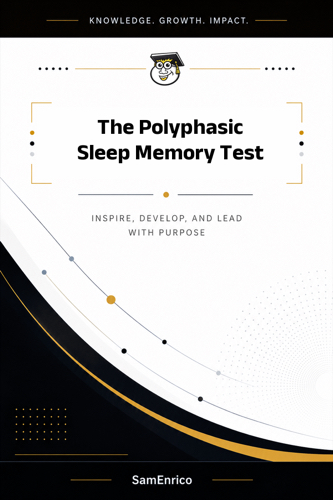
The Polyphasic Sleep Memory Test eBook
Evaluates if multiple short sleeps preserve memory
Evaluates if multiple short sleeps preserve memory function.
Formats
Free sample
Chapter 1: The Segmented Ancestor--–- It is two hours past midnight in a pre-industrial English cottage. The fire has dimmed to embers. Outside, the wind carries the smell of woodsmoke and damp earth. Inside, a married couple stirs from their first sleep. They do not reach for their phones—there are none.
They do not check the time—there is no clock. Instead, they lie quietly, then rise to stoke the fire. They talk softly about the children, the harvest, the argument they had three days ago that still sits between them. They might make love. They might pray.
After an hour or two of quiet wakefulness, they return to their straw mattress and slip into a second sleep, which will last until dawn.This was not an eccentric habit. It was the standard pattern of human sleep for most of recorded history. The historian Roger Ekirch, after examining more than five hundred diaries, court records, and medical texts spanning ancient Greece to nineteenth-century Europe, discovered that humans did not always aim for one solid block of eight hours. Instead, they practiced biphasic sleep: two segments separated by one to three hours of waking calm. The first sleep began around dusk.
The second sleep ended at dawn. The interval between was called the watch—a space for reflection, intimacy, or quiet work.Then everything changed. Streetlights, factory shifts, and the stern moralizing of the Industrial Revolution labeled segmented sleep as wasteful, even sinful. By 1920, the eight-hour block had become the new normal—not because biology demanded it, but because capitalism and electricity made it possible. And in that single transition, we lost something.
We lost the memory of a different way of resting. We lost the knowledge that sleep could be flexible. And we began to believe, with the fervor of a religious convert, that any sleep not contained within a single, unbroken night was either pathological or the fantasy of eccentrics.This book is going to challenge that belief. Not by dismissing the value of a good night's sleep—science is unequivocal that sleep is essential—but by asking a more precise, more useful question: Does the structure of sleep matter more than its total duration? Specifically, if you break sleep into multiple short naps across the day and night, do you preserve the one cognitive function that most defines your waking life?
Do you preserve memory?This chapter is the foundation. Before we can test whether polyphasic sleep harms or helps memory, we must first understand that the eight-hour block is a cultural artifact, not a biological mandate. Once we shed that assumption, we can approach polyphasic sleep not as a bizarre experiment, but as a return to a deeper, more flexible human possibility. And only then can we ask the real question: at what cost?The Invention of the Monophasic Night Let us be precise with our terms. Monophasic sleep means one continuous sleep period in twenty-four hours.
Biphasic sleep means two periods—typically a longer nighttime core and a shorter afternoon nap, or, historically, two nighttime segments separated by a waking interval. Polyphasic sleep means three or more sleep periods in twenty-four hours, often consisting of short naps with no single long core.If you were born in London in 1750, you were almost certainly biphasic. The evidence is overwhelming. Ekirch's archival research found that the words "first sleep" and "second sleep" appeared in every major European language. Chaucer's Canterbury Tales refers to a character's "firste sleep." In The Odyssey, Homer describes "first sleep" as a distinct phase.
Medical texts from Hippocrates to Galen assumed segmented sleep was normal. Even as late as the 1880s, French novels and English diaries casually mention the waking interval between sleeps.What did people do during that interval? The answer is quietly beautiful. They lay in bed thinking. They talked to their spouses.
They had sex—fertility studies suggest that the prolactin surge after first sleep may have increased conception rates. They prayed. They stoked fires. They tended to sick children. Some wrote letters by candlelight.
The interval was not considered insomnia or a disorder. It was a natural pause.The shift began with the Industrial Revolution. Factories needed workers at consistent hours. Street lighting—first gas, then electric—extended the usable day. Moral reformers, including some physicians, began to argue that lying awake in bed was lazy.
The watch became an embarrassment. By the 1920s, the term "second sleep" had all but disappeared from English. Sleep was compressed into a single, efficient block. And we have been trying to fit ourselves into that block ever since, often failing, and then medicating ourselves for the failure.The crucial insight for this book is this: The fact that humans naturally slept in two segments for millennia suggests that our sleep architecture is not rigid. It can adapt.
The question is not whether polyphasic sleep is "unnatural." It is whether polyphasic sleep is memory-safe for the specific cognitive tasks that modern life demands.Enter Claudio Stampi: The Man Who Broke Sleep If the history of biphasic sleep tells us that flexibility is possible, the work of Dr. Claudio Stampi tells us that extreme flexibility is also possible—but with a catch.Stampi is a chronobiologist and the founder of the Chronobiology Research Institute in Boston. In the 1980s and 1990s, he became fascinated by a practical problem: solo sailors competing in around-the-world races. These athletes needed to be awake and alert for twenty or more hours per day to navigate, adjust sails, and watch for hazards. They could not afford eight hours of continuous sleep.
But they also could not afford to hallucinate from exhaustion and crash into a reef.Stampi's solution was to design ultrashort sleep schedules: multiple twenty-minute naps spaced evenly across the twenty-four-hour day. The most famous of these schedules is the Uberman, which consists of six to eight naps of twenty minutes each, totalling only two to three hours of sleep per day. Stampi tested this schedule on a single, highly motivated subject—a young man in his twenties—over fifty days in a controlled laboratory setting.The results, published in Stampi's 1992 book Why We Nap: Evolution, Chronobiology, and Functions of Polyphasic and Ultrashort Sleep, were astonishing. After a brutal adaptation period of about ten days (during which the subject struggled with overwhelming sleepiness and cognitive fog), he adapted. By week three, he was alert, productive, and able to perform complex analytical tasks—logical reasoning, mathematical calculations—at near-baseline levels.
He felt fine. He reported no subjective impairment.But there was a problem. And that problem is the central tension of this book.When Stampi tested the subject's long-term declarative memory—the ability to recall facts, events, names, and stories from days earlier—he found a consistent deficit. Compared to the subject's own baseline performance on a monophasic eight-hour sleep schedule, memory retention dropped by approximately twelve percent. Twelve percent does not sound dramatic.
But in practical terms, it means forgetting one out of every eight things you learned. It means studying for ten hours and retaining only the equivalent of eight hours and forty-eight minutes of learning. Over weeks and months, that gap accumulates.The twist, which Stampi was…
This is the end of the free sample. Get the eBook to keep going. Buy now
About this book
Details
- Author
- Hirsch Sherly
- Publisher
- SamEnrico
- Language
- English
- Genre
- Non-Fiction, Self-Help, Sleep Schedules
- Released
- 2026-06-07
- Pages (approx.)
- 148
- Available as
- eBook, Audiobook

Read better in the ZLOADR app
Your eBooks on your phone or tablet. Sign in with your SamEnrico account and start reading.
More by Hirsch Sherly
 Email Interruption Management CourseHirsch Sherly$11.99
 Limitation As Liberation WorkbookHirsch Sherly$11.99
 Divorce and New Partner BlendingHirsch Sherly$11.99
 Sociology Essay GPT GuideHirsch Sherly$11.99
 The Great Colonial Races: How a Horse Rivalry United a Divided NationHirsch Sherly$11.99
 Energy Sector M&A GuideHirsch Sherly$12.99
 Wave Accountant CollaborationHirsch Sherly$12.99
 Understanding Placental AbruptionHirsch Sherly$17.99
 Astrophotography GuideHirsch Sherly$11.99
 How to Start a Operation of Irrigation Canals Business (Beginners Guide)Hirsch Sherly$11.99