
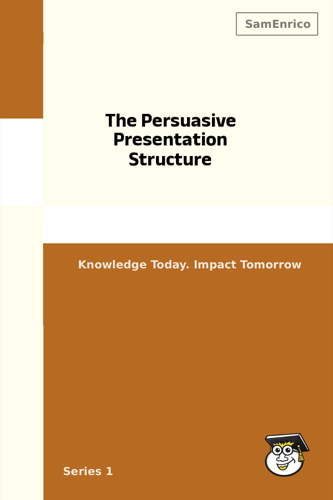
Non-FictionSelf-HelpPublic Speaking
The Persuasive Presentation Structure eBook
Organizes slides, openings, and closings for maxim
by Daley Alexia
Organizes slides, openings, and closings for maximum impact.
Formats
Free sample
Chapter 1: The Audience Letter...--–- Most speakers walk into a room carrying a suitcase full of what they want to say. They have data. They have slides. They have charts that took seventeen hours to build. They have a clear agenda, a tight timeline, and a confident smile.
And then they fail. Not because their content is wrong. Not because they are nervous. Not because the audience is hostile or distracted or stupid. They fail because they never answered the only question that matters: What is in it for me?This is not a rhetorical question.
It is the filter through which every human brain processes every presentation, every sales pitch, every meeting, every sermon, every lecture, and every conversation that lasts longer than thirty seconds. Neuroscientists call it the reticular activating system—the part of your brain that decides what to pay attention to and what to ignore. And here is what your audience’s reticular activating system does the moment you open your mouth: it scans for personal relevance. If it does not find any, it shuts off. You become background noise.
A human-shaped screensaver.The problem is not that audiences are selfish. The problem is that they are efficient. They cannot process 100 percent of the information coming at them, so they filter aggressively. The primary filter is self-interest. Always has been.
Always will be. And most speakers, most of the time, lead with their own agenda. They say things like, “Today I want to talk about our new product roadmap,” or “Let me walk you through our Q3 results,” or “I am here to present the findings of the six-month study we conducted.” The audience hears one word: our. Not your. Our.
And they tune out.This chapter dismantles the most common presentation error. It introduces the single most important mindset shift you will ever make as a speaker: moving from what I want to say to what they need to hear. It teaches the WIIFM Factor—What’s In It For Me—and shows you how to map every piece of content directly to the audience’s self-interest. It defines the “Aha!” moment, the emotional pivot point where an audience shifts from resistance to belief. And it tells the story of two companies—Yahoo!
and e Bay—who presented identical technical specifications to the same room and got opposite results, proving that the difference between a yes and a no is rarely the content. It is the frame.By the end of this chapter, you will never write another slide without first writing a letter from the audience’s perspective. And that one habit will save you more time, more money, and more embarrassment than any other practice in this book.The $400 Million Typo That Wasn’t a Typo In 1999, a small internet company called Yahoo! sent a team of engineers to pitch a new search algorithm to a room of executives at a major media conglomerate. The engineers had worked for eleven months.
The algorithm was objectively excellent: 15 percent faster than anything on the market, 30 percent more efficient on server resources, and capable of handling twice the query volume of their current system. The engineers built a forty-two-slide deck. Slide one: title. Slide two: agenda. Slide three: “Technical Specifications Overview.” Slide four through forty-two: data, charts, benchmarks, and performance metrics.They rehearsed for three days.
They memorized every number. They wore matching navy blazers. And they lost the deal in the first ninety seconds.Here is what the lead engineer said: “Thank you for having us. I am here today to present the technical specifications of our new search algorithm, which we believe offers significant performance improvements over your current solution.” The executives listened politely. They asked a few questions about server compatibility.
They shook hands. And then they chose not to proceed.A year later, a different company—e Bay—walked into almost the same room. Not the same executives, but the same industry, the same level of skepticism, the same technical complexity. e Bay’s engineers had built something similar: a faster, more efficient search and listing tool. But they presented it differently.
Their lead speaker opened with this: “Good morning. Your current listing tool costs you an average of forty-seven seconds per item. You list twelve thousand items per day. That means your team spends ninety-four hours every single day waiting for pages to load. We are going to give you those ninety-four hours back.”They won the deal.
Not because their technology was better—it was roughly equivalent. Not because they were better speakers—they were equally nervous. They won because they reframed a technical specification as an audience benefit. Forty-seven seconds became “ninety-four hours per day.” A server efficiency number became “time you get back.” An engineering benchmark became a gift.The difference between Yahoo! and e Bay was not a typo.
It was a philosophy. Yahoo! led with their agenda—what they built. e Bay led with the audience’s agenda—what you lose and what you gain. That is the Audience Advocacy Mindset.
And it is the foundation of every persuasive presentation in every industry, every language, and every room on earth.The Psychological Sell: Why Empathy Beats Data Dumping Let us be honest about something most presentation books dance around: your audience does not care about you. They do not care about your product. They do not care about your six-month study. They do not care about your career progression or your bonus or the fact that you stayed up until 2:00 AM perfecting your font choices. They care about themselves.
Their problems. Their goals. Their stress. Their fear of looking stupid in front of their own boss. Their hope of getting promoted.
Their desire to go home at 5:00 PM instead of 8:00 PM.This is not cynicism. It is neuroscience.The human brain processes approximately eleven million bits of information per second. But conscious attention—the part of your brain that can actually think about information—can handle only about fifty bits per second. That is a ratio of 220,000 to one. Your audience is filtering out 99.9995 percent of the information available to them.
The only information that survives the filter is the information their brain deems personally relevant.What makes information personally relevant? Four things, in order of importance:Threat. Will this hurt me? Will I lose money, status, time, or safety?Reward. Will this help me?
Will I gain money, status, time, or pleasure?Novelty. Is this surprising enough to override my autopilot?Social proof. Is everyone else paying attention to this?Notice what is not on that list: your expertise. Your data. Your passion.
Your carefully crafted bullet points. Those things only matter if they connect to threat, reward, novelty, or social proof. Otherwise, they are noise.The psychological sell is the practice of translating everything you want to say into the language of threat and reward. It is not manipulation. It is translation.
You have valuable information. Your audience has limited attention. Your job is to build a bridge between the two. Empathy is not about feeling what your audience feels. It is about seeing what your audience sees—and then showing them how your…
This is the end of the free sample. Get the eBook to keep going. Buy now
About this book
Details
- Author
- Daley Alexia
- Publisher
- SamEnrico
- Language
- English
- Genre
- Non-Fiction, Self-Help, Public Speaking
- Released
- 2026-06-05
- Pages (approx.)
- 148
- Available as
- eBook, Audiobook

Read better in the ZLOADR app
Your eBooks on your phone or tablet. Sign in with your SamEnrico account and start reading.
More by Daley Alexia
 Jaw Relaxation Knot UntieDaley Alexia$11.99
 MBSR For Flying Anxiety HandbookDaley Alexia$11.99
 Southeast Asia Digital SpendDaley Alexia$11.99
 Galen and the Art of Healing: Rome's Medical RevolutionDaley Alexia$11.99
 Understanding Oto-palatal-digital SyndromeDaley Alexia$17.99
 Tutoring Chinese Students Book ClubDaley Alexia$12.99
 Forum Community Terms HandbookDaley Alexia$12.99
 How to Become a Sewing-machine OperatorDaley Alexia$11.99
 Putin vs Navalny: The Kremlin's PrisonerDaley Alexia$11.99
You may also like
 Hong Kong Handover 1997Dunn Johnnie$11.99
 Zumba For Postnatal Recovery CourseNeal Christian$11.99
 Zumba for BeginnersLadner Nikia$11.99
 YouTube Comment Mining GuideHumes Pandora$12.99
 Worry Box MeditationCarlin Rudy$11.99
 Workplace Stress MeditationNguyen Lynn$11.99
 Workplace Stress and Sleep RepairHawley Ivory$11.99
 Workplace Perfectionism CureDelaney Jeffry$11.99
 Workplace Injustice Anger GuideWallen Isabelle$11.99
 Work Addiction and Burnout LinkGreenwood Ester$11.99
 Women in Yoga and WellnessBeattie Galina$11.99
 Women in Stand Up ComedyChun Evangeline$11.99