
Non-FictionHealth & WellnessPediatric
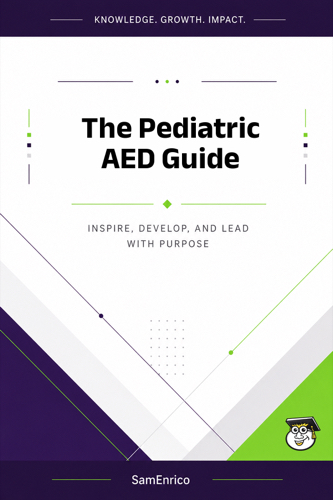
The Pediatric AED Guide eBook
Use child pads or attenuators for children aged on
Use child pads or attenuators for children aged one to eight years.
Formats
Free sample
Chapter 1: The Walnut-Sized Heart...--The first time I watched a child receive a defibrillation shock, I was standing in a pediatric intensive care unit, clutching a clipboard I no longer needed. The patient was a six-year-old girl named Maya who had developed ventricular fibrillation after a routine cardiac surgery. The defibrillator charged with a sound I can only describe as a wounded animal waking up. The attending physician called "Clear!" and delivered the shock. Maya's small body arched once, then relaxed.
The monitor beeped back into a normal sinus rhythm. She survived.But what has haunted me for the fifteen years since that day is not the shock itself. It is what the attending physician said afterward, as she wrote her notes. She looked at the defibrillator's energy readout and frowned. "That was set for adult mode," she said quietly.
"Someone forgot to switch the attenuator."The shock Maya received was 150 Joules. She weighed 18 kilograms. That is 8.3 Joules per kilogram—more than four times the recommended dose of 2 Joules per kilogram for a first shock. Maya was lucky. She suffered only minor skin burns at the electrode sites.
But I have since reviewed cases where children were not so fortunate: myocardial necrosis, refractory ventricular fibrillation that would not convert, and in three cases, death attributed at least in part to the electrical injury itself.This is the problem that this book exists to solve. And it begins with understanding one simple, terrifying fact: the heart of a child is not a small adult heart. It is a different organ entirely.The Anatomy of Vulnerability Let us start with size, because size is the most obvious difference but not the most important one. A newborn's heart is approximately the size of a walnut. A one-year-old's heart is about the size of a small apricot.
A five-year-old's heart is roughly the size of a golf ball. An eight-year-old's heart—the upper end of this book's scope—is about the size of a tennis ball. By comparison, an adult heart is the size of a fist, or approximately two to three times larger by volume.But size alone does not explain why a child's heart is more vulnerable to electrical injury. The real answer lies in the tissue itself.The myocardium of a young child differs from adult myocardium in three critical ways. First, the contractile elements—the protein filaments that actually squeeze the heart muscle—are arranged less densely.
A child's heart has more water and less organized muscle fiber. This means that an electrical current spreads differently through a child's heart, creating unpredictable patterns of depolarization and repolarization. Second, the connective tissue scaffold that supports the muscle cells is less mature, making the heart more susceptible to mechanical and electrical injury. Third, the autonomic nervous system's control over heart rhythm is still developing, which means a child's heart is more likely to degenerate into chaotic rhythms after a shock.These differences are not academic. They are the reason that the International Liaison Committee on Resuscitation (ILCOR) and the American Heart Association (AHA) have spent the past two decades refining pediatric defibrillation guidelines.
They are the reason that a shock that might save an adult life can end a child's.The Attenuation Threshold: A Clear Definition Throughout this book, you will encounter the term attenuation threshold. Because this term has been confused in previous literature, let me define it with absolute precision.The attenuation threshold is a physiological concept. It refers to the weight below which a child's heart cannot safely receive the full energy output of a standard adult automated external defibrillator (AED). That weight is approximately twenty-five kilograms (fifty-five pounds). Children weighing less than twenty-five kilograms require attenuated energy—reduced electrical output achieved through either child pads or a hardware attenuator.
Children weighing twenty-five kilograms or more can safely receive adult energy without attenuation.Note the distinction carefully. The attenuation threshold is the physiological boundary in the child's heart. An attenuator is a hardware device—a key, a switch, or a specialized pad—that reduces the AED's energy output. The two terms are related but not interchangeable. You will learn about attenuators in Chapter 3.
For now, focus on the threshold.Why twenty-five kilograms? The answer comes from a combination of animal studies, mathematical modeling, and the limited human data available. In porcine models (pigs have cardiovascular systems remarkably similar to young humans), researchers have found that energy doses above 4 Joules per kilogram begin to cause visible myocardial injury on histopathology. Doses above 6 Joules per kilogram cause functional impairment measurable by echocardiography. Doses above 10 Joules per kilogram cause necrosis—dead heart muscle.Now do the math.
A standard adult AED delivers between 150 and 360 Joules, depending on the manufacturer and the shock number. For a twenty-five kilogram child, an adult shock of 150 Joules delivers 6 Joules per kilogram. This is above the threshold for functional impairment but below the threshold for necrosis in most animal models. For a twenty kilogram child, 150 Joules delivers 7.5 Joules per kilogram—well into the impairment zone and approaching necrosis. For a ten kilogram child (approximately one year old), 150 Joules delivers 15 Joules per kilogram.
That is necrosis territory.The twenty-five kilogram cutoff is therefore a compromise between safety and practicality. It is the weight at which the risk of myocardial injury from an adult shock becomes acceptably low, while the risk of delaying defibrillation while searching for child pads becomes unacceptably high. This is evidence-based medicine at its most pragmatic.The Physics of a Shock To understand why energy matters, you need a basic grasp of what a defibrillation shock actually does. I will keep this as painless as possible.The heart beats because electrical signals travel through specialized conduction pathways, triggering muscle cells to contract in a coordinated sequence. In ventricular fibrillation (VF), this system breaks down.
Instead of a coordinated wave, the electrical activity becomes chaotic. Hundreds of different regions of the heart fire at random, each trying to beat on its own. The result is a heart that quivers like a bag of worms but does not pump blood.A defibrillation shock works by depolarizing the entire myocardium simultaneously. Think of it as pressing a global reset button. Every heart cell that is electrically active receives the same signal at the same time: stop what you are doing and reset.
In a healthy heart, after this reset, the natural pacemaker (the sinoatrial node) resumes normal control. In a damaged or diseased heart, the heart may remain in asystole (flatline) or revert to VF.The energy of the shock—measured in Joules—determines how completely and how safely this depolarization occurs. Too little energy, and you do not depolarize enough cells to stop the VF. Too much energy, and you damage the cells, causing them to leak enzymes, swell, and potentially die.This is the Goldilocks problem of pediatric defibrillation. The dose must be just right.Modern AEDs use a biphasic waveform.
Instead of sending current in a single direction (monophasic), biphasic shocks send current in one direction for a few milliseconds, then reverse direction for a few milliseconds. This is more efficient at terminating VF and requires less total energy. For adults, biphasic shocks of 150-200…
This is the end of the free sample. Get the eBook to keep going. Buy now
About this book
Details
- Author
- Mccracken Lovie
- Publisher
- SamEnrico
- Language
- English
- Genre
- Non-Fiction, Health & Wellness, Pediatric
- Released
- 2026-06-11
- Pages (approx.)
- 125
- Available as
- eBook, Audiobook

Read better in the ZLOADR app
Your eBooks on your phone or tablet. Sign in with your SamEnrico account and start reading.
More by Mccracken Lovie
 The Autoimmune Micronutrient GuideMccracken Lovie$11.99
 Molar Pregnancy Emotional RecoveryMccracken Lovie$11.99
 Glass Fragment DatingMccracken Lovie$11.99
 Comparison Culture At WorkMccracken Lovie$11.99
 Sudden Child Death ShockMccracken Lovie$11.99
 Dakar African Independence HubMccracken Lovie$11.99
 The Alchemist Who Unlocked the Cosmos: Robert Boyle and the Birth of Modern ChemistryMccracken Lovie$11.99
 The Poisoning Priestess: Belle Gunness and the Butcher of LaPorteMccracken Lovie$11.99
 How to Produce Scanner Circuit BoardsMccracken Lovie$11.99
 Irish Setter: Enthusiastic & ScatteredMccracken Lovie$11.99
 A Collector's Handbook to the Austin A55-Mccracken Lovie$11.99
 Canva Scrum for No Code StartupsMccracken Lovie$12.99
You may also like
 Hong Kong Handover 1997Dunn Johnnie$11.99
 Zumba For Postnatal Recovery CourseNeal Christian$11.99
 Zumba for BeginnersLadner Nikia$11.99
 YouTube Comment Mining GuideHumes Pandora$12.99
 Worry Box MeditationCarlin Rudy$11.99
 Workplace Stress MeditationNguyen Lynn$11.99
 Workplace Stress and Sleep RepairHawley Ivory$11.99
 Workplace Perfectionism CureDelaney Jeffry$11.99
 Workplace Injustice Anger GuideWallen Isabelle$11.99
 Work Addiction and Burnout LinkGreenwood Ester$11.99
 Women in Yoga and WellnessBeattie Galina$11.99
 Women in Stand Up ComedyChun Evangeline$11.99