
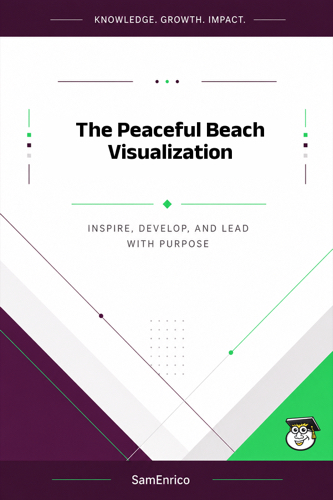
Non-FictionSelf-HelpRelaxation
The Peaceful Beach Visualization eBook
Imagine warm sand and gentle waves to release tens
Imagine warm sand and gentle waves to release tension and calm your mind.
Formats
Free sample
Chapter 1: The Lighthouse in Your Mind...--–- The first time Sarah tried meditation, she lasted eleven seconds. Not minutes. Seconds. She sat on a cushion, closed her eyes, and immediately began mentally composing a grocery list, then worrying about an email she’d sent six hours ago, then wondering if the odd sound coming from her car’s engine was going to cost her two hundred dollars or two thousand. When she opened her eyes, her phone said eleven seconds had passed.
She laughed, then never tried meditation again.That was three years ago. Today, Sarah is a nurse in a busy emergency department. She works twelve-hour shifts where she regularly watches people experience the worst moments of their lives. She has learned to stitch wounds, interpret cardiac monitors, and deliver bad news with compassion. But she still cannot sit still with her eyes closed for more than a few seconds without her mind staging a rebellion.
When a well-meaning friend recently suggested she try “mindfulness” for her rising blood pressure, Sarah said something she rarely admits out loud: “I think I’m broken. Everyone talks about meditation like it’s the answer, but my brain doesn’t work that way.”If you related to any part of Sarah’s story, this chapter is for you. This entire book is for you.You are not broken. Your brain is not defective. You have simply been given instructions designed for monks and retired schoolteachers, not for people who have jobs, children, deadlines, and the endless hum of modern life.
The good news is that there is another way to calm your nervous system—one that does not require you to empty your mind, sit in uncomfortable silence, or feel like a failure before your phone timer even reaches one minute.Welcome to the neuroscience of sensory relaxation, and welcome to your first glimpse of the lighthouse that lives inside your own mind.The Eleven-Second Problem Before we build anything, we need to understand why traditional meditation fails so many intelligent, motivated people. The answer lies not in your lack of discipline but in the basic architecture of your brain.When you try to sit still and focus on your breath—the classic meditation instruction—you are asking your brain to do something it has evolved specifically to resist. The human brain is not a machine designed for peaceful stillness. It is a survival organ, honed over millions of years to scan for threats, anticipate danger, and keep you alive in a world full of predators, resource scarcity, and social conflict. Your brain’s default mode network (DMN) is the neural system responsible for this constant scanning.
When you are not actively engaged in a task, the DMN lights up like a Christmas tree, generating a continuous stream of thoughts about the past (rumination) and the future (worry).Here is the cruel irony: the very act of trying to meditate often activates the DMN even more. You sit down, close your eyes, and tell yourself, “Don’t think about anything.” Your brain hears, “Think about not thinking,” which is still thinking. Then you notice you are thinking, judge yourself for failing, and now you are thinking about failing at thinking about not thinking. This is not a character flaw. This is neurology.The eleven-second problem—that moment when your mind races away before you can even settle in—is not evidence that meditation “doesn’t work for you.” It is evidence that you have a healthy, functioning brain.
The question is not how to stop your thoughts. The question is how to work with your brain’s natural tendencies instead of against them.Why a Beach?This brings us to the central question of this book: of all the possible images, why a beach? Why not a forest, a mountain meadow, a cozy fireside, or a floating cloud?The answer is rooted in something called evolutionary sensory preference. Human beings, across every culture and continent, show a consistent, measurable relaxation response to specific environmental features: open sightlines, rhythmic sounds, blue-green color palettes, and the presence of water. These features reliably signal safety to the ancient parts of your brain.
An open horizon means no predators are hiding in tall grass. Rhythmic waves mean no sudden, threatening noises. The color blue-green, in nature, typically means drinkable water and edible resources.Researchers have measured this effect in laboratories around the world. In one study, participants who viewed images of beach scenes showed a 23 percent faster reduction in cortisol (the primary stress hormone) compared to those who viewed urban scenes. In another study, simply listening to recorded wave sounds for five minutes lowered heart rate and blood pressure more effectively than silence or white noise.
The effect is so consistent that some hospitals now pipe wave sounds into their waiting rooms and intensive care units.But here is where this gets truly interesting for people like Sarah, who cannot meditate. The brain does not fully distinguish between a real beach and a vividly imagined one. When you close your eyes and imagine warm sand beneath your feet, your somatosensory cortex—the part of your brain responsible for touch—activates almost as strongly as if you were actually standing on a beach. When you imagine the sound of waves, your auditory cortex responds. When you visualize the horizon, your visual cortex lights up.This phenomenon is called neural coupling.
It is the reason athletes mentally rehearse their performances. It is the reason trauma therapists use guided imagery to help patients heal. And it is the reason you can calm your nervous system without leaving your chair, without a beach vacation, without any special equipment, and—most importantly—without having to “empty your mind.”You do not need to stop your thoughts. You only need to give them somewhere else to go.The Horizon as Anchor Every effective visualization practice needs an anchor—a single, simple image you can return to when your mind drifts. For the beach visualization, that anchor is the horizon line where the sky meets the water.The horizon is uniquely suited to be your anchor for several reasons.
First, it is naturally calming. The visual system interprets a straight, horizontal line as stable and predictable. Unlike a jagged mountain peak or a cluttered forest floor, the horizon contains no sudden surprises. Second, the horizon is infinite. You cannot “complete” it or “finish” looking at it.
This quality makes it an ideal object for attention because there is no endpoint, no moment when your brain can say, “Done. What’s next?” Third, the horizon exists at the boundary between two vast, open spaces—the sky and the sea. Both of these spaces are perceived by the brain as limitless, which paradoxically helps quiet the DMN. When your brain perceives infinite space, it stops scanning for finite threats.Think of the horizon as your lighthouse. When a storm of thoughts rises—and it will; storms are normal—you do not need to fight the waves or curse the wind.
You only need to locate the lighthouse, keep your eyes on its beam, and let the storm pass around you. The lighthouse does not…
This is the end of the free sample. Get the eBook to keep going. Buy now
About this book
Details
- Author
- Mcnair Hannelore
- Publisher
- SamEnrico
- Language
- English
- Genre
- Non-Fiction, Self-Help, Relaxation
- Released
- 2026-06-09
- Pages (approx.)
- 152
- Available as
- eBook, Audiobook

Read better in the ZLOADR app
Your eBooks on your phone or tablet. Sign in with your SamEnrico account and start reading.
More by Mcnair Hannelore
 Lindsay Davenport Giant GameMcnair Hannelore$11.99
 Menopause Mediterranean Diet GuideMcnair Hannelore$11.99
 Workplace Esteem AssessmentMcnair Hannelore$11.99
 Yahoo Account Backdoor CreationMcnair Hannelore$11.99
 The Forgotten Father of AI: The Untold Story of Alan Turing's Robot DreamsMcnair Hannelore$11.99
 The Great Rift Debate: Africa’s Fossil Wars and the Quest for Human OriginsMcnair Hannelore$11.99
 How to Become a Music CopyistMcnair Hannelore$11.99
 Digital ArtistMcnair Hannelore$11.99
 Freelance Gap Filler GuideMcnair Hannelore$12.99
 Domestic Airline RecoveryMcnair Hannelore$12.99
 Understanding Gaucher Ichthyosis Restrictive DermopathyMcnair Hannelore$17.99
You may also like
 Hong Kong Handover 1997Dunn Johnnie$11.99
 Zumba For Postnatal Recovery CourseNeal Christian$11.99
 Zumba for BeginnersLadner Nikia$11.99
 YouTube Comment Mining GuideHumes Pandora$12.99
 Worry Box MeditationCarlin Rudy$11.99
 Workplace Stress MeditationNguyen Lynn$11.99
 Workplace Stress and Sleep RepairHawley Ivory$11.99
 Workplace Perfectionism CureDelaney Jeffry$11.99
 Workplace Injustice Anger GuideWallen Isabelle$11.99
 Work Addiction and Burnout LinkGreenwood Ester$11.99
 Women in Yoga and WellnessBeattie Galina$11.99
 Women in Stand Up ComedyChun Evangeline$11.99