
Non-FictionSelf-HelpMicrobreaks
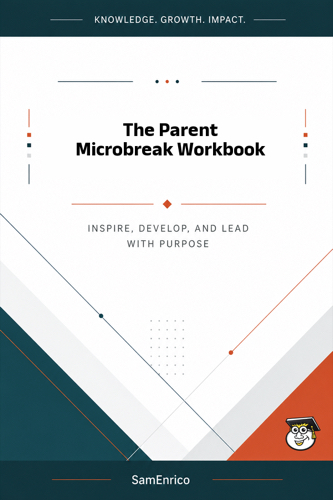
The Parent Microbreak Workbook eBook
Find two minute self care moments during chaotic p
by Bunn Lavina
Find two minute self care moments during chaotic parenting days without extra time.
Formats
Free sample
Chapter 1: The Two-Minute Lie--–- You are about to do something that feels impossible. You are going to learn how to take care of yourself in the time it takes to microwave a burrito. And you are going to do it without adding a single new thing to your already overflowing plate.This is not a book about self-care. Not the kind you have been sold, anyway. The kind that requires candles, silence, a babysitter, a yoga mat, a meditation app subscription, and a level of executive function that disappeared somewhere around the third consecutive night of broken sleep.
That version of self-care is not available to you right now. And it never will be, not in the way you are living. That is not a failure on your part. That is a design flaw in the cultural story about what it means to take care of yourself as a parent.Here is the truth that the wellness industry does not want you to know. Your nervous system does not need an hour.
It does not need silence. It does not need a retreat. What it needs is ninety to one hundred and twenty seconds of intentional reset. That is it. That is the entire window.
Two minutes. One hundred and twenty seconds. Less time than it takes to argue with a toddler about whether socks go on before shoes.This chapter is going to dismantle everything you think you know about self-care. It is going to show you why waiting for the perfect conditions is actually making your burnout worse. It is going to teach you the basic neuroscience of why two minutes works.
And then it is going to send you into your day with a single assignment: find the hidden gaps that are already there.The Trap of Waiting for Me Time Let us name the thing that is quietly breaking you. It is not the chaos itself. It is the belief that you are supposed to have something else. You look at your life and see a thousand demands and zero margins. And somewhere in the back of your mind, you carry an image of what real self-care looks like.
Maybe it is a solo coffee shop trip with a novel. Maybe it is an hour-long bath with the door locked. Maybe it is a weekend away that has been discussed but never actually planned. That image becomes a measuring stick. And every day, you measure your actual life against it.
Every day, you come up short.This is what the researchers call the ideal self-care fallacy. It shows up in every study on parental burnout. The parents who suffer the most are not the ones with the least amount of time. They are the ones who believe they need large, uninterrupted blocks of restorative time and cannot get them. The gap between what you think you need and what you actually have creates a low-grade shame that runs underneath everything.
You are not just tired. You feel like you are failing at rest itself.Here is what the stress-recovery cycle teaches us. Your nervous system operates on a pattern of activation and recovery. When your child screams, your sympathetic nervous system kicks in. Your heart rate rises.
Cortisol floods your system. This is normal. This is good. The problem is not activation. The problem is what happens next.
In a healthy cycle, the activation is followed by recovery. Your heart rate drops. Your parasympathetic nervous system takes over. You return to baseline.But here is where parents get trapped. You never enter recovery because you are waiting for the big break that never comes.
You tell yourself that you will recover during naptime. Then naptime gets eaten by laundry. You tell yourself that you will recover after bedtime. Then bedtime runs two hours late. You tell yourself that you will recover on Saturday.
Then Saturday brings a stomach bug. The recovery window never opens. So your nervous system stays in a state of low-grade activation for hours, then days, then weeks. That is burnout. Not exhaustion.
Burnout is the absence of recovery.The solution is not bigger windows. The solution is smaller windows that actually happen.The Neuroscience of One Hundred and Twenty Seconds You need to know about a nerve. It is called the vagus nerve. It runs from your brainstem down through your neck and chest and into your abdomen. It is the main highway of your parasympathetic nervous system.
That is the system that tells your body to calm down. When the vagus nerve is stimulated, your heart rate slows. Your blood pressure drops. Your digestion restarts. Your body receives the signal that the threat has passed.Here is what most people do not know.
The vagus nerve responds to very specific inputs. And those inputs take seconds, not hours. You do not need to meditate for twenty minutes to stimulate your vagus nerve. You need to do something that triggers it directly. The three most accessible triggers are cold exposure, humming or singing, and slow extended exhalation.Cold water on your face or wrists triggers what is called the dive reflex.
It is an ancient mammalian response. Your body thinks it is entering cold water, so it automatically slows everything down to conserve oxygen. Heart rate drops. Blood vessels constrict then dilate. Within thirty seconds, your nervous system shifts.
This is not a metaphor. This is measurable physiology.Humming stimulates the vagus nerve through vibration. The nerve passes right through the larynx and pharynx. When you hum, the vibration travels directly into the nerve. Low, rhythmic humming is particularly effective.
Sixty seconds of humming can shift your heart rate variability, which is the primary marker of nervous system regulation.Slow exhalation works through a different mechanism. When you exhale longer than you inhale, you activate the baroreceptors in your carotid arteries. These pressure sensors signal your brain to lower heart rate. The classic pattern is four seconds in, six seconds out. Repeat six times.
That is sixty seconds. That is enough to move you from sympathetic to parasympathetic.None of these require silence. None of these require solitude. None of these require a babysitter. You can do them while stirring pasta.
You can do them while a toddler screams next to you. You can do them in the car, in the bathroom, in the grocery store line, in the two minutes between buckling car seats and pulling out of the driveway.The only requirement is that you stop waiting and start stealing.Redefining Self-Care as Maintenance, Not Indulgence You brush your teeth every day. You do not wait until you have an hour of free time to brush your teeth. You do not feel guilty about brushing your teeth. You do not tell yourself that brushing your teeth is selfish.
Brushing your teeth is maintenance. It takes two minutes. It prevents a much larger problem. And you have woven it into the fabric of your daily routine without drama or negotiation.That is what this book is asking you to do with your nervous system.Your nervous system is a biological organ. It needs maintenance.
It needs to be reset multiple times a day. And right now, you are treating that maintenance as an indulgence.…
This is the end of the free sample. Get the eBook to keep going. Buy now
About this book
Details
- Author
- Bunn Lavina
- Publisher
- SamEnrico
- Language
- English
- Genre
- Non-Fiction, Self-Help, Microbreaks
- Released
- 2026-06-09
- Pages (approx.)
- 138
- Available as
- eBook, Audiobook

Read better in the ZLOADR app
Your eBooks on your phone or tablet. Sign in with your SamEnrico account and start reading.
More by Bunn Lavina
 The Maharam SchiffBunn Lavina$11.99
 The Emotional Chain Reaction CourseBunn Lavina$11.99
 Single Dad Anger Management GuideBunn Lavina$11.99
 Self Hypnosis Breathing MethodBunn Lavina$11.99
 The Silk Road in the Sky: The First Aerial Survey of Central AsiaBunn Lavina$11.99
 Love Letters from the Pacific: The Secret Romance of WWII’s ‘Code Girls’Bunn Lavina$11.99
 African Coding Bootcamp GuideBunn Lavina$12.99
 Returns Management Five Year ViewBunn Lavina$12.99
 Understanding Brachydactyly Types B and E CombinedBunn Lavina$17.99
 How to Become a Insulation Cutter And FormerBunn Lavina$11.99
 Forensic EntomologyBunn Lavina$11.99
You may also like
 Hong Kong Handover 1997Dunn Johnnie$11.99
 Zumba For Postnatal Recovery CourseNeal Christian$11.99
 Zumba for BeginnersLadner Nikia$11.99
 YouTube Comment Mining GuideHumes Pandora$12.99
 Worry Box MeditationCarlin Rudy$11.99
 Workplace Stress MeditationNguyen Lynn$11.99
 Workplace Stress and Sleep RepairHawley Ivory$11.99
 Workplace Perfectionism CureDelaney Jeffry$11.99
 Workplace Injustice Anger GuideWallen Isabelle$11.99
 Work Addiction and Burnout LinkGreenwood Ester$11.99
 Women in Yoga and WellnessBeattie Galina$11.99
 Women in Stand Up ComedyChun Evangeline$11.99