
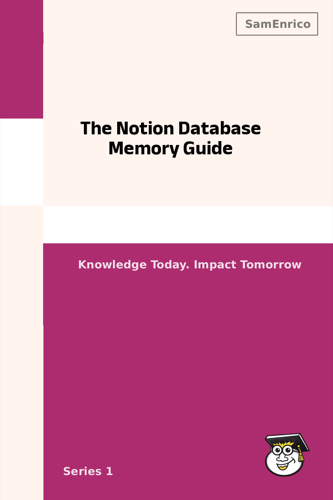
The Notion Database Memory Guide eBook
Builds personal wikis and knowledge bases.
Builds personal wikis and knowledge bases.
Formats
Free sample
Chapter 1: The Graveyard Fallacy--–- The first time someone calls your meticulously organized digital notebook a “graveyard,” you will feel defensive. You have folders inside folders. You have color-coded tags. You have a system, damn it. But here is the brutal truth that no productivity influencer will tell you during their 20-minute You Tube setup tutorial: most personal knowledge bases are not second brains.
They are digital landfills. They are where information goes to die, preserved perfectly, visited rarely, and mourned by no one.This chapter opens with a harsh diagnosis of a problem that has become epidemic in the age of “build a second brain.” We have mistaken collection for connection, storage for understanding, and hoarding for learning. The average knowledge worker saves 47 articles, 12 podcast notes, and 8 meeting transcripts every week. They revisit exactly three of those items. Within 90 days, 94% of saved content has never been opened again.
This is not a memory problem. This is a structural problem. You cannot remember what you cannot find, and you cannot find what you have organized using the wrong mental model.The folder hierarchy—that beloved tree structure of nested categories borrowed from 1980s file systems—is the primary culprit. When you ask “where does this note go,” you are asking the wrong question. You are treating a note like a physical object that must occupy one and only one location.
But a thought about a productivity technique you read in a business book is also relevant to your morning routine, your team meeting agenda, and your annual review. A folder forces you to choose. A database does not.Welcome to the Database-First Principle. This is the foundational shift that distinguishes a graveyard from a garden. Instead of asking where a note belongs, you ask what it is.
Instead of nesting, you tag and relate. Instead of hierarchies, you build networks. This chapter will walk you through why your current system is failing, what the Database-First Principle actually means, and how a single shift in perspective transforms a collection of dead notes into a living, breathing knowledge base that grows more valuable the longer you use it.The Digital Graveyard vs. The Digital Garden Imagine two people. One, whom we will call the Collector, has 3,400 notes in Evernote.
Every article is filed into a folder structure eight layers deep: Work > Projects > Q4 > Marketing > Social > Drafts > Approved > Final. The Collector spends ten minutes each morning deciding where to save a new note. The Collector has never once used the search function because “my organization is perfect.” When asked to find a note about a competitor analysis from eleven months ago, the Collector disappears for twenty minutes, emerges frustrated, and admits defeat. The note exists. It is in the system.
It is irretrievable.The second person, whom we will call the Gardener, has 1,200 notes in Notion. The Gardener uses one master database. Each note has a type—Book, Meeting, Idea, Highlight. Each note has a status—Inbox, Live, Vault. Each note has tags for topics—Productivity, Psychology, Design.
When the Gardener needs the competitor analysis from eleven months ago, they type “competitor” into search. It appears in two seconds. But more importantly, the Gardener discovers that the competitor analysis is linked to three other notes: a product roadmap from last quarter, a customer feedback note from a sales call, and a strategy document written yesterday. The note did not just sit in a folder. It grew roots.
It connected.The Collector has a graveyard. The Gardener has a garden. The difference is not effort. The difference is architecture.A digital graveyard is characterized by three symptoms. First, hierarchical paralysis: you spend more time deciding where to put a note than actually processing its content.
Second, structural amnesia: you forget what you have because nothing reminds you that it exists. Third, single-parent orphans: each note lives in exactly one folder, making it invisible to every other context where it might be useful.A digital garden, by contrast, exhibits three different traits. First, fluid entry: new notes enter a single Inbox with zero friction. Second, emergent connections: notes reveal relationships automatically through relations and tags rather than through manual filing. Third, resurfacing: notes appear in multiple contexts because they are linked, not copied.The Database-First Principle Explained The Database-First Principle sounds technical, but its essence is philosophical.
In a folder-based system, you organize by location. In a database-based system, you organize by attributes. This distinction changes everything.Consider a book note. In a folder system, you might create a folder called “Books,” then a subfolder called “Business,” then a subfolder called “Productivity,” then a file called “Atomic Habits Summary.md.” That file exists in exactly one place. If you later write a blog post about habit formation, you have three options: copy the note (creating duplication), move the note (breaking its original location), or link to it using an external system (complex and fragile).
None of these are good.In a database system, you create one database called “Knowledge Vault.” You add a property called “Type” and select “Book.” You add a property called “Topics” and select “Productivity” and “Psychology.” You add a property called “Related Notes” and leave it empty for now. This single note now belongs simultaneously to every view that filters for “Type = Book” or “Topics includes Productivity.” You have not filed it anywhere. You have described it. And because you described it, it can appear anywhere.The Database-First Principle has four core tenets:Tenet One: One Source of Truth Every piece of knowledge exists in exactly one place—the master database. Every other appearance is a view, a filter, or a relation.
This eliminates the duplication chaos that plagues copy-paste workflows.Tenet Two: Attributes Over Location You navigate your knowledge base by asking questions of your data: “Show me all notes related to productivity created in the last 30 days.” “Show me all book notes where Status = Live and Area = Learning.” You do not navigate by clicking through folders because folders are paths. Databases are queries.Tenet Three: Relations as Roots A note without relations is an orphan. A note with relations is connected. The power of a digital garden comes not from the notes themselves but from the links between them. Each relation is a root that allows knowledge to spread and interact.Tenet Four: Auditable Memory Your knowledge base should be transparent and traceable.
You should be able to see, at a glance, which notes are orphaned, which properties are unused, and which topics are dominating your attention. Auditable memory borrows from software engineering’s concept of debuggability: a system is maintainable when you can inspect its state and understand why it behaves the way it does.The Failure of Folder Hierarchies Let us be precise about why folders fail. The problem is not folders themselves. Folders are excellent for certain use cases: organizing files by project phase, grouping assets by type, structuring a course curriculum. The problem is using folders as the primary organization method for atomic knowledge notes.Folder hierarchies impose a single, rigid taxonomy on information that is inherently multi-dimensional.
A note about a marketing experiment from a Saa S company could be relevant to: Marketing (discipline), Saa S (industry)…
This is the end of the free sample. Get the eBook to keep going. Buy now
About this book
Details
- Author
- Dahl Mauricio
- Publisher
- SamEnrico
- Language
- English
- Genre
- Non-Fiction, Self-Help, Notion
- Released
- 2026-06-06
- Pages (approx.)
- 151
- Available as
- eBook, Audiobook

Read better in the ZLOADR app
Your eBooks on your phone or tablet. Sign in with your SamEnrico account and start reading.
More by Dahl Mauricio
 TM Scientific Research GuideDahl Mauricio$11.99
 The New ProsecutorDahl Mauricio$11.99
 Low Maintenance Landscaping for RetirementDahl Mauricio$11.99
 Caregiver Partner Burnout HelpDahl Mauricio$11.99
 The Silent Storm: Trafalgar's Naval GauntletDahl Mauricio$11.99
 Understanding Waardenburg Syndrome Type 1Dahl Mauricio$17.99
 Terms Template CustomizationDahl Mauricio$12.99
 Angel Investors vs VCs GuideDahl Mauricio$12.99
 Regional Account ManagerDahl Mauricio$11.99
 How to Start a Basket Furniture Business (Beginners Guide)Dahl Mauricio$11.99
You may also like
 Hong Kong Handover 1997Dunn Johnnie$11.99
 Zumba For Postnatal Recovery CourseNeal Christian$11.99
 Zumba for BeginnersLadner Nikia$11.99
 YouTube Comment Mining GuideHumes Pandora$12.99
 Worry Box MeditationCarlin Rudy$11.99
 Workplace Stress MeditationNguyen Lynn$11.99
 Workplace Stress and Sleep RepairHawley Ivory$11.99
 Workplace Perfectionism CureDelaney Jeffry$11.99
 Workplace Injustice Anger GuideWallen Isabelle$11.99
 Work Addiction and Burnout LinkGreenwood Ester$11.99
 Women in Yoga and WellnessBeattie Galina$11.99
 Women in Stand Up ComedyChun Evangeline$11.99