
Non-FictionTrue CrimeLegal Perspective
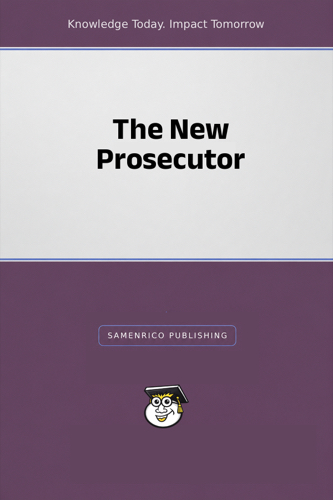
The New Prosecutor eBook
How fresh eyes on the case have brought renewed en
How fresh eyes on the case have brought renewed energy and new perspectives.
Formats
Free sample
Chapter 1: The Blindness We Chose--–- The first time Elena Vasquez reviewed a murder conviction she hadn’t personally charged, she threw up in her office trash can. Not because the crime was violent—she had seen far worse. She threw up because she realized that if she had been the original prosecutor, she would have made the same mistakes. And that meant the difference between a man on death row and a man walking free was not evidence, not law, not justice. It was sheer, dumb luck.The case was twelve years old.
A man named Jerome Bakersfield had been convicted of killing a convenience store clerk during a late-night robbery. The evidence was, by the standards of the era, strong: a jailhouse informant testified that Jerome had confessed to him in a holding cell. A single eyewitness—the clerk’s coworker, who had hidden behind a soda machine—picked Jerome out of a photo array. Jerome’s public defender had been overworked and underfunded, and the trial lasted three days. The jury deliberated for four hours.
Life without parole.Elena, now a third-year prosecutor in the Conviction Integrity Unit, had been assigned to review the file because a new defense attorney had filed a habeas petition claiming ineffective assistance. She did what the original prosecutor should have done. She read the entire file without reading the charging memo first. She took out a yellow legal pad and listed every fact the state had assumed but never independently verified. She highlighted every piece of evidence that came from a single source.
And then she went looking for the people the original investigation had deemed irrelevant.Within two hours, she found three things.First, the jailhouse informant had a pending drug charge in an adjoining county. The original prosecutor had not disclosed that deal to the defense. That was a Brady violation—the suppression of exculpatory evidence—and it alone would have been enough to overturn the conviction. Second, a witness had told police that she saw a man matching Jerome’s description two miles away from the store at the time of the murder. The police report dismissed her as “unreliable” because she had a prior trespass warning.
But her statement was internally consistent, she had no motive to lie, and she had placed herself at a bus stop with a timestamped transfer. No one had ever followed up. Third, the lead detective had been suspended for six months, three years before the arrest, for coercing a confession from a mentally disabled teenager. That suspension was in the detective’s personnel file. The original prosecutor had not looked.Elena sat back in her chair, her stomach churning.
She had not found evidence of innocence. She had found evidence of blindness. And she knew, with the kind of certainty that settles into your bones, that if she had been the original prosecutor—rushing to clear the docket, trusting the detective, assuming the informant was credible because he was “one of ours”—she would have done exactly the same thing.That was the moment she stopped believing in bad prosecutors. She started believing in bad systems.The Ordinary Disaster of Tunnel Vision The American prosecutor does not wake up in the morning and decide to convict an innocent person. That is not how wrongful convictions happen.
They happen the way Jerome Bakersfield’s conviction happened: one small oversight at a time, each one reasonable in isolation, each one invisible to the person making it.The problem is not malice. The problem is prosecutorial tunnel vision—the cognitive phenomenon in which, once a prosecutor adopts a theory of the case, the brain systematically filters out information that contradicts that theory. It is not a character flaw. It is a feature of how human brains process information under conditions of scarcity, stress, and repetition.A typical assistant district attorney handles between 150 and 300 active cases at any given time. That is not a sustainable number.
It is not a number that allows for reflection, curiosity, or doubt. It is a number that demands shortcuts. The brain obliges. Pattern recognition replaces individual assessment. Assumptions stack on top of assumptions.
The first narrative the prosecutor hears—usually from the arresting officer—becomes the anchor, and every subsequent piece of evidence is weighed against that anchor, not independently evaluated.This is the anchoring bias. It is well-documented in cognitive psychology. In one study, judges who were randomly assigned to see a low sentencing anchor (a prosecutor’s demand for a short sentence) imposed significantly shorter sentences than judges who saw a high anchor—even though the anchor was arbitrary and irrelevant. For prosecutors, the anchor is almost always the police report. And once that anchor is set, the case becomes a story.
The prosecutor’s job becomes proving the story, not questioning it.Then there is the outcome bias. If the defendant looks guilty—if they have a record, if they fit a profile, if the crime was brutal—the prosecutor unconsciously assumes the process was fair. Studies have shown that prosecutors are sixty percent less likely to notice procedural errors when they believe the defendant is factually guilty. The logic is backwards, but emotionally intuitive: He did it, so how he got caught doesn’t matter as much. Except it does.
Procedure is not a technicality. Procedure is the difference between reliable and unreliable convictions.The ingroup bias is perhaps the most pernicious. Police officers are “us.” Defense attorneys and defendants are “them.” This tribal loyalty is not explicit; no prosecutor says, I will credit this officer’s testimony because he has a badge. But the data is relentless. Prosecutors are significantly more likely to believe officer testimony over civilian testimony, even when the officer has documented credibility problems, and even when the civilian has no motive to lie.
The blue wall does not have to be spoken to be real.Finally, there is the sunk cost fallacy. Once a case has been charged, resources have been spent, witnesses have been interviewed, and the prosecutor’s reputation has been staked. Backing down feels like failure. Dropping a case feels like admitting you were wrong. So the prosecutor pushes forward, even when the evidence weakens, even when doubt creeps in.
The investment in the outcome becomes a reason to pursue the outcome.None of these biases make a prosecutor evil. They make a prosecutor human. And that is precisely why they are so dangerous.The Outsider Effect There is a reason that Conviction Integrity Units—offices dedicated to reviewing old cases for possible errors—have exonerated hundreds of wrongfully convicted people over the last two decades. It is not because CIU prosecutors are smarter or more ethical than their colleagues. It is because they are outsiders to the original investigation.The psychologist Karl Duncker first described the phenomenon of functional fixedness in 1945: the cognitive bias that limits a person to using an object only in the way it is traditionally used.
A hammer is for nails. A box is for holding things. But when you show someone a box and ask them to use it as a platform, they often fail because they cannot see past the…
This is the end of the free sample. Get the eBook to keep going. Buy now
About this book
Details
- Author
- Dahl Mauricio
- Publisher
- SamEnrico
- Language
- English
- Genre
- Non-Fiction, True Crime, Legal Perspective
- Released
- 2026-06-10
- Pages (approx.)
- 134
- Available as
- eBook, Audiobook

Read better in the ZLOADR app
Your eBooks on your phone or tablet. Sign in with your SamEnrico account and start reading.
More by Dahl Mauricio
 TM Scientific Research GuideDahl Mauricio$11.99
 Low Maintenance Landscaping for RetirementDahl Mauricio$11.99
 The Notion Database Memory GuideDahl Mauricio$11.99
 Caregiver Partner Burnout HelpDahl Mauricio$11.99
 The Silent Storm: Trafalgar's Naval GauntletDahl Mauricio$11.99
 Understanding Waardenburg Syndrome Type 1Dahl Mauricio$17.99
 Terms Template CustomizationDahl Mauricio$12.99
 Angel Investors vs VCs GuideDahl Mauricio$12.99
 Regional Account ManagerDahl Mauricio$11.99
 How to Start a Basket Furniture Business (Beginners Guide)Dahl Mauricio$11.99
You may also like
 Hong Kong Handover 1997Dunn Johnnie$11.99
 Zumba For Postnatal Recovery CourseNeal Christian$11.99
 Zumba for BeginnersLadner Nikia$11.99
 YouTube Comment Mining GuideHumes Pandora$12.99
 Worry Box MeditationCarlin Rudy$11.99
 Workplace Stress MeditationNguyen Lynn$11.99
 Workplace Stress and Sleep RepairHawley Ivory$11.99
 Workplace Perfectionism CureDelaney Jeffry$11.99
 Workplace Injustice Anger GuideWallen Isabelle$11.99
 Work Addiction and Burnout LinkGreenwood Ester$11.99
 Women in Yoga and WellnessBeattie Galina$11.99
 Women in Stand Up ComedyChun Evangeline$11.99