
Non-FictionHealth & WellnessSleep Hygiene
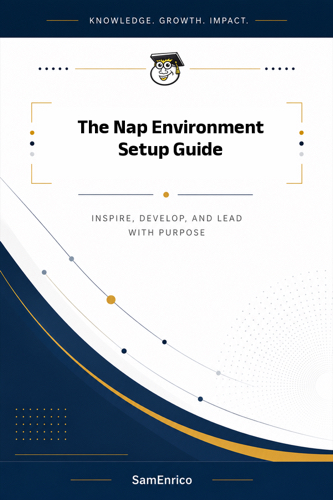
The Nap Environment Setup Guide eBook
Darkness, temperature, and noise control.
Darkness, temperature, and noise control.
Formats
Free sample
Chapter 1: The Thalamus Trap--–- You close your eyes. You lie still. You are exhausted. And yet, fifteen minutes later, you are still awake. Not fully awake, not fully asleep, but trapped in a gray zone of frustrated half-consciousness.
Your mind drifts. A car passes outside. The refrigerator hums. A sliver of light cuts across your eyelids like a laser. You shift.
You sigh. You check your phone. Twenty-three minutes have passed, and you feel worse than when you lay down. You blame yourself. I just can’t relax.
I’m too stressed. I’m bad at napping.Stop.The problem is not your willpower. The problem is not your stress level. The problem is not some fundamental flaw in your ability to rest. The problem is a tiny, walnut-shaped structure deep inside your brain called the thalamus – and your environment is failing it.This chapter will change everything you think you know about napping.
By the time you finish reading, you will understand exactly why your naps fail, why "trying harder" will never work, and why the billionaires, executives, and elite performers who swear by power naps are not more disciplined than you. They have simply learned to work with their thalamus instead of against it.Let us begin with a story.The Executive Who Could Not Nap A few years ago, I consulted with a senior vice president at a Fortune 500 company. Let us call her Sarah. Sarah was brilliant, driven, and perpetually exhausted. She had read every productivity book on the market.
She meditated. She exercised. She ate organic. But every day at 2:00 PM, her brain turned to cotton. She would retreat to her office, close the door, lie down on a small couch, and try to nap for twenty minutes.
Most days, she failed. She would lie there, eyes closed, mind racing, listening to the faint sounds of the office – keyboards clicking, voices murmuring, a printer whirring. On the rare days she did fall asleep, she woke up groggy, disoriented, and worse off than before.Sarah came to me convinced that something was wrong with her. "Maybe I'm just not a napper," she said. "Some people can do it, and some can't."I asked her a simple question: "What did you change about your environment before lying down?"She looked confused.
"What do you mean? I closed my eyes."That was the moment I realized how widespread this misunderstanding is. Sarah had done everything behaviorally correct. She had set aside time. She had a comfortable couch.
She had the intention to rest. But she had not touched her environment. The lights were on. The thermostat was set to 72°F – the standard office temperature. The door was closed but not sealed, allowing the irregular sounds of the office to bleed through.
She had no eye mask, no earplugs, no fan, no blackout film on the window.Sarah was not a bad napper. Sarah was a victim of her thalamus.What Is the Thalamus, and Why Does It Hate You?The thalamus is one of the most ancient and important structures in your brain. Located roughly at the center of your skull, just above your brainstem, it serves as the body's primary sensory relay station. Every piece of sensory information – light from your eyes, sound from your ears, temperature from your skin, pressure from your body – passes through the thalamus before reaching your cortex, the part of your brain responsible for conscious thought.Think of the thalamus as a gatekeeper. During wakefulness, the gate is wide open.
Every sensory signal passes through, and your cortex processes everything. You hear the refrigerator hum. You feel the fabric of your shirt. You see the dust motes floating in sunlight. This is normal.During deep nighttime sleep, the thalamus closes the gate almost completely.
Sensory signals are blocked or severely dampened. This is why you can sleep through a thunderstorm but wake up instantly when someone says your name – the thalamus selectively filters based on importance.During a nap, however, something different happens. The nap window is typically 10 to 30 minutes, and during this time, the brain normally stays in light sleep (stages N1 and N2). In light sleep, the thalamus does not close the gate entirely. It leaves it cracked open.
This is a biological necessity – the brain needs to remain somewhat responsive to the environment during short sleeps to ensure survival. In evolutionary terms, a napping ancestor who was completely unresponsive for twenty minutes would have been an easy meal for a predator.So the thalamus compromises. It reduces the volume of sensory information but does not shut it off completely.Here is the problem: the modern world is far louder, brighter, and hotter than the savannas where our ancestors napped. A single 10-lux light source – roughly the brightness of a nightlight two feet away – is enough to keep the thalamus partially active. A sudden noise of just 40 decibels – the sound of a whispered conversation – triggers an orienting response.
A room temperature of 72°F instead of 68°F causes thermal stress that the thalamus dutifully reports to your cortex.In other words, your thalamus is not broken. It is doing exactly what evolution designed it to do: keeping you alert enough to survive. The problem is that "alert enough to survive" is incompatible with "restorative nap."The Three Myths That Keep You Exhausted Before we go further, let us clear the table of three persistent myths that have been reinforced by well-meaning but misinformed advice.Myth #1: "If I am tired enough, I can nap anywhere."This is the most damaging myth of all. It assumes that fatigue overrides the thalamus. It does not.
The thalamus does not negotiate. It does not care about your sleep debt, your deadlines, or your frustration. It responds to sensory input the same way regardless of how exhausted you are.Here is the proof: shift workers who are severely sleep-deprived still struggle to nap during the day. Why? Because daylight (10,000 to 100,000 lux) keeps their thalamus active.
Noise from traffic, coworkers, and machines keeps their thalamus active. Heat keeps their thalamus active. Fatigue does not close the gate. Only darkness, cool temperatures, and quiet can do that.Myth #2: "Closing my eyes is enough to block light."This is a physiological falsehood. Your eyelids are not blackout curtains.
They are thin layers of skin and muscle that transmit significant amounts of light, particularly blue wavelengths. A study published in the Journal of Sleep Research found that closed eyelids reduce light intensity by only 60 to 80 percent. That means if you are in a room with 10,000 lux of daylight (a typical office), your closed eyes are receiving 2,000 to 4,000 lux – orders of magnitude above the 10 lux threshold for cortical arousal.The hand test, which we will cover in Chapter 3, is the simplest way to verify this. Close your eyes and hold your hand an inch from your face. If you can see the silhouette of your hand against the light coming through your eyelids, you are receiving too much light for a restorative nap.Myth #3: "My phone's night mode solves the light problem."Night mode reduces blue light emission by shifting the display to warmer amber colors.
This is helpful for nighttime sleep because blue light suppresses melatonin production. However, during a daytime nap, melatonin is naturally…
This is the end of the free sample. Get the eBook to keep going. Buy now
About this book
Details
- Author
- Philyaw Arnulfo
- Publisher
- SamEnrico
- Language
- English
- Genre
- Non-Fiction, Health & Wellness, Sleep Hygiene
- Released
- 2026-06-06
- Pages (approx.)
- 139
- Available as
- eBook, Audiobook

Read better in the ZLOADR app
Your eBooks on your phone or tablet. Sign in with your SamEnrico account and start reading.
More by Philyaw Arnulfo
 Body Scan for Forgiveness PracticePhilyaw Arnulfo$11.99
 What Happened to Asha DegreePhilyaw Arnulfo$11.99
 Self Talk for Work Stress WorkbookPhilyaw Arnulfo$11.99
 Gratitude Over Spending GuidePhilyaw Arnulfo$11.99
 The Angel of Death: Dr. Thomas Neill Cream's Poisonous LegacyPhilyaw Arnulfo$11.99
 Understanding Vas Deferens, Congenital Bilateral Aplasia OfPhilyaw Arnulfo$17.99
 Ultimate Handbook Guide to Bishkek : (Kyrgyzstan) Travel GuidePhilyaw Arnulfo$11.99
 Bubble User AuthenticationPhilyaw Arnulfo$12.99
 Promotion Case StorytellingPhilyaw Arnulfo$12.99
 Lead Product ManagerPhilyaw Arnulfo$11.99
You may also like
 Hong Kong Handover 1997Dunn Johnnie$11.99
 Zumba For Postnatal Recovery CourseNeal Christian$11.99
 Zumba for BeginnersLadner Nikia$11.99
 YouTube Comment Mining GuideHumes Pandora$12.99
 Worry Box MeditationCarlin Rudy$11.99
 Workplace Stress MeditationNguyen Lynn$11.99
 Workplace Stress and Sleep RepairHawley Ivory$11.99
 Workplace Perfectionism CureDelaney Jeffry$11.99
 Workplace Injustice Anger GuideWallen Isabelle$11.99
 Work Addiction and Burnout LinkGreenwood Ester$11.99
 Women in Yoga and WellnessBeattie Galina$11.99
 Women in Stand Up ComedyChun Evangeline$11.99