
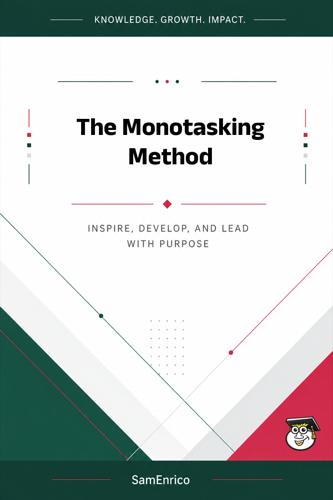
The Monotasking Method eBook
Stop multitasking and focus on one cognitive task
Stop multitasking and focus on one cognitive task at a time.
Formats
Free sample
Chapter 1: The Dopamine Scatter--–- The first time I realized I had a problem, I was standing in my kitchen, phone in one hand, a carton of milk in the other, and absolutely no memory of having opened the refrigerator. It was 8:47 on a Tuesday morning. I had been "working" for exactly forty-seven minutes. In that time, I had checked email twice, glanced at Slack three times, opened and closed Twitter four times, written exactly two sentences of a report, and somehow found myself watching a thirty-second video of a panda sneezing. The milk, I would later discover, had been sitting on the counter for eleven minutes while I scrolled.
This is not a confession of weakness. This is a description of normal life in the twenty-first century, and normal is destroying us.Let me ask you something uncomfortable. Think about the last time you sat down to do one thing—just one thing—and did only that thing until it was finished. No phone checks. No tab switches.
No quick glances at email. No sudden recollection that you needed to order more toothpaste. When was that? Last week? Last month?
Last year? If you are like the vast majority of people I have spoken with, lectured to, and surveyed over the past several years, you cannot remember. And that forgetting is not a memory problem. It is an attention problem. You have not had a single, uninterrupted cognitive task in so long that your brain no longer knows what one feels like.This chapter is called The Dopamine Scatter because that is precisely what has happened to your attention.
It has been scattered across devices, notifications, open tabs, half-written emails, and the endless low-grade hum of digital obligation. And like scattered light, scattered attention produces no heat, no focus, no finished work. It only produces the illusion of busyness. The science is clear, the costs are measurable, and the fix is neither complicated nor easy. But before we can fix anything, you need to understand how you got here.
Because the problem is not that you are weak or lazy or undisciplined. The problem is that you have been systematically trained to be distracted, and you are now living inside a machine that was designed to keep you that way.The Birth of the Slot Machine In 1947, a psychologist named B.F. Skinner placed a hungry rat inside a small box. The box contained a lever. When the rat pressed the lever, a pellet of food dropped into a tray.
The rat learned quickly. Press lever, get food. Press lever, get food. This is called continuous reinforcement, and it produces predictable, stable behavior. But then Skinner changed the game.
He programmed the box so that the lever produced food only sometimes—randomly, unpredictably. Sometimes one press worked. Sometimes ten presses worked. Sometimes fifty. The rat went insane.
Not literally, but behaviorally. It pressed the lever obsessively. It pressed the lever thousands of times per hour. It ignored food that was already in the tray to press the lever again. What Skinner had discovered is now called variable ratio reinforcement, and it is the single most powerful behavioral conditioning mechanism ever studied.
It is how slot machines keep people pulling the handle for hours. It is how email keeps you checking even when there is nothing new. It is how your phone became a lever that you press three thousand times a day.Your phone is not a tool. It is a slot machine. Every time you check it, you are pulling the lever.
Sometimes there is a reward—a notification, a like, a message, a piece of information that feels useful. Sometimes there is nothing. But the randomness is precisely what makes it addictive. Your brain releases dopamine not when you receive a reward, but when you anticipate one. And variable rewards produce the highest levels of anticipatory dopamine.
This is not a moral failing. This is neurochemistry. Your brain is doing exactly what evolution designed it to do: seek unpredictable rewards in an unpredictable environment. The problem is that evolution did not design you to carry a slot machine in your pocket twenty-four hours a day. And the people who built that slot machine—the engineers at Apple, Google, Facebook, Twitter, Instagram, Tik Tok—they know exactly what they are doing.
They have studied Skinner. They have studied dopamine. They have built billion-dollar businesses on the back of your scattered attention.The average smartphone user checks their phone two hundred and sixty-one times per day. That is once every five and a half minutes of waking life. But that is an average.
Heavy users check four hundred or more times per day. Each check is a lever pull. Each lever pull resets your attention. Each reset costs you time, accuracy, and cognitive energy. And because the rewards are variable, you cannot stop.
Not because you are addicted in the clinical sense, but because your brain has been conditioned to treat every moment of boredom or uncertainty as a reason to pull the lever. This is the first layer of the dopamine scatter. It is the layer that lives in your pocket, and it is the layer you can feel.But there is a second layer, and it is more insidious because it has been normalized. It is the layer of the browser tab.The Infinite Sidetrack Open your browser right now. How many tabs do you have?
Be honest. I have watched audiences physically flinch when I ask this question. The average knowledge worker keeps between fifteen and thirty tabs open at any given time. Some keep more. I once spoke to a graphic designer who had ninety-four tabs open across three browser windows.
She described it as "fine" and "normal." It is neither. Each open tab is an open loop. Each open loop is a cognitive burden. Your brain knows those tabs are there, even when you are not looking at them. They create a low-grade sense of unfinished business, a background hum of obligation that never quite resolves.
Psychologists call this the Zeigarnik effect: the human brain remembers unfinished tasks better than finished ones. Open tabs are unfinished tasks. They are also future distractions, each one a click away from pulling you out of whatever you are currently doing.Here is what happens inside your brain when you switch between tabs. First, your brain must disengage from the current task. This process, called task-set deactivation, takes approximately one-tenth of a second.
That does not sound like much, but it is only the beginning. Next, your brain must activate the rules, memories, and procedures associated with the new tab. This is task-set activation, which takes another one-tenth of a second. Two tenths of a second. Two hundred milliseconds.
That is the switching cost. It is tiny. It is also a lie. Because the real cost is not the two hundred milliseconds. The real cost is attention residue.When you leave a task unfinished, your brain does not fully let it go.
Part of your attention stays stuck to the previous task, like a piece of tape that did not quite detach. This is attention residue, and it…
This is the end of the free sample. Get the eBook to keep going. Buy now
About this book
Details
- Author
- Snipes Toccara
- Publisher
- SamEnrico
- Language
- English
- Genre
- Non-Fiction, Business Brief, Monotasking
- Released
- 2026-06-06
- Pages (approx.)
- 150
- Available as
- eBook, Audiobook

Read better in the ZLOADR app
Your eBooks on your phone or tablet. Sign in with your SamEnrico account and start reading.
More by Snipes Toccara
 Treehouse Escape GuideSnipes Toccara$11.99
 Flow in TeachingSnipes Toccara$11.99
 Stress Skin Health GuideSnipes Toccara$11.99
 Tea House Ceremony CalmSnipes Toccara$11.99
 Affirmations for GriefSnipes Toccara$11.99
 Rock Climber's Self HypnosisSnipes Toccara$11.99
 Priority Matrix for Busy PeopleSnipes Toccara$11.99
 The Golden Age of Axum: Africa’s Forgotten Architectural MarvelsSnipes Toccara$11.99
 The Comeback Kid: James Harrison's Unlikely Super Bowl TriumphSnipes Toccara$11.99
 Water Buffaloes: Domestic & WildSnipes Toccara$11.99
 How to Produce DiapersSnipes Toccara$11.99
 How to Produce Pizzelle MakersSnipes Toccara$11.99