
Non-FictionSelf-HelpDEI Communication
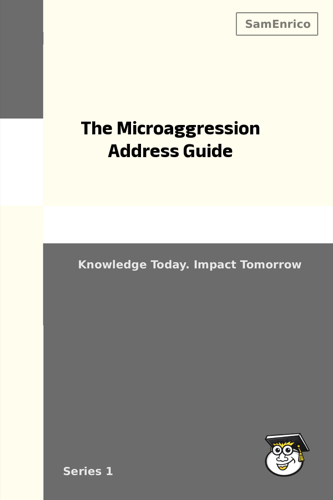
The Microaggression Address Guide eBook
Calls out subtle racism or bias without escalating
Calls out subtle racism or bias without escalating.
Formats
Free sample
Chapter 1: The Software Update...--Most of us walk around believing we are good people. We donate to charity, hold doors for strangers, and would never dream of using a racial slur. Yet somehow, without warning, a casual comment leaves a colleague looking stricken. A joke at dinner lands like a brick. You open your mouth to defend yourself and hear yourself saying, “That’s not what I meant,” even as you watch the other person’s face close off like a shuttered window.Welcome to the gap.
The gap between who you intend to be and how you sometimes land. The gap between your values and your reflexes. This entire book exists because that gap is real, it is universal, and it is almost never closed by shame or accusation.The problem with microaggressions is not that only villains commit them. The problem is that good people commit them constantly, usually without the slightest awareness, and then react with defensive horror when someone points it out. This book is not a guide to winning arguments or collecting apologies.
It is a guide to updating your social software so that you can address subtle bias—your own and others’—without escalating every interaction into a showdown.Let us begin with a story that does not appear in any psychology textbook but happens in every office, every family dinner, and every friend group in the country.Aisha is the only Black woman on her engineering team. She has been there for three years. She has excellent performance reviews. One morning, her white male colleague Tom walks past her desk and says cheerfully, “You know, Aisha, you’re so articulate. I just love hearing you explain things.”Aisha feels something drop in her stomach.
She knows Tom means well. He is not a racist. He is actually a decent guy who brings cookies to meetings. But the word “articulate” lands like a paper cut—tiny, sharp, and impossible to ignore. It carries a history.
It carries the implication that she, unlike other Black people, can string sentences together. It carries the assumption that Tom is surprised.Aisha has three options. Option one: say nothing. Bury the feeling. Smile.
This is what she usually does. It leaves her exhausted by 2 PM. Option two: say, “That’s racist.” Tom’s face would crumple. He would spend the rest of the day telling other colleagues that Aisha called him a racist for giving a compliment. He would never hear the word “articulate” the same way again, but he would also never trust Aisha again.
Option three: say something in between. Something that names the impact without torching the relationship. Something that educates without escalating.Most people do not have option three. That is why you are reading this book.The Myth of the Bad Person Let us dismantle the most seductive lie about microaggressions right now. The lie is this: only bad people say biased things.
If you believe this, then every time someone points out that you said something biased, you hear it as an accusation that you are a bad person. Your brain immediately goes into defense mode. You think, But I marched in that protest. But I have friends from that group. But I would never.
And because you cannot accept being a bad person, you reject the feedback entirely.This is not weakness. This is neuroscience.The human brain is wired to protect its self-concept. Psychologists call this cognitive dissonance: the discomfort of holding two contradictory beliefs at once. In this case, the two beliefs are “I am a good person” and “I just said something harmful.” The brain resolves the discomfort not by accepting the harm but by rejecting the feedback. You’re too sensitive.
That’s not what I meant. You’re looking for problems.The same mechanism operates when you are the target of a microaggression. If you believe that only bad people commit them, then every microaggression you experience becomes a confirmation that you are surrounded by monsters. That belief is exhausting and usually inaccurate. Most microaggressions come from people who genuinely like you and genuinely harbor unconscious stereotypes they did not ask for and do not know they have.This book asks you to hold a more useful belief: Most people are decent.
Most people also have implicit biases. These two truths coexist.Once you accept that, everything changes. When you are the target, you can respond with calibration rather than fury. When you are the offender, you can receive feedback with curiosity rather than shame. When you are a bystander, you can intervene without becoming a hero or a villain.What Actually Happens Inside the Brain To understand why microaggressions are so sticky and why addressing them is so hard, we need to look under the hood.
The brain does not process social information as a calm, rational computer. It processes social information through two systems.System one is fast, automatic, and unconscious. It is the part of your brain that recognizes a face in 200 milliseconds, that knows a friend’s voice on the phone, that flinches at a sudden loud noise. System one runs on stereotypes because stereotypes are efficient. Your ancestors needed to know instantly whether that rustling in the bushes was a predator or the wind.
Your brain evolved to categorize rapidly: us versus them, safe versus dangerous, familiar versus foreign.System two is slow, deliberate, and conscious. It is the part of your brain that solves math problems, plans a vacation, or decides which health insurance plan to choose. System two is lazy. It takes energy. The brain would rather run on system one whenever possible.Here is the crucial insight: microaggressions are almost always system one errors.
They are not calculated acts of hatred. They are automatic stereotypes firing faster than empathy can catch up.When Tom tells Aisha she is articulate, his system one has associated “Black person” with “less educated” or “less verbal.” That association was not consciously chosen. It was absorbed from media, from news stories that overrepresent Black people in crime reports and underrepresent them in expert interviews, from a thousand tiny cultural cues. His system two, the rational part, genuinely believes in equality. But system two is slower.
By the time it wakes up, the words are already out of his mouth.This is why “I didn’t mean it” is both true and insufficient. Tom did not mean it in the sense that he did not consciously decide to insult Aisha. But the harm exists whether he meant it or not. And more importantly, the stereotype exists whether he endorses it or not.Cognitive load makes this worse. When you are tired, stressed, multitasking, or in a hurry, system two gets even lazier.
The brain defaults even more heavily to system one shortcuts. That is why microaggressions spike during busy periods at work, during family holidays when everyone is overstimulated, and in the last hour of a long social event. It is not that people become more racist when tired. It is that their brain’s brakes fail.The Harm Is Real Even When the Intent Is Innocent A critic might say, “If the person didn’t mean…
This is the end of the free sample. Get the eBook to keep going. Buy now
About this book
Details
- Author
- Cooke Argelia
- Publisher
- SamEnrico
- Language
- English
- Genre
- Non-Fiction, Self-Help, DEI Communication
- Released
- 2026-06-07
- Pages (approx.)
- 138
- Available as
- eBook, Audiobook

Read better in the ZLOADR app
Your eBooks on your phone or tablet. Sign in with your SamEnrico account and start reading.
More by Cooke Argelia
 Gen X Gamer DemographicsCooke Argelia$11.99
 Lead Paint Safe RenovationCooke Argelia$11.99
 Affirmations for LoversCooke Argelia$11.99
 Body Scan During Physical TherapyCooke Argelia$11.99
 The Billionaire's Gamble: How Richard Branson Defied GravityCooke Argelia$11.99
 Understanding PsychosisCooke Argelia$17.99
 Brand Awareness One Page PlanCooke Argelia$12.99
 Bridgewater GuideCooke Argelia$12.99
 How to Become a CompilerCooke Argelia$11.99
You may also like
 Hong Kong Handover 1997Dunn Johnnie$11.99
 Zumba For Postnatal Recovery CourseNeal Christian$11.99
 Zumba for BeginnersLadner Nikia$11.99
 YouTube Comment Mining GuideHumes Pandora$12.99
 Worry Box MeditationCarlin Rudy$11.99
 Workplace Stress MeditationNguyen Lynn$11.99
 Workplace Stress and Sleep RepairHawley Ivory$11.99
 Workplace Perfectionism CureDelaney Jeffry$11.99
 Workplace Injustice Anger GuideWallen Isabelle$11.99
 Work Addiction and Burnout LinkGreenwood Ester$11.99
 Women in Yoga and WellnessBeattie Galina$11.99
 Women in Stand Up ComedyChun Evangeline$11.99