
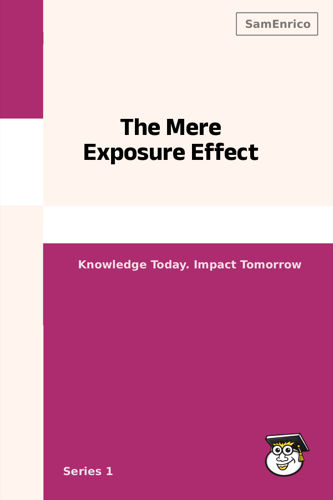
The Mere Exposure Effect
Use repeated low-key exposure to increase customer
Use repeated low-key exposure to increase customer preference.
Formats
About this book
Free sample
Chapter 1: The Mirror Lie--–- You have probably never heard of Robert Zajonc. That is about to change. But before we get to the Polish-born psychologist who upended everything we thought we knew about human preference, let me ask you a question that will reveal the invisible machinery inside your own skull.Why do you hate the sound of your own voice on a recording?Think about it. You speak every day. You hear your own voice constantly.
But when a voicemail plays back or a video records you unexpectedly, you cringe. “Is that what I really sound like?” you ask yourself, a little horrified. Meanwhile, everyone around you says, “That’s just your voice. It sounds normal.”Now here is the even stranger question: Why do you like the way you look in a mirror, but hate the way you look in a photograph?Again, the mirror feels right. The photograph feels wrong.
Your nose seems wider. Your eyes seem smaller. Your smile looks crooked. Yet your friends say, “That’s just what you look like.”These two everyday mysteries are not random annoyances. They are the front door to one of the most powerful, most underestimated, and most profitable psychological forces in human decision-making.
A force that determines which politician you vote for, which soda you buy, which software your company renews, and which restaurant you choose when you are too tired to think.That force is called the Mere Exposure Effect.And here is the radical truth that will take most of this book to fully absorb: You do not prefer things because you have carefully evaluated them and found them superior. You prefer things because you have seen them before.Full stop.The brain does not say, “I have seen this logo ten times, therefore I should trust this company.” The brain does not say, “I have heard this song before, therefore I like it.” The brain simply feels a little warmer, a little safer, a little more relaxed when it encounters something familiar. And then, after the feeling arrives, the brain fabricates a rational reason. “Oh, I like this…
This is the end of the free sample. Get the eBook to keep going. Buy now
Contents
- Chapter 1
- Chapter 2
- Chapter 3
- Chapter 4
- Chapter 5
- Chapter 6
- Chapter 7
- Chapter 8
- Chapter 9
- Chapter 10
- Chapter 11
- Chapter 12
Details
- Author
- Cahill Glendora
- Publisher
- SamEnrico
- Language
- English
- Genre
- Non-Fiction, Business Brief, Marketing
- Released
- 2026-06-07
- Pages (approx.)
- 157
- Available as
- eBook, Audiobook

Read better in the ZLOADR app
Your eBooks on your phone or tablet. Sign in with your SamEnrico account and start reading.
More by Cahill Glendora
 Shopping Emotion RegulationCahill Glendora$11.99
 Elizabeth I Foreign Policy GuideCahill Glendora$11.99
 Financial Stress and Physical HealthCahill Glendora$11.99
 The Guerrilla Artists of the Berlin Wall: Painting Rebellion in a Divided WorldCahill Glendora$11.99
 How to Produce Atvs and UtvsCahill Glendora$11.99
 Smart Document Archiving GuideCahill Glendora$12.99
 Conceptual PhotographyCahill Glendora$11.99
 How to Start a Braces (wholesale) Business (Beginners Guide)Cahill Glendora$11.99
You may also like
 The Attraction EffectJuarez Emerald$11.99
 London Marketing StrategiesJacobson Rosario$11.99
 Fiverr Buyer Persona GuideMcclellan Kermit$11.99
 The Self Reference EffectAckerman Kirby$11.99
 Mentorship for MarketersRawls Jamee$11.99
 The Social Proof BlueprintFenton Launa$11.99
 The Humor EffectBraden Nadia$11.99
 The Endowment Effect GuideHartley Yuriko$11.99
 Leading Hybrid Marketing TeamsHollins Korey$11.99
 Email Drip Campaign ManagementHeck Neva$11.99
 The Representativeness BiasDarby Magen$11.99
 Business Credit for Marketing AgenciesGrisham Maranda$11.99