
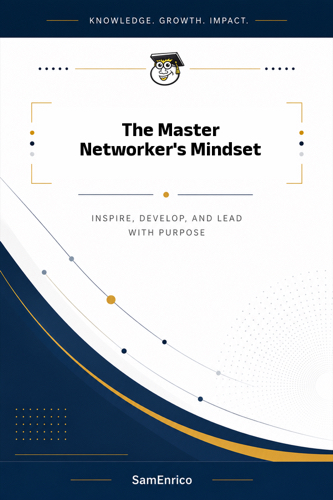
The Master Networker's Mindset eBook
Cultivate the attitudes and beliefs that make rela
by Comer Glayds
Cultivate the attitudes and beliefs that make relationship building natural and effective.
Formats
Free sample
Chapter 1: The Giver's Genius–- The conference room smelled of stale coffee and desperate ambition. Thirty-seven professionals sat in a semicircle, name tags affixed to expensive blazers, each person silently calculating who in the room could advance their career. I watched as a woman in a red dress approached a man with "Vice President" on his tag. Within twelve seconds, she had delivered her elevator pitch, asked for a job referral, and handed him her card. He nodded politely, pocketed the card, and turned away before she finished her sentence.
She never saw him again.That was me seven years ago. The woman in the red dress. The card collector. The person who treated every human interaction as a transaction waiting to happen. And I was miserable—not because I failed, but because even when I succeeded, the relationships felt hollow, the favors felt owed, and the network I had built felt like a house of cards ready to collapse at the slightest wind.Everything changed when a mentor sat me down after watching me work a room for three hours.
He said something I have never forgotten: "You're not networking. You're panhandling with a business card. You ask before you give. You extract before you plant. And people can smell it on you from across the room."That was the beginning of the Great Renaming.
The moment I stopped asking "What can I get?" and started asking "What can I give?"The Zero-Sum Lie That Destroyed Your Networking Most people believe networking is a zero-sum game: if someone else wins, you lose. If they get the introduction, you don't. If they close the deal, the opportunity is gone. This belief is not just wrong—it is the single most destructive force in professional relationship building.Let me be clear about what zero-sum thinking looks like in practice. It sounds like this: "I only have so much time, so I need to spend it with the most important people." "If I introduce these two people, they might cut me out." "I'll help you, but only after you help me first." "What's in this for me?"These statements reveal a scarcity mindset that treats relationships as finite resources to be hoarded rather than infinite opportunities to be created.
And here is the irony that every master networker eventually discovers: the people who think this way are the poorest networkers, not because they lack skill, but because they lack a fundamental belief about how the world works.The research backs this up unequivocally. Adam Grant, the organizational psychologist at Wharton, spent a decade studying how givers, takers, and matchers succeed across industries. His findings, detailed in his landmark book Give and Take, upend everything we think we know about networking success.Takers (people who try to get more than they give) rise quickly but crash harder. They win in the short term and lose in the long term because people eventually stop helping them.Matchers (people who believe in tit-for-tat, quid pro quo) do okay. They build sustainable but shallow networks.
They are reliable but not beloved.Givers (people who give more than they receive, at least in any single transaction) sit at both the very bottom and the very top of every success metric. The lowest performers are givers who give without boundaries and burn out. The highest performers are givers who give strategically, generously, and without immediate expectation—but who also know when to protect their time.The difference between the giver who fails and the giver who dominates is not the act of giving itself. It is the mindset behind it.Introducing the Two-Ring Model: Universal Courtesy, Strategic Investment One of the most common criticisms of "give first" networking is that it sounds exhausting. "You expect me to help everyone I meet?
I don't have that kind of time or energy." This criticism is valid—which is why it needs a response that earlier networking books failed to provide.Let me introduce the Two-Ring Model. Think of your network as two concentric circles.The Outer Ring: Universal Courtesy. Everyone you meet—the barista, the intern, the CEO, the person who annoys you at the cocktail party—deserves basic human generosity. This means: a genuine smile, eye contact, a kind word, a willingness to answer a simple question, a quick piece of helpful information. These acts cost you almost nothing.
A thirty-second introduction. A one-sentence email. A sincere compliment. You can and should offer universal courtesy to everyone without expectation of return.The Inner Ring: Strategic Investment. A much smaller group of people—those who have demonstrated reciprocity over time, who share your values, who show up consistently—deserves your deeper investment.
These are the people you schedule regular coffee with. The ones you make warm introductions for. The ones you send opportunities to before they ask. The ones whose crises you drop everything to help with.Here is the critical insight that most networking books miss: the outer ring feeds the inner ring. You cannot know who belongs in your inner ring until you have extended universal courtesy to many people in your outer ring.
Some of those people will reciprocate. Some will not. The ones who reciprocate—who say "thank you," who offer help back, who remember your name—earn a closer look.The ones who take and never give? You do not cut them off. You do not burn the bridge.
You simply stop investing beyond universal courtesy. You remain polite, professional, and helpful in small ways. But you do not lose sleep over them. You do not resent them. You simply redirect your deeper investment to the people who have earned it.This model resolves the false tension between "help everyone unconditionally" and "protect your time strategically." You do both.
You help everyone in small ways. You invest deeply in a few. And you let time and reciprocity be your filters.The Self-Audit: Your Last Five Interactions Before you can change your mindset, you need to know where you currently stand. Let me walk you through a simple but uncomfortable self-audit.Think back to your last five professional networking interactions. These could be:A conversation at a conference A coffee meeting A Linked In message exchange A post-event follow-up email A chance encounter at an industry gathering For each interaction, ask yourself these four questions:Question 1: Did I lead with an ask or an offer?
Be honest. Did your opening sentence ask for something (advice, an introduction, a favor, a job lead) or offer something (a resource, an idea, a compliment, an introduction to someone else)?Question 2: What did I know about this person before we spoke? Did you research them? Did you know what they cared about? Did you know what problems they were trying to solve?
Or did you go in cold, hoping to extract value?Question 3: Did I follow up with value, or did I follow up with another ask? After the interaction, did you send them something useful (an article, a connection, a piece of feedback) or did you send them a reminder of what you wanted?Question 4: Would this person describe our interaction as a net positive for them? If you…
This is the end of the free sample. Get the eBook to keep going. Buy now
About this book
Details
- Author
- Comer Glayds
- Publisher
- SamEnrico
- Language
- English
- Genre
- Non-Fiction, Self-Help
- Released
- 2026-06-09
- Pages (approx.)
- 148
- Available as
- eBook, Audiobook

Read better in the ZLOADR app
Your eBooks on your phone or tablet. Sign in with your SamEnrico account and start reading.
More by Comer Glayds
 Suburban Mobile Lifestyle PatternsComer Glayds$11.99
 Stress and Friendship ManagementComer Glayds$11.99
 Birth Control And Blood ClotsComer Glayds$11.99
 The Fall of Constantinople: The Cannon's Roar That Shattered an EmpireComer Glayds$11.99
 How to Produce Baseball BatsComer Glayds$11.99
 Community Association ManagerComer Glayds$11.99
 Chinese Student Motivation HacksComer Glayds$12.99
 How to Start a Boiled Sweet Business (Beginners Guide)Comer Glayds$11.99
You may also like
 Hong Kong Handover 1997Dunn Johnnie$11.99
 Zumba For Postnatal Recovery CourseNeal Christian$11.99
 Zumba for BeginnersLadner Nikia$11.99
 YouTube Comment Mining GuideHumes Pandora$12.99
 Worry Box MeditationCarlin Rudy$11.99
 Workplace Stress MeditationNguyen Lynn$11.99
 Workplace Stress and Sleep RepairHawley Ivory$11.99
 Workplace Perfectionism CureDelaney Jeffry$11.99
 Workplace Injustice Anger GuideWallen Isabelle$11.99
 Work Addiction and Burnout LinkGreenwood Ester$11.99
 Women in Yoga and WellnessBeattie Galina$11.99
 Women in Stand Up ComedyChun Evangeline$11.99