
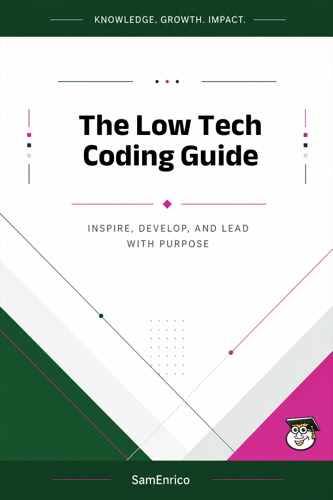
Non-FictionSelf-HelpProgramming
The Low Tech Coding Guide eBook
Limited computing power forces efficiency.
Limited computing power forces efficiency.
Formats
Free sample
Chapter 1: The Forgotten Constraint...–- The first computer I ever fell in love with had 256 bytes of memory. Not 256 gigabytes. Not 256 megabytes. Two hundred and fifty-six bytes. That is less space than it takes to store this sentence.
It was a simple embedded controller in a piece of laboratory equipment, and I spent an entire summer coaxing it to do things its manufacturer had declared impossible. I learned more about programming in those three months than in four years of computer science. Because when you have 256 bytes, you cannot afford a single wasted instruction. You cannot hide behind layers of abstraction. You cannot call a function just because it feels clean.
You have to think. Really think. Every byte, every cycle, every branch matters. And that, dear reader, is where this book begins.The chapter that follows is not another celebration of the cloud, where we spin up another hundred containers because monitoring showed a 0.2% latency spike. It is not a tribute to the latest framework that compiles down to Java Script only to run a to-do list that could have been written in twenty lines of HTML.
This chapter is an autopsy of our collective amnesia. We forgot how to be efficient. Worse, we started believing that efficiency no longer mattered. But the pendulum swings back. And those who understand the forgotten constraint will inherit the next era of computing.The Great Acceleration and the Greater Forgetting In 1965, Gordon Moore observed that the number of transistors on an integrated circuit doubled approximately every two years.
For decades, this prediction held with uncanny precision. Clock speeds rose from kilohertz to gigahertz. Memory grew from bytes to gigabytes. Disk space expanded from kilobytes to terabytes. A programmer in 1985 who wrote code that took ten seconds to run could wait two years and run the same unoptimized code in five seconds, just from hardware improvements.
By 1995, that same code ran in two seconds. By 2005, it ran in half a second. The hardware engineers were cleaning up our mess.Something insidious happened during this golden age. We stopped feeling the weight of our code. A web developer today might ship a front-end bundle that contains more Java Script than the entire source code of the Apollo Guidance Computer, which landed humans on the Moon.
That isn't hyperbole. The Apollo Guidance Computer had 72 kilobytes of ROM and 4 kilobytes of RAM. Your average news website downloads ten megabytes of tracking scripts before rendering a single paragraph of text. We have built a trillion-dollar industry on the assumption that waste is free.But the free lunch ended. Clock speeds stopped climbing around 2005.
Dennard scaling, which allowed transistors to get faster and more efficient with each shrink, broke down. We now pack more cores onto chips instead of making individual cores faster. Meanwhile, the number of devices with severe constraints exploded. The Internet of Things put computers into light bulbs, door locks, and soil moisture sensors. Satellites the size of shoeboxes orbit the Earth with less computing power than a smartphone from 2010.
Medical implants must run for years on a battery smaller than a pea. Autonomous drones must process video and make decisions within millisecond deadlines, not because the hardware is slow, but because the physics of flight demands it.Efficiency is not a relic. Efficiency is the future.The Myth of Abundance Let me tell you about a conversation I had with a senior engineer at a well-known social media company. He was complaining about their build times. The codebase had grown so large that a clean compilation took over an hour.
I asked him what they had tried. He listed: faster servers, SSDs instead of spinning disks, distributed compilation across a hundred machines, precompiled headers. I asked a different question: "Have you tried deleting code?" He looked at me as if I had suggested sacrificing a goat. Deleting code simply wasn't in his mental toolbox.That is the myth of abundance. When resources appear infinite, subtraction never occurs to us.
We only know how to add. Add another service. Add another abstraction. Add another dependency. Add another layer of caching.
Add another configuration option. The codebase expands like a gas filling an infinite container. But the container is never infinite. The container is a finite machine with a finite power budget and a finite heat dissipation limit and a finite latency requirement before the user taps away in frustration.The physicist Rolf Landauer once said that information is physical. Every bit you store, every instruction you execute, every branch you mispredict consumes energy and time.
When you pretend these costs don't exist, you don't escape physics. You simply make your code slower and more expensive in ways you fail to measure.Consider the humble smartphone in your pocket. It has more computing power than a supercomputer from 1990. And yet, open any popular app and wait. Count the seconds before the interface responds to your touch.
Watch the spinner spin. The hardware improved by a factor of ten thousand, but the user experience improved by… what? Perhaps a factor of ten? Two? All that exponential growth in capability was eaten by exponential growth in bloat.
We took a miracle of engineering and turned it into a slightly faster spinner.A Brief History of Getting Things Done with Nothing To understand where we are, we must understand where we came from. The early programmers had no choice but to be efficient. They programmed on machines with core memory measured in kilobytes, or even bytes. They wrote in assembly language or machine code because compilers for high-level languages were luxuries that consumed precious resources. They invented data structures and algorithms that are now taught in textbooks but emerged from pure necessity.Edsger Dijkstra, one of the giants of computer science, wrote his shortest path algorithm while working with the ARMAC computer in 1956.
The ARMAC had 4 kilobytes of memory. Dijkstra's algorithm wasn't a theoretical exercise. It was the only way to compute routes on a machine that couldn't hold a full map in memory all at once. Constraints forced elegance.Grace Hopper, while working on the UNIVAC I, developed the first compiler because she believed that programmers should focus on problems, not on the tedious details of machine code. But her compiler produced efficient code because the UNIVAC's 1,000-word memory left no room for waste.
The compiler had to earn its keep.The programmers of the Apollo Guidance Mission created what is still regarded as a masterpiece of real-time systems engineering. They used rope memory, where each bit was literally a wire threaded through or around a magnetic core. Writing the software meant physically threading wires. You cannot push a hotfix to rope memory. You cannot ship a patch.
You must get it right, and you must get it small. The Apollo Guidance Computer ran on 2 megahertz and never crashed during a mission. Your laptop runs on billions of cycles per second and crashes weekly.Then came the era of plenty. The 1980s and 1990s saw personal computers with increasingly generous specifications. The Macintosh in 1984 had 128 kilobytes of RAM.
By 1990, a typical PC had 2 megabytes. By 2000, 64 megabytes. By 2010, 4 gigabytes. Each doubling made the…
This is the end of the free sample. Get the eBook to keep going. Buy now
About this book
Details
- Author
- Richie Frieda
- Publisher
- SamEnrico
- Language
- English
- Genre
- Non-Fiction, Self-Help, Programming
- Released
- 2026-06-06
- Pages (approx.)
- 140
- Available as
- eBook, Audiobook

Read better in the ZLOADR app
Your eBooks on your phone or tablet. Sign in with your SamEnrico account and start reading.
More by Richie Frieda
 Racial Stress Physical TollRichie Frieda$11.99
 International Franchise Gift Card ProgramsRichie Frieda$11.99
 Dual Diagnosis HIV AIDSRichie Frieda$11.99
 Anger Management for ArchitectsRichie Frieda$11.99
 The Last Flight of the Enola Gay: The Untold Story of the Atomic Bomb’s ShadowRichie Frieda$11.99
 How to Start a Capeline Felt Business (Beginners Guide)Richie Frieda$11.99
 Understanding Salla DiseaseRichie Frieda$17.99
 UK Business Credit Bureaus GuideRichie Frieda$12.99
 Parts Sales AssociateRichie Frieda$11.99
You may also like
 Hong Kong Handover 1997Dunn Johnnie$11.99
 Zumba For Postnatal Recovery CourseNeal Christian$11.99
 Zumba for BeginnersLadner Nikia$11.99
 YouTube Comment Mining GuideHumes Pandora$12.99
 Worry Box MeditationCarlin Rudy$11.99
 Workplace Stress MeditationNguyen Lynn$11.99
 Workplace Stress and Sleep RepairHawley Ivory$11.99
 Workplace Perfectionism CureDelaney Jeffry$11.99
 Workplace Injustice Anger GuideWallen Isabelle$11.99
 Work Addiction and Burnout LinkGreenwood Ester$11.99
 Women in Yoga and WellnessBeattie Galina$11.99
 Women in Stand Up ComedyChun Evangeline$11.99