
Non-FictionSelf-HelpLegal Stress
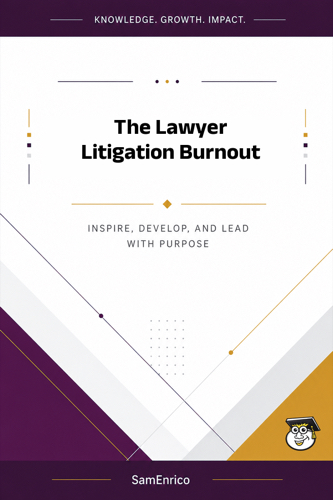
The Lawyer Litigation Burnout eBook
Manages case pressure, opposing counsel, and clien
by Barden Gino
Manages case pressure, opposing counsel, and client expectations.
Formats
Free sample
Chapter 1: The Secret Epidemic--I was a third-year litigation associate when I first understood that I was not merely tired but broken. The realization did not arrive during a dramatic courtroom collapse or a tearful confession to a partner. It came on a Tuesday morning, 6:47 AM, in my parked car. I had been sitting in my garage for twenty-three minutes. The engine was off.
The garage door was closed. My hands were on the steering wheel. I was not thinking about a case. I was not thinking about opposing counsel. I was not thinking about a client.
I was thinking about whether I had the energy to turn the key again and drive to the office. That was the moment I knew something was wrong.I share this not because my story is unique. It is not. I share it because, in the four years since that morning, I have spoken with over two hundred litigators across twelve states. Every single one of them had a version of that moment.
Some were in courthouse bathrooms before a hearing. Some were in bed at 2 AM, staring at a ceiling, unable to sleep but too exhausted to work. Some were at dinner with their families, answering emails under the table. Some were at their desks, crying silently between billable tasks.Every single one of them thought they were the only one.That is the first lie this book will dismantle. You are not the only one.
You are not weak. You are not failing. You are not secretly unsuited for this profession. You are experiencing a predictable, structural, and solvable problem. And the legal industry has spent decades convincing you that the problem is you.It is not.The Three Lies You Have Been Told Before we can solve burnout, we must name the poison.
The legal profession feeds litigators three toxic lies, and the longer you have practiced, the more deeply you have internalized them.Lie Number One: If you are exhausted, you are doing it right.Law firms reward endurance more than intelligence. The associate who sleeps at her desk is praised. The partner who answers emails from the delivery room is held up as a model. The lawyer who takes a vacation and does not check in is viewed with suspicion. This is not accidental.
The billable hour model—which we will dismantle in Chapter 2—depends on treating time as the only currency. And time is infinite only if you are willing to sacrifice everything else.The result is a profession that confuses suffering with virtue. I have heard senior partners say, with genuine pride, that they went three years without a weekend. I have heard firm administrators celebrate "all-nighters" as team-building. I have heard judges remark, approvingly, that a lawyer "must really care" because she looked exhausted at oral argument.This is not dedication.
This is a trauma bond.Lie Number Two: Burnout is a personal failure of resilience.When a litigator crashes, the profession offers three explanations: you are not tough enough, you are not organized enough, or you are not cut out for this. Notice what none of these explanations do. They do not examine the system. They do not examine the caseload. They do not examine the opposing counsel who torments you or the client who drains you.
They place the problem entirely inside your skull and call it a character flaw.This is gaslighting. And it is extremely effective gaslighting because it comes wrapped in the language of self-improvement. "Have you tried meditation?" "Have you tried time blocking?" "Have you tried a gratitude journal?" These are not bad tools. They become bad when they are offered as the complete solution to a structural problem. You cannot meditate your way out of a 250-hour billing month.
You cannot gratitude-journal your way out of opposing counsel who threatens you daily. You cannot time-block your way out of a client who calls at 10 PM.Lie Number Three: The stress will go away when you make partner / close this case / get through trial / [insert milestone here].This is the most seductive lie because it contains a grain of truth. There are moments of relief. The trial ends. The settlement signs.
The partner title arrives. And for a few days or weeks, you feel lighter. Then the next case arrives. Then the next client. Then the next opposing counsel.
The stress does not go away. It changes shape. It is a hydra. Cut off one head, and two grow back.The milestone myth keeps lawyers running on a treadmill that has no off switch. You tell yourself that you just need to survive this deposition, this motion, this quarter.
But the deposition is followed by the next deposition. The motion is followed by the appeal. The quarter is followed by the next quarter. The treadmill accelerates until you fall off or burn out.Here is the truth that no law firm will tell you: burnout is not a sign that you are failing. Burnout is a sign that the system is working exactly as designed.What Burnout Actually Is The word "burnout" is used so casually that it has lost meaning.
Lawyers say they are burned out after a long week. Athletes say it after a tough season. Parents say it after a sleepless night with a newborn. But clinical burnout is not fatigue. It is not stress.
It is not being tired.Clinical burnout, as defined by decades of research, has three components.First, emotional exhaustion. This is not just feeling tired. It is feeling depleted at a cellular level. You have nothing left to give. You wake up exhausted.
You go to bed exhausted. The exhaustion follows you into weekends, into vacations, into moments that should restore you. You cannot think your way out of it. You cannot sleep your way out of it. It is a bone-deep emptiness that makes every task feel like climbing a mountain.Second, depersonalization.
This is the gradual numbing of your emotional responses. You stop caring about clients the way you once did. You stop feeling outrage at opposing counsel's tactics. You stop feeling satisfaction at wins. The work becomes mechanical.
You go through the motions because going through the motions is easier than feeling the feelings you no longer have access to.Depersonalization is the profession's most dangerous adaptation because it feels like professionalism. You tell yourself you are being objective. You tell yourself you are being detached. You tell yourself you are being strategic. But detachment and numbness are not the same thing.
Strategic distance is a choice. Depersonalization is a loss of choice.Third, reduced personal accomplishment. This is the quiet belief that nothing you do matters. You win a motion, and you feel nothing. You lose a motion, and you feel nothing.
You help a client, and the gratitude slides off you like water off a raincoat. The cases blur together. The outcomes blur together. You cannot remember why you wanted to be a lawyer in the first place, and the fact that you cannot remember does not bother you as much as it should.If you recognize yourself in these three components, you are not imagining things. You…
This is the end of the free sample. Get the eBook to keep going. Buy now
About this book
Details
- Author
- Barden Gino
- Publisher
- SamEnrico
- Language
- English
- Genre
- Non-Fiction, Self-Help, Legal Stress
- Released
- 2026-06-05
- Pages (approx.)
- 139
- Available as
- eBook, Audiobook

Read better in the ZLOADR app
Your eBooks on your phone or tablet. Sign in with your SamEnrico account and start reading.
More by Barden Gino
 Workplace Stress Recovery VacationBarden Gino$11.99
 Buprenorphine Induction ProtocolBarden Gino$11.99
 Bookstagram Aesthetic TrapBarden Gino$11.99
 Phidias: Sculptor of the GodsBarden Gino$11.99
 How to Start a Denatured Ethyl Alcohol Business (Beginners Guide)Barden Gino$11.99
 AI Data Analysis for Finance TeamsBarden Gino$12.99
 Learn to Play the Pocket CornetBarden Gino$11.99
 Customer Experience CoorBarden Gino$11.99
You may also like
 Hong Kong Handover 1997Dunn Johnnie$11.99
 Zumba For Postnatal Recovery CourseNeal Christian$11.99
 Zumba for BeginnersLadner Nikia$11.99
 YouTube Comment Mining GuideHumes Pandora$12.99
 Worry Box MeditationCarlin Rudy$11.99
 Workplace Stress MeditationNguyen Lynn$11.99
 Workplace Stress and Sleep RepairHawley Ivory$11.99
 Workplace Perfectionism CureDelaney Jeffry$11.99
 Workplace Injustice Anger GuideWallen Isabelle$11.99
 Work Addiction and Burnout LinkGreenwood Ester$11.99
 Women in Yoga and WellnessBeattie Galina$11.99
 Women in Stand Up ComedyChun Evangeline$11.99