
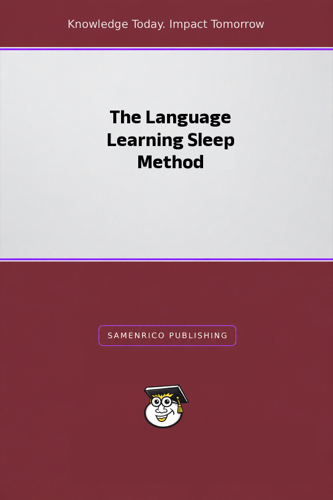
Non-FictionSelf-HelpLanguage Learning
The Language Learning Sleep Method eBook
Replays vocabulary during sleep to boost acquisiti
Replays vocabulary during sleep to boost acquisition.
Formats
Free sample
Chapter 1: The Midnight Librarian--–- Every night, while you sleep, your brain runs a silent, automated library. The head librarian—a small, seahorse-shaped structure called the hippocampus—does not rest. It sorts through the day’s receipts, discards what seems useless, and files what matters into long-term storage. If you have ever studied a list of foreign words before bed, only to find them strangely familiar the next morning without any conscious effort, you have already experienced this nocturnal filing system. You just did not know how to use it deliberately.This book is about learning how to hand the midnight librarian exactly what you want it to file.
Not twenty random words. Not a full paragraph of grammar rules. Not the audio track from a movie. Just ten specific vocabulary items, delivered in the right format, at the right time, so that your sleeping brain does the work of moving them from temporary scratch space into permanent memory. The method is called the Language Learning Sleep Method, and despite what late-night television commercials have promised for decades, it does not teach you new information while you are unconscious.
No credible study has ever shown that human beings can absorb brand‑new facts, conjugations, or syntax from silence or sound during deep sleep. What the research does prove—repeatedly, across dozens of peer‑reviewed studies—is that sleep dramatically enhances the retention of information you encountered while awake. That distinction is not a minor footnote. It is the entire foundation of this book.If you have tried sleep‑learning products before, you have likely been disappointed. You may have purchased an expensive album promising to teach you French or Mandarin while you slept, played it all night, and woken up knowing little more than the melody of the opening track.
That failure was not your fault. Those products violate the basic biology of memory consolidation. They assume that the sleeping brain is a sponge, passively absorbing whatever liquid is poured onto it. In reality, the sleeping brain is a selective gatekeeper. It actively filters incoming sound, admits only what it has been primed to expect, and strengthens only those memories that were tagged as important during waking hours.
Understanding that filter—and learning to work with it—is the single most important skill you will develop in this book.The Myth of Effortless Learning The idea of learning while asleep is ancient. In the early twentieth century, manufacturers sold “phonopedic” devices that played educational records under pillows. By the 1970s, “hypnopedia” had entered the mainstream imagination through novels and films, often depicted as a dystopian tool for mind control. In reality, the first rigorous studies of sleep learning produced a clear, consistent, and disappointing result: people do not remember new information first presented to them during deep sleep. In a landmark experiment conducted in 1956, researchers played lists of word pairs to sleeping subjects and tested them the next morning.
Subjects showed no recall whatsoever unless they had been briefly awakened during playback—which meant they were technically learning while awake.For decades, the scientific community largely abandoned sleep learning as a pseudoscientific dead end. Then, in the early 2000s, a subtle but crucial shift occurred. Researchers stopped asking “Can you learn new information during sleep?” and started asking “Can sleep strengthen information you already learned while awake?” The answer, it turned out, was a resounding yes. The 2014 Swiss study that you may have seen in news headlines is the most famous example: participants learned word pairs in the evening, then heard audio cues of those same words during slow‑wave sleep. The next morning, those who received the sleep cues remembered significantly more than those who heard no cues or who heard random, unlearned words.
The brain did not learn the words during sleep. It replayed and reinforced them.That distinction is everything. You cannot fall asleep with zero knowledge of the Spanish word for “apple” and wake up knowing manzana. But if you studied manzana for ten minutes before bed, and if your brain hears that same sound during the right sleep stage, your hippocampus will prioritize that word for long‑term storage. Sleep does not teach.
Sleep files.The Gatekeeper: Your Thalamus To understand why the sleep method works only for vocabulary you have already primed, you need to meet the thalamus. Located deep in the center of your brain, the thalamus acts as a sensory relay station. During wakefulness, it dutifully passes almost all incoming sensory information to the cortex for processing. During sleep, however, the thalamus becomes a strict gatekeeper. It actively blocks most sounds from reaching the cortex, because your brain does not want to wake up every time a car passes or a floorboard creaks.But the thalamus is not a perfect barrier.
It has a set of rules about what gets through. Familiar sounds—your name, the voice of a loved one, a specific alarm tone—are more likely to pass the thalamic filter. So are sounds that your brain has been told to expect. When you prime a set of vocabulary words immediately before sleep, you are essentially telling your thalamus, “These sounds are important. Let them through.” The following morning, when you replay those same words as audio cues during slow‑wave sleep, the thalamus recognizes them and permits them to reach the cortex, where the hippocampus can work its consolidation magic.This is why random, unfamiliar words played all night do nothing.
The thalamus has no reason to admit them. They are noise, not signal. By contrast, the ten words you actively reviewed twenty minutes before bedtime are tagged as high‑priority traffic. They cross the gate, trigger hippocampal replay, and move from fragile short‑term memory into the durable architecture of long‑term storage.Vocabulary Versus Grammar: One Sleep, Two Systems Not all language learning benefits equally from sleep replay. This is a point where most commercial sleep products either remain silent or actively mislead you.
Vocabulary—specifically, the association between a word’s sound and its meaning—is uniquely suited to sleep‑enhanced consolidation. Grammar, syntax, and sentence structure are not.Why the difference? Vocabulary learning is essentially a pairing task. Your brain must connect a novel sound sequence (the foreign word) to an existing concept or translation. This kind of paired‑associate learning relies heavily on the hippocampus, which is extremely active during slow‑wave sleep.
Grammar, on the other hand, involves abstract rules about word order, conjugation, and agreement. These rules are processed by different neural circuits—including the frontal cortex and basal ganglia—that do not show the same sleep‑dependent replay activity. You can hear “the cat eats the mouse” a hundred times during sleep, and your brain will not extract the subject‑verb‑object rule any more effectively than if you had heard it once while awake.This does not mean grammar is unimportant. It means you must learn grammar during waking hours, through active practice and explicit instruction. Sleep can then help you remember the examples of grammar you have already studied—the specific conjugated verb forms, the correct prepositions, the adjective endings.
But the rule itself? That requires a conscious, wakeful brain.The practical implication is straightforward: use your waking study time for…
This is the end of the free sample. Get the eBook to keep going. Buy now
About this book
Details
- Author
- Boykin Andera
- Publisher
- SamEnrico
- Language
- English
- Genre
- Non-Fiction, Self-Help, Language Learning
- Released
- 2026-06-05
- Pages (approx.)
- 145
- Available as
- eBook, Audiobook

Read better in the ZLOADR app
Your eBooks on your phone or tablet. Sign in with your SamEnrico account and start reading.
More by Boykin Andera
 Workplace Chat Interruption GuideBoykin Andera$11.99
 Creative Starvation ArtsBoykin Andera$11.99
 Economics Essay GPT PromptsBoykin Andera$11.99
 Divorce and Tax FilingBoykin Andera$11.99
 The Golden Contract: How Pelé and His Agent Changed Football ForeverBoykin Andera$11.99
 Understanding Plague, BubonicBoykin Andera$17.99
 Audience Flywheel DesignBoykin Andera$11.99
 SaaS Consolidation GuideBoykin Andera$12.99
 QuickBooks Class Tracking GuideBoykin Andera$12.99
 How to Start a Opera Production Business (Beginners Guide)Boykin Andera$11.99
You may also like
 Hong Kong Handover 1997Dunn Johnnie$11.99
 Zumba For Postnatal Recovery CourseNeal Christian$11.99
 Zumba for BeginnersLadner Nikia$11.99
 YouTube Comment Mining GuideHumes Pandora$12.99
 Worry Box MeditationCarlin Rudy$11.99
 Workplace Stress MeditationNguyen Lynn$11.99
 Workplace Stress and Sleep RepairHawley Ivory$11.99
 Workplace Perfectionism CureDelaney Jeffry$11.99
 Workplace Injustice Anger GuideWallen Isabelle$11.99
 Work Addiction and Burnout LinkGreenwood Ester$11.99
 Women in Yoga and WellnessBeattie Galina$11.99
 Women in Stand Up ComedyChun Evangeline$11.99