
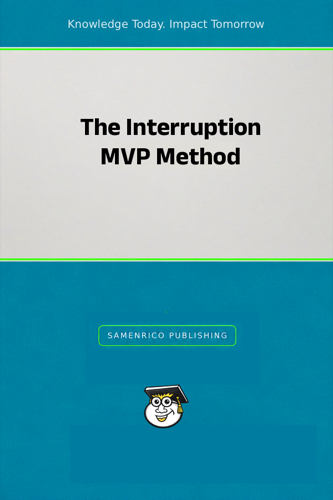
The Interruption MVP Method eBook
Asks interrupters: Is this Minimum Viable Problem
Asks interrupters: Is this Minimum Viable Problem or can you solve it?
Formats
Free sample
Chapter 1: The Two Doors--Every interruption is a choice disguised as an emergency.You feel it in your chest first—that small spike of adrenaline when someone appears at your desk, your Slack icon blinks, or your phone buzzes. Your brain, wired for social connection and problem-solving, prepares to drop everything. In that half-second before you respond, you have already lost something: your focus, your momentum, and—most dangerously—your permission to think.This chapter is not about becoming less helpful. It is about becoming helpfully precise. Before you can master the Interruption MVP Method, you must understand its foundational architecture: the distinction between a Minimum Viable Problem and a problem someone can solve themselves.
Get this wrong, and every tool in this book will fail. Get it right, and you will cut your interruptions by more than half before you finish Chapter 12.The Most Expensive Door in Business Imagine a busy emergency room. A nurse runs to a doctor and says, “Patient in room four is in pain.” The doctor has a choice. She can ask, “What kind of pain? Where?
What are the vitals? What have you given them already?” Or she can drop everything and run to room four without a single additional question.In a well-run ER, the nurse would never deliver that first vague statement. Instead, they use a structured handoff called SBAR—Situation, Background, Assessment, Recommendation. The nurse would say, “Room four, thirty-two-year-old male, post-op from appendectomy, heart rate one-twenty, blood pressure ninety over sixty, reports ten-out-of-ten abdominal pain. I recommend pain medication and a surgical consult.” That is a Minimum Viable Problem.
The doctor has exactly what she needs to act. She does not need to extract information. She does not need to investigate what the nurse should have noticed. She can make a decision in seconds.Your workplace is not an emergency room. Ninety-nine percent of the interruptions you receive are not emergencies.
But they feel like emergencies because of how they are delivered. The asker walks through Door Number One—the door marked “MVP Problem”—but they have not done the work to make it an MVP. They have handed you a raw, unprocessed, solvable mess and called it an urgent unknown.Door Number Two is the door marked “Solvable Problem.” Behind this door are all the questions, tasks, and puzzles that the asker already has the skills, access, and resources to resolve themselves. They are not walking through Door Two because they are stuck. They are walking through Door Two because Door Two is easier.
Door Two requires no thinking, no trying, no failing. Door Two is the escape hatch from effort.The tragedy is that most askers do not realize there are two doors. They interrupt because they are stuck, and they believe being stuck means they need someone else. They have never been taught the difference between a genuine unknown—a gap only you can fill—and the natural discomfort of working through a solvable problem alone.Your job, as a reader of this book, is to learn how to recognize which door the interruption came from before you respond. And then to respond accordingly.
Not cruelly. Not lazily. But strategically.Defining the Minimum Viable Problem A Minimum Viable Problem has four characteristics. Memorize them. They will save you thousands of hours.First, it has one specific unknown.
Not two. Not three. One. The asker can articulate exactly what they do not know in a single sentence. For example: “I do not know whether to use encryption protocol A or B for the customer data field.” That is one unknown.
“I do not know how to fix the database and also I am not sure if the front end is working” is two problems masquerading as one.Second, the unknown cannot be solved by the asker alone. There is a genuine gap in authority, expertise, or access. The asker has tried reasonable steps and hit a wall that only you can help with. They can tell you what they tried, what happened, and why they are still stuck.Third, the solution to the unknown requires no more than two minutes of your time. This is the single time limit that governs the entire Interruption MVP Method.
Two minutes. Not five. Not “a quick call.” Two minutes. Why two? Because research from UC Irvine and Microsoft shows that the average context-switch recovery time is twenty-three minutes.
If you spend two minutes solving someone’s MVP, you lose twenty-three minutes of focus. That is an acceptable trade for a genuine blocker. If you spend five minutes, you lose twenty-three minutes, and the math stops working. Two minutes is the maximum investment for any interruption-worthy problem. (We will explore the two-minute rule in depth in Chapter 9.)Fourth, the asker has already done all solvable work.
They have looked for documentation. They have tried the obvious solutions. They have spent at least ten minutes attempting to solve it themselves. They can answer the question from Chapter 5: “What have you tried already?” with a list of specific, failed attempts.When all four conditions are met, you have a genuine Minimum Viable Problem. It is interruption-worthy.
It is your job to answer it as quickly as possible—in two minutes or less—and send the asker back to work.Everything else is a solvable problem. And solvable problems do not get your attention.Defining the Solvable Problem A solvable problem is any interruption that fails one or more of the four MVP conditions. Let us walk through the most common failures.Failure of specificity. The asker says, “Can you look at this report? Something is wrong.” They cannot tell you what “wrong” means.
They have not isolated the unknown. This is not an MVP. It is a request for you to do their debugging for them.Failure of genuine stuckness. The asker has the skills to solve the problem but lacks confidence. They are a senior developer asking how to write a basic SQL query.
They are a manager asking you to draft an email they could draft themselves. They have the access and the ability. They are choosing to outsource because outsourcing feels safer than trying and failing.Failure of the two-minute rule. The asker’s problem would take thirty minutes to explain, an hour to debug, or a full conversation to resolve. That is not an interruption.
That is a project. Projects belong on calendars, not in your Slack at 2:47 PM.Failure of attempted work. The asker has tried nothing. They opened the problem, felt a twinge of discomfort, and immediately looked for someone to rescue them. They have no list of attempts.
They cannot answer “What have you tried?” without saying “Nothing yet.”Every solvable problem is an opportunity. Not an opportunity for you to solve it—an opportunity for the asker to grow. When you solve a solvable problem for someone, you are not helping them. You are disabling them. You are teaching them that you are the path of least resistance.
You are training them to interrupt you more.This is the great betrayal of workplace “helpfulness.” We think we are being good colleagues when we say yes to everything. We…
This is the end of the free sample. Get the eBook to keep going. Buy now
About this book
Details
- Author
- Lyon Camellia
- Publisher
- SamEnrico
- Language
- English
- Genre
- Non-Fiction, Self-Help, Problem Solving
- Released
- 2026-06-10
- Pages (approx.)
- 139
- Available as
- eBook, Audiobook

Read better in the ZLOADR app
Your eBooks on your phone or tablet. Sign in with your SamEnrico account and start reading.
More by Lyon Camellia
 The Workaholic's Exercise RebootLyon Camellia$11.99
 NVC For Guilt GuideLyon Camellia$11.99
 Hillary Everest Trash CleanupLyon Camellia$11.99
 Behavioral Experiment AngerLyon Camellia$11.99
 The Koresh Messiah ComplexLyon Camellia$11.99
 Cash Flow for DistributorsLyon Camellia$11.99
 Teresa and John of CrossLyon Camellia$11.99
 Blair New LabourLyon Camellia$11.99
 The Serpent’s Gambit: What If Cleopatra Defeated Rome?Lyon Camellia$11.99
 The Unseen Maestro: The Secret Life of Quincy JonesLyon Camellia$11.99
 Whispers of the Silk Road: The Lost Caravan of the Celestial AtlasLyon Camellia$11.99
 The Mineral Guide to WhitlockiteLyon Camellia$11.99
You may also like
 Define Problem Statement WorkshopNichols Curtis$11.99
 Pain Point Innovation GuideHagan Davina$11.99
 The Struggle Is Data GuideBattle Kirby$11.99
 Problem Solving DBT WorkbookCriswell Violette$11.99
 Problem Solving VisualizationWeeks Jamar$11.99
 Problem Solving for EmotionsCollado Zelda$11.99
 Problem Framing WorkshopDancy Rosario$11.99
 Group Creative Problem Solving HandbookOliveira Mardell$11.99
 Problem Solving DreamsSchmid Ray$11.99
 Collaborative Problem SolvingGilson Dara$11.99
 Collaborative Problem Solving HandbookCross Lisa$11.99
 TM Obstacle TroubleshootingRubio Carly$11.99