
Non-FictionSelf-HelpEmail ManagementAutomation
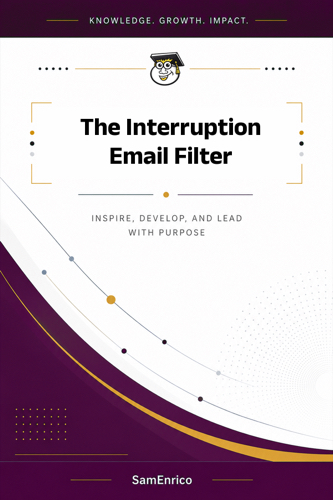
The Interruption Email Filter eBook
Create rules, folders, and auto-replies to dramati
Create rules, folders, and auto-replies to dramatically cut email's interruption power.
Formats
Free sample
Chapter 1: The 11-Hour Funeral--–- Sarah’s thumb hovered over the email icon for the seventeenth time that morning. She was sitting on a park bench, her daughter Clara wobbling across the grass toward a swing set. Clara had been trying to take her first independent steps for three weeks. Sarah had watched every failed attempt from behind a glowing rectangle. Today, Clara finally did it—three wobbly steps, a pause, then two more.
Sarah saw it happen in her peripheral vision because she was deleting a message about Q2 expense reporting. She missed the first steps. She would never get them back.This is not a book about email. This is a book about attention, about the quiet war being fought every day for the most valuable resource you own—and the strange way a $5 billion industry has convinced you to give it away for free, one notification at a time. Email is not the enemy.
Email is a tool, and like any tool, it can build a house or smash a window. The problem is that somewhere between the invention of the Black Berry in 2003 and the rise of the smartphone a decade later, the tool took over the workshop. You stopped managing email. Email started managing you.The evidence is everywhere, hiding in plain sight. Watch any waiting room, any dinner table, any crosswalk.
Look at the faces illuminated by blue light, thumbs twitching, jaws slack. These are not bad people or lazy people. These are prisoners of a system designed to exploit a quirk in human neurology. Every buzz, every badge icon, every unread count is a tiny lever pulled by a machine that wants one thing: your eyeballs, one more time, just one more time. And you pull back.
You check your email at 11:00 PM in bed. You check it while the coffee brews. You check it while sitting on the toilet. You check it while your daughter takes her first steps.This book is the intervention.The Invention of the Interruption Email was never supposed to be like this. When Ray Tomlinson sent the first networked email in 1971, he was solving a technical problem: how to leave messages between users on different computers.
The experience was deliberately asynchronous. You sent a message, logged off, and maybe checked back hours later or the next day. There were no notifications because there were no screens small enough to carry. There was no expectation of instant reply because instant was impossible.Fast forward to today. There are 4.5 billion email users worldwide.
The average office worker receives 121 emails per day and sends 40. The average executive receives twice that. And here is the number that should terrify you: the average knowledge worker checks email 77 times per day. That is not a typo. Seventy-seven times.
If you sleep eight hours, that means you are checking email roughly once every twelve waking minutes.Let me say that again. Every twelve minutes, you voluntarily interrupt yourself to look at a box of other people's requests.The consulting firm Rescue Time analyzed data from 50,000 workers who used their time-tracking software. The findings were devastating. Of those 77 daily checks, only 38 percent of emails required any action at all. The other 62 percent were pure noise—newsletters, Reply All chains, CCs that should have been BCCs, thank-yous, receipts, and messages that could have been a two-word text message.
The average worker spends 11 hours per week on email. Nearly three of those hours are spent reading and deleting messages that never should have been sent.Eleven hours. That is nearly half a day. That is a second job. That is the entire workweek of a part-time employee, and you are doing it for free.The Email Tax: Three Hidden Costs Let me introduce a concept that will appear throughout this book: the Email Tax.
It is not a tax the government collects. It is a tax you pay with your time, your sanity, and your potential. The Email Tax has three components, and understanding each one is the first step toward building your interruption filter.The Switching Tax The first component is the switching tax. Every time you glance at an email, you make a decision: open it or ignore it. That decision takes a fraction of a second.
But the cost is not the glance. The cost is what happens after you look away.Sophie Leroy, a professor at the University of Washington, studied what happens when people switch between tasks. She coined the term "attention residue." When you are working on Task A and you switch to Task B, a portion of your attention remains stuck on Task A. You cannot help it. The brain takes time to disengage from one cognitive context and engage with another.
Leroy found that the average attention residue lasts 22 minutes and 47 seconds.Let me translate that. You are writing a report—deep focus, good flow. Ping. An email arrives. You glance at the subject line.
You do not even open it. You just see the sender's name and the subject. That glance costs you twenty-three minutes of partial focus. You will work slower, make more errors, and feel more tired. And if you actually open the email—even just to read it and say "I'll deal with this later"—the residue lasts even longer.Now do the math.
Seventy-seven glances per day. Twenty-three minutes of residue per glance. That is 1,771 minutes, or 29.5 hours of lost focus every single week. You cannot get that time back. You can only stop paying the tax.The Emotional Tax The second component is the emotional tax.
Your inbox is not a neutral space. It is charged with anxiety, obligation, and fear. Every unread message is a tiny weight on your chest. Psychologists call this the "Zeigarnik effect": uncompleted tasks occupy more mental space than completed ones. Your brain literally holds open a file for every unfinished thing, constantly scanning for resolution.Email exploits this mercilessly.
Each unread message is an open loop. The red badge icon is a blinking reminder of your inadequacy. "You have 847 unread messages" is not a neutral fact. It is a judgment. It whispers: You are behind.
You are failing. Everyone is waiting for you.A 2019 study from the University of British Columbia measured cortisol levels in workers who checked email frequently versus those who checked in batches three times per day. The frequent checkers had cortisol spikes throughout the day, their heart rates were elevated, and they self-reported higher anxiety. The batching group had flat cortisol lines, normal heart rates, and reported feeling "in control." The only difference was the rhythm of interruption.The emotional tax manifests in other ways too. It is the dread you feel opening your phone after vacation.
It is the guilt of ignoring a non-urgent email for three days. It is the vague sense of being watched, of being measured, of falling behind some invisible metric that everyone else has already mastered. That tax is real, and it follows you home. You check email at dinner. You check it while watching a movie.
You check it in bed, and then you wonder why you cannot sleep.The Opportunity Tax The third component is the…
This is the end of the free sample. Get the eBook to keep going. Buy now
About this book
Details
- Author
- Reddick Drusilla
- Publisher
- SamEnrico
- Language
- English
- Genre
- Non-Fiction, Self-Help, Email Management, Automation
- Released
- 2026-06-10
- Pages (approx.)
- 124
- Available as
- eBook, Audiobook

Read better in the ZLOADR app
Your eBooks on your phone or tablet. Sign in with your SamEnrico account and start reading.
More by Reddick Drusilla
 Letting Go of Social Media ResentmentReddick Drusilla$11.99
 Turkey Living Abroad Business GuideReddick Drusilla$11.99
 Commercial Real Estate CrowdfundingReddick Drusilla$11.99
 Chunking for Grocery ShoppingReddick Drusilla$11.99
 The Hoarder’s Child Recovery GuideReddick Drusilla$11.99
 Pelvic Floor Exercises GuideReddick Drusilla$11.99
 Partner Anger De escalationReddick Drusilla$11.99
 Body Image For Plus SizeReddick Drusilla$11.99
 Quantum Leap: The Untold Story of the First Commercial Quantum ComputerReddick Drusilla$11.99
 The Spark of the East: Japan's Hidden Electromagnetic PioneersReddick Drusilla$11.99
 The Billionaire's Gambit: How a Single Trade Shattered a DynastyReddick Drusilla$11.99
 The Complete Guide to Jenny CraigReddick Drusilla$11.99
You may also like
 Hong Kong Handover 1997Dunn Johnnie$11.99
 Zumba For Postnatal Recovery CourseNeal Christian$11.99
 Zumba for BeginnersLadner Nikia$11.99
 YouTube Comment Mining GuideHumes Pandora$12.99
 Worry Box MeditationCarlin Rudy$11.99
 Workplace Stress MeditationNguyen Lynn$11.99
 Workplace Stress and Sleep RepairHawley Ivory$11.99
 Workplace Perfectionism CureDelaney Jeffry$11.99
 Workplace Injustice Anger GuideWallen Isabelle$11.99
 Work Addiction and Burnout LinkGreenwood Ester$11.99
 Women in Yoga and WellnessBeattie Galina$11.99
 Women in Stand Up ComedyChun Evangeline$11.99