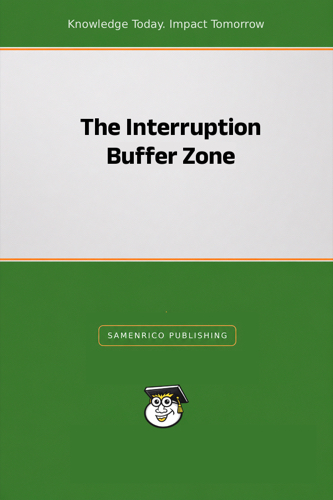
The Interruption Buffer Zone eBook
Create protected time zones in your daily schedule
Create protected time zones in your daily schedule where interruptions are explicitly forbidden.
Formats
Free sample
Chapter 1: The Billion-Dollar Fragment--–- In the time it takes you to read this sentence, your phone has probably buzzed. And you felt it—that tiny zip of electricity in your chest, that reflexive twitch toward the screen. That is not anxiety. That is not diligence. That is addiction wearing a work ethic costume.The myth of the “always-on hero” is one of the most destructive fables of the modern workplace.
It tells you that the best employees are the ones who reply to emails at 11:00 PM, who answer Slack messages during dinner, who keep fourteen browser tabs open and a phone screen glowing beside the keyboard. It tells you that responsiveness equals reliability, that speed equals competence, that fragmentation equals hustle.Every single part of that myth is a lie.And it is a very expensive lie. Not just for your company’s bottom line, though the numbers are staggering. It is expensive for your sanity, for your creativity, for the quality of your thinking, and for the quiet hours of your life that you will never get back.This book is the robbery report. And then the plan to steal your time back.The 23-Minute Thief Let us begin with a number that will either infuriate you or liberate you: twenty-three.Twenty-three minutes is the average time it takes the human brain to fully recover from a single three-minute interruption.
This finding, replicated across dozens of studies in cognitive psychology and workplace productivity research, represents one of the most underreported facts about how our minds actually work.Here is what happens when you are writing a report, debugging code, designing a presentation, or any other task that requires what psychologists call “executive function”—the high-level cognitive processing that distinguishes deep work from shallow reactivity. Your brain assembles what is known as a “cognitive map”: a temporary neural network that holds together the context, the goal, the next step, the half-formed idea, the relevant data, and the emotional stake you have in doing the work well. This map is fragile. It is built quickly but maintained delicately. And when you are interrupted—even for three seconds to glance at a notification—that map begins to collapse.Not all at once.
It disintegrates like a sandcastle hit by a wave. Some pieces remain. But the coherence, the flow, the sense of knowing exactly what you were about to do next—that evaporates.When you return to your work after a three-minute interruption, you do not simply pick up where you left off. You spend an average of twenty-three minutes reloading the context: re-reading the last few paragraphs, retracing your mental steps, remembering why you made that choice, re-establishing the emotional momentum. Sometimes you never fully recover.
Sometimes you give up and switch to a different task, which is itself another interruption, which triggers another recovery period, and so on down the spiral.Let me say that again because it is the single most important sentence in this chapter: A three-minute interruption costs you twenty-three minutes of productive brainpower.Now do the math.If you are interrupted just five times in a workday—and most knowledge workers experience between fifteen and thirty interruptions daily—you lose nearly two hours to recovery time. Not to the interruptions themselves. To the cost of the interruptions. If you are interrupted fifteen times, you lose nearly six hours. That is not a workday.
That is a day spent mostly rebuilding sandcastles that keep getting kicked over.This is what I call the fragmentation tax. And you are paying it right now, whether you know it or not.The Myth of the Multitasker Before we go further, we must kill another lie: the myth of multitasking.You have heard someone say it. You may have said it yourself. “I am great at multitasking.” “I can do email while on a conference call while reviewing a document.” “I have seven screens and I watch them all.”No, you do not.What the human brain actually does when you “multitask” is something called rapid task-switching. Your attention does not split like a beam of light through a prism.
It bounces like a pinball between tasks, pausing briefly on each one before lurching to the next. Each bounce carries a switching cost: the time and cognitive energy required to disengage from Task A, reorient to Task B, and rebuild the context for Task B. Then you bounce back to Task A, paying the switching cost again.Neuroscientists have measured this cost in laboratory settings using functional MRI scans. When subjects switch between tasks, the brain’s prefrontal cortex—the region responsible for complex reasoning and decision-making—lights up with activity. That activity is not productive work.
That activity is overhead. It is the mental equivalent of a semi-truck downshifting through every gear to climb a hill, then upshifting again on the descent, burning fuel the entire time without moving forward.One of the most cited studies on this topic comes from Gloria Mark at the University of California, Irvine. Her research team observed knowledge workers in their natural environments and found that the average employee switches tasks every three minutes and five seconds. After each switch, it takes approximately twenty-three minutes to return to the original task at full focus. That is not a typo.
The same number appears again and again across different studies, different industries, different job roles.Three minutes of interruption. Twenty-three minutes of recovery. That is the rhythm of the fragmented life.The Interruption Quotient: Measuring Your Own Fragmentation Before you can fix a problem, you must measure it. This chapter includes the Interruption Quotient (IQ) self-assessment—a tool you will use again at the end of this book to measure your progress.Take out a piece of paper or open a blank document. For the next three workdays, keep a simple tally.
Every time you are interrupted—by a notification, a colleague stopping by, a phone call, your own wandering mind—mark it down. At the end of each day, count your interruptions and multiply by twenty-three minutes. That is your daily fragmentation tax in minutes. Divide by sixty. That is your daily fragmentation tax in hours.I have administered this assessment to hundreds of professionals.
The average daily interruption count is eighteen. Eighteen times twenty-three minutes is 414 minutes—nearly seven hours. Most people are spending an entire workday recovering from interruptions, not doing their actual work.Let that sink in.You may be working nine hours to produce two hours of deep, focused output. The rest is recovery, context switching, and shallow reactivity.But here is the liberating part of this discovery: the fragmentation tax is not inevitable. It is not a law of nature.
It is a consequence of choices—your choices, your environment’s choices, your technology’s default settings. And choices can be unmade and remade.What Interruptions Actually Cost You (Beyond Time)The fragmentation tax steals more than minutes and hours. It steals the quality of your thinking.When you work in a state of constant interruption, you never descend into what psychologist Mihaly Csikszentmihalyi called “flow”—that effortless, timeless state where work feels like play and your best ideas emerge unbidden. Flow requires sustained, uninterrupted…
This is the end of the free sample. Get the eBook to keep going. Buy now
About this book
Details
- Author
- Moreland Herlinda
- Publisher
- SamEnrico
- Language
- English
- Genre
- Non-Fiction, Self-Help, Time Blocking
- Released
- 2026-06-07
- Pages (approx.)
- 127
- Available as
- eBook, Audiobook

Read better in the ZLOADR app
Your eBooks on your phone or tablet. Sign in with your SamEnrico account and start reading.
More by Moreland Herlinda
 Stevie Wonder InnervisionsMoreland Herlinda$11.99
 Self Doubt In Caregiving GuideMoreland Herlinda$11.99
 Housing Preference Contrast StudyMoreland Herlinda$11.99
 Anger in Divorce ProcessMoreland Herlinda$11.99
 Sleep Memory For College StudentsMoreland Herlinda$11.99
 Low Carb Snacks HandbookMoreland Herlinda$11.99
 Long Term Care FundingMoreland Herlinda$11.99Long Term Care FundingMoreland Herlinda$11.99
 The Phantom of the Andes: A Dog’s Hunt for Peru’s Greatest HoaxMoreland Herlinda$11.99
 The Battle of Talikota: The Fall of VijayanagaraMoreland Herlinda$11.99
 Understanding Head InjuryMoreland Herlinda$11.99
 A Collector's Handbook to the Buick SkylarkMoreland Herlinda$11.99